Jamie Dimon Says AI Is Already Replacing Jobs at JPMorgan – What comes next?
February 25, 2026

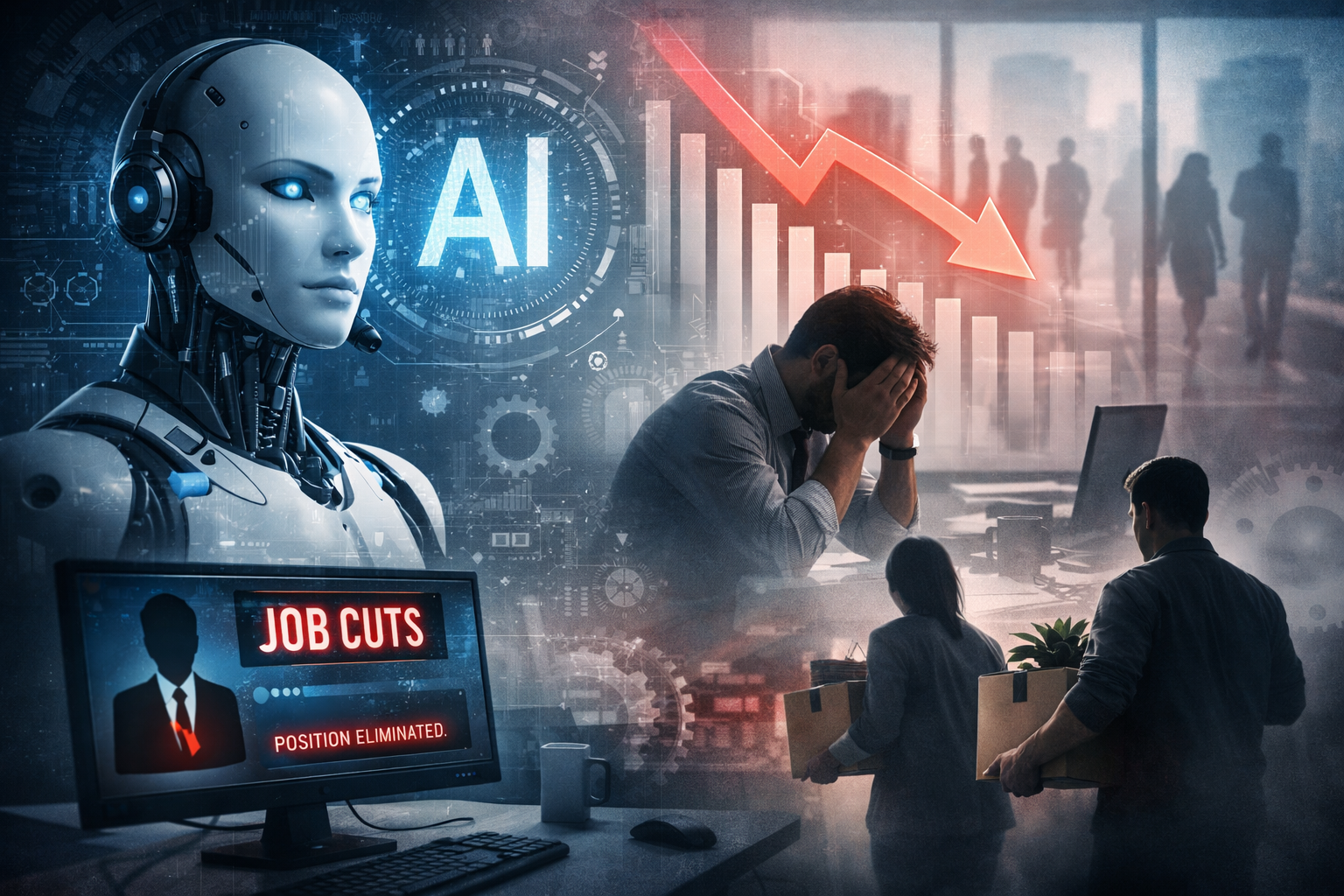
If you’ve been wondering what AI actually looks like inside a giant corporation, JPMorgan Chase is giving us one of the clearest real world examples so far. And the story is not just about robots taking jobs. It is more complicated, more gradual, and honestly more interesting.
CEO Jamie Dimon recently pulled back the curtain on how the biggest U.S. bank is dealing with automation as artificial intelligence spreads across its operations. His message was surprisingly direct. AI is already replacing certain tasks and roles at the bank. But instead of mass layoffs, JPMorgan is trying something that many workers hope will become the norm: redeployment.
“We already have huge redeployment plans for our own people,” Dimon said. “We have displaced people from AI and we offer them other jobs.”
That single statement captures a massive shift happening across corporate America. AI is not some future scenario anymore. It is actively reshaping the internal structure of companies right now.
The headcount illusion
At first glance, nothing seems to have changed at JPMorgan. The bank still employs roughly 318,000 people, almost exactly the same as a year ago.
But that stability is a bit of an illusion.
Under the surface, entire categories of work are shrinking while others are growing quickly. Routine operations jobs are declining. Client facing roles, tech positions, and revenue generating teams are expanding. Think fewer people manually processing paperwork and more people analyzing data, building AI tools, or working directly with customers.
This is what an AI driven workforce transformation actually looks like. It is less about layoffs and more about reshuffling.
For example, automation has helped employees manage more customer accounts than before. Fraud detection systems powered by AI have cut operational costs significantly. Coding assistants are making engineers more productive, sometimes boosting efficiency by double digit percentages.
So instead of needing fewer people overall, JPMorgan is changing what those people actually do.
AI is already everywhere inside the bank
JPMorgan is not just dabbling in artificial intelligence. It is investing heavily and integrating it across nearly every business unit.
The bank reportedly spends close to 20 billion dollars annually on technology. Hundreds of AI use cases are already deployed internally. These range from customer service chat systems to document analysis tools to advanced risk monitoring.
Some of these systems rely on large language models developed by companies like OpenAI and Anthropic. Others are built in house.
The key takeaway is that AI at JPMorgan is not experimental anymore. It is operational. It is embedded into daily workflows. And it is directly influencing hiring decisions.
Redeployment instead of layoffs
Dimon keeps emphasizing a point that feels almost radical in today’s corporate environment. The bank has a long tradition of moving workers into new roles when technology changes their old ones.
Historically, that happened during earlier waves of automation such as online banking and digital payments. Now it is happening again with generative AI.
Employees whose jobs are reduced by automation are often retrained and shifted into different positions. Sometimes those roles are within tech. Sometimes they are in customer facing teams. Sometimes they involve oversight of the AI systems themselves.
This approach helps explain why JPMorgan’s total headcount has stayed steady even as productivity rises.
It also reflects a reality that many people miss in AI discussions. Automation does not instantly eliminate jobs. It often eliminates tasks first.
But fewer jobs are coming eventually
Even with all this talk about redeployment, Dimon has been very clear that AI will likely reduce total employment over time.
He has said the bank will probably have fewer workers within the next five years as automation continues to improve efficiency.
That does not necessarily mean a sudden wave of layoffs. It could happen gradually through slower hiring, natural attrition, and early retirement.
Still, the long term direction is obvious. AI allows companies to produce more with fewer people.
Dimon has also warned that the speed of this transition could create social and economic challenges if businesses and governments are not proactive.
He has called for investments in worker retraining, relocation support, and education programs to help people move into new careers as old roles disappear.
A preview of the future workplace
JPMorgan is basically functioning as a test case for what AI adoption might look like across the broader economy.
The pattern we are seeing is not mass job destruction overnight. Instead, it is a gradual restructuring of work.
Routine and repetitive tasks are automated first. Productivity rises. Companies redirect workers toward higher value activities. Over time, overall employment levels may decline, but not necessarily through sudden layoffs.
This is very different from the dystopian narrative many people imagine when they hear about AI.
It is also not entirely comforting. A gradual shift can still be disruptive, especially for workers whose skills no longer match the roles companies need.
The bottom line
What is happening inside JPMorgan tells us something important about the AI economy.
The real story is not about whether AI will replace jobs. That is already happening. The real question is how companies manage the transition.
So far, JPMorgan is betting on redeployment, retraining, and slow structural change rather than dramatic workforce cuts. Whether that strategy becomes the corporate standard or the exception will shape the future of work for millions of people.
And if Dimon is right, we are still only at the very beginning of this transformation.