XEQT vs. FEQT: Which All-Equity ETF Actually Wins for Long-Term Investors?
February 27, 2026

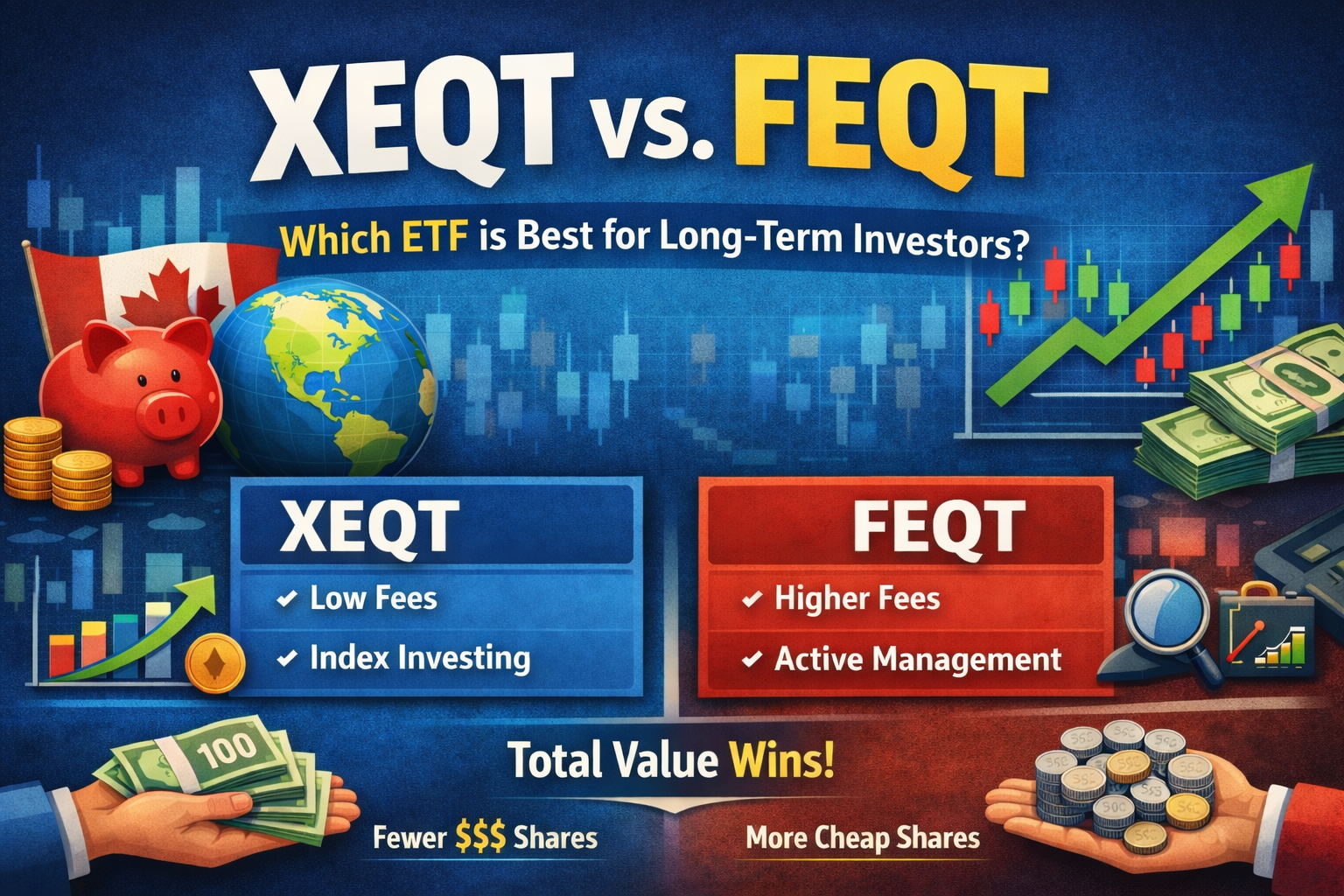
No JustBuyXEQT vibes yet for FEQT
If you’re a Canadian investor in your 20s or 30s, chances are you’ve come across the classic debate: XEQT vs. FEQT. These two ETFs sit in the same category, promise the same end goal, and often appear side-by-side in beginner investing discussions. On the surface, they look almost interchangeable. Both are all-equity, globally diversified, one-ticket solutions designed for long-term growth.
But once you move beyond the ticker symbols and dig into how these funds are built, their fee structures, and the philosophies behind them, the differences start to matter. And for most long-term investors who value simplicity, cost efficiency, and predictable compounding, one option tends to stand out more clearly.
Let’s unpack what actually separates these two funds and why the decision is less complicated than it first appears.
What Are XEQT and FEQT Designed to Do?
Both XEQT and FEQT belong to a category known as asset allocation ETFs, specifically the “all-equity” variety. That means they hold 100 percent stocks, spread across global markets, and are intended for investors with long time horizons who can tolerate market volatility in exchange for higher expected returns.
The appeal of this type of ETF is simplicity. Instead of buying separate funds for Canadian stocks, U.S. markets, international developed economies, and emerging markets, investors can buy a single ticker that automatically maintains the appropriate mix. Rebalancing happens behind the scenes, which removes the need for manual portfolio management.
XEQT, launched by BlackRock in 2019, is built entirely from low-cost index ETFs that track broad market segments. It aims to deliver pure market exposure with minimal fees and very little active decision-making.
FEQT, introduced by Fidelity in 2022, takes a slightly different approach. While it still offers global equity exposure, it blends passive indexing with elements of active management in an attempt to outperform the market over time.
On paper, both funds target the same outcome: long-term capital growth through diversified global equities. In practice, the way they pursue that goal leads to meaningful differences for investors.
How Their Investment Philosophies Differ
The biggest distinction between XEQT and FEQT is not where they invest, but how they invest.
XEQT follows a strict index strategy. Its holdings track major market benchmarks, meaning it does not attempt to pick winning stocks or time the market. Instead, it captures the performance of entire economies and sectors. This approach relies on a simple principle that decades of research support: consistently beating the market after fees is extremely difficult, and most active managers fail to do so over long periods.
FEQT introduces an active layer. Fidelity allocates portions of the portfolio to actively managed strategies in the hope of generating additional returns beyond what pure indexing can achieve. While this can sometimes produce short-term outperformance, it also introduces higher fees and uncertainty. Active management requires skill, consistency, and a bit of luck, and history shows that even talented managers struggle to outperform broad market indexes over decades.
For investors, this philosophical difference translates into a trade-off between predictability and the possibility, but not the guarantee, of higher returns.
Why Fees Matter More Than Most Beginners Realize
One of the most overlooked factors when comparing ETFs is cost. XEQT’s management expense ratio sits around 0.20 percent, while FEQT’s is roughly double that. At first glance, this difference may seem insignificant, especially when expressed as fractions of a percentage point.
However, over a multi-decade investing horizon, even small fee differences compound dramatically. When investors pay higher ongoing fees, they are effectively giving up a portion of their future returns every single year. This reduces the base amount that can continue compounding, which can result in a significantly smaller portfolio over time.
For a young investor consistently contributing to their portfolio over 25 or 30 years, the cost difference between a low-fee index ETF and a higher-fee actively influenced ETF can easily translate into tens of thousands of dollars in lost growth. Because both XEQT and FEQT provide similar market exposure, paying more does not necessarily mean receiving better performance.
Track Record and Stability Considerations
Another factor that often gets overlooked is the importance of a fund’s history and size. XEQT has been in the market longer and has accumulated substantially more assets. Larger funds tend to benefit from tighter trading spreads, higher liquidity, and a longer performance record that investors can evaluate.
FEQT, being newer, simply does not have the same track record. While Fidelity is a well-established asset manager, the ETF itself has not yet been tested across multiple market cycles. For long-term investors who prioritize reliability and transparency, this shorter history introduces an element of uncertainty.
In investing, longevity matters because it demonstrates how a strategy performs during both bull markets and downturns. A longer track record provides more data points and helps investors make more informed decisions.
The Common Share Count Misconception
One of the most persistent beginner investing myths appears when investors compare ETFs with different prices per share. Many assume that buying more shares of a lower-priced ETF somehow means they are making a better investment.
This belief is rooted in psychology rather than financial reality. Humans naturally associate owning more units with having more wealth. In investing, however, the number of shares owned is irrelevant. What matters is the total dollar value invested and how that investment grows over time.
For example, investing one thousand dollars into an ETF priced at fifty dollars per share yields twenty shares. Investing the same amount into an ETF priced at one hundred dollars per share yields ten shares. In both cases, the investor has committed the same capital and will experience identical percentage gains or losses relative to the market.
The misconception persists because beginners often view shares as tangible units, similar to physical objects, rather than proportional ownership in a portfolio of underlying assets.
Why XEQT Typically Comes Out Ahead
When evaluating the two ETFs holistically, XEQT tends to make more sense for most long-term investors. Its lower fees allow more of each dollar to remain invested and compounding over time. Its purely indexed structure reduces the risk of underperformance associated with active management decisions. Its larger size and longer track record provide additional confidence in its stability.
Perhaps most importantly, XEQT aligns closely with the core principles of long-term investing: minimize costs, maintain diversification, and avoid unnecessary complexity. While FEQT offers a respectable alternative and may appeal to investors who believe in active management, it requires paying higher fees without any guarantee of superior returns.
For investors focused on building wealth steadily over decades, simplicity and cost efficiency often outweigh the appeal of potential outperformance.
The Bottom Line
The XEQT versus FEQT debate ultimately highlights a broader lesson in investing. Long-term success rarely comes from chasing complexity or trying to outsmart the market. Instead, it comes from consistently applying simple principles such as diversification, cost control, and disciplined investing.
Both ETFs provide convenient global equity exposure and can serve as solid foundations for a portfolio. However, XEQT’s lower fees, longer history, and straightforward index approach give it a clear advantage for most investors seeking a reliable, long-term solution. It’s an even more compelling choice if your broker isn’t charging any trading fees. Check out our Wealthsimple Review if you’re into the idea of free trade and a 3% account transfer match.
And perhaps the most important takeaway for beginners is this: wealth is not built by owning the most shares of an investment, but by consistently investing over time and allowing compounding to work in your favor.