XEQT Fees: The Real Cost of Owning Canada’s Most Popular All-In-One ETF
February 26, 2026

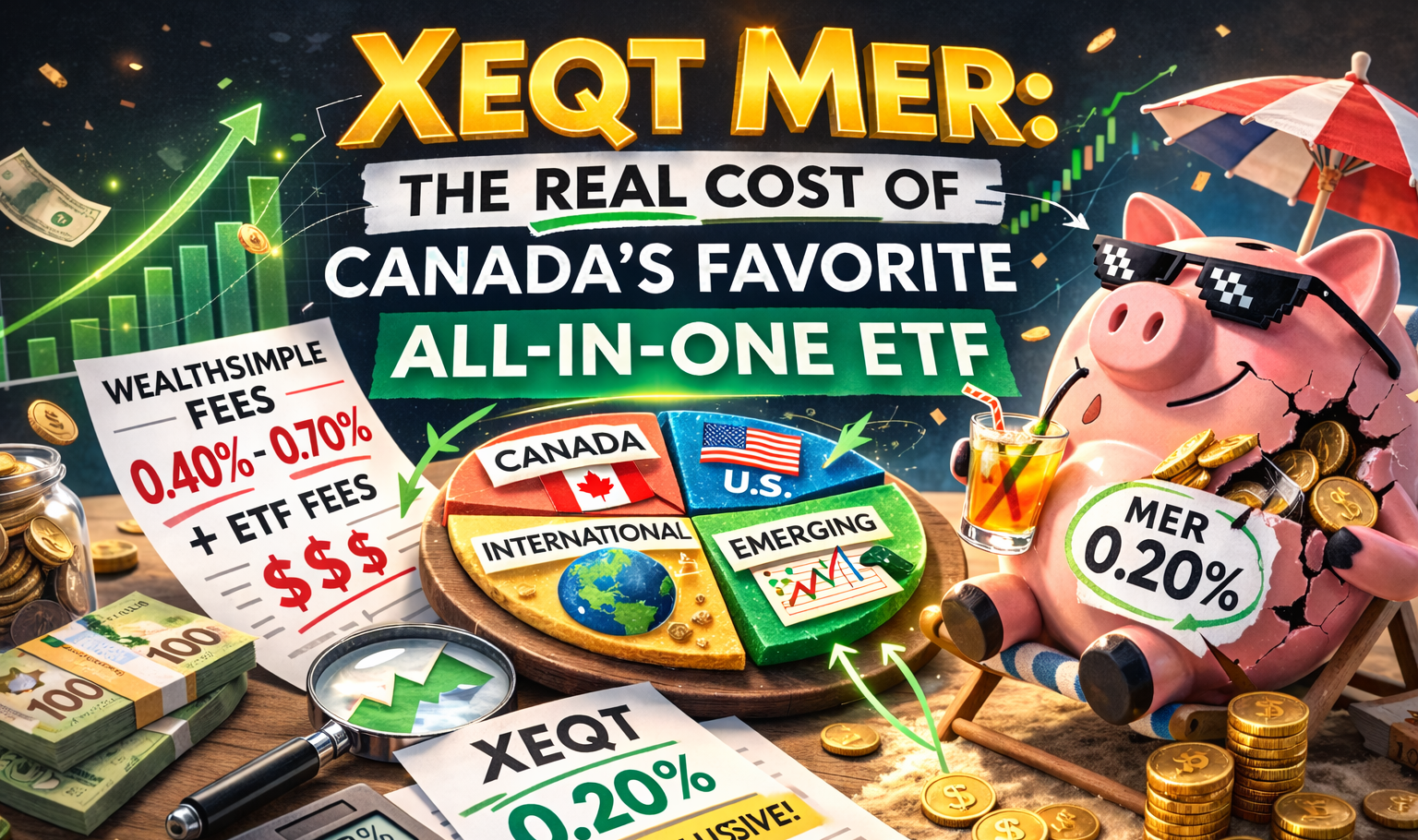
XEQT Fees? That’s the right question to be asking
If you’re a millennial investor, there is a good chance fees were the first thing that made you question traditional investing.
We grew up in the era of robo advisors, zero commission trading, and Reddit threads dissecting every basis point. For many Canadians, it would be extremely helpful to understand just what XEQT actually costs you and what is hidden inside that tiny management expense ratio.
Let us break it down properly.
What XEQT Fees Actually Are
XEQT, the iShares Core Equity ETF Portfolio, has:
- Management fee: about 0.17 percent
- Total MER: about 0.20 percent
That 0.20 percent is the number that matters.
The MER, or Management Expense Ratio, includes a whole of admin type bits and bobs including:
- The management fee
- Operating expenses
- Administration
- Custody
- Legal and compliance costs
Here is the key clarification. You’re not getting billed separately. The MER is deducted automatically from the fund’s performance. You will never see a charge hit your account.
For example:
If you invest 10,000 dollars in XEQT, a 0.20 percent MER works out to roughly 20 bucks per year. That’s like a two medium pizza deal from Pizza Pizza in exchange for managing $10k of your hard earned cash for a year. That’s wild if you really think about it.
Does XEQT Double Charge Fees?
This is another one of those questions you see in forums with people confidently arguing both side of the coin. Facts matter and in this case, one side is just wrong. You’re not paying twice on basket of other baskets.
XEQT is a fund of funds. It holds other ETFs inside it, including exposure to:
- Canadian equities
- U.S. equities
- International developed markets
- Emerging markets
So naturally people wonder if they are paying the MER on XEQT and the MER on all the underlying ETFs. The answer is no. The published MER already accounts for the underlying ETF costs. There is not an additional layer of fees being stacked on top. There is no double charging and no hidden fee structure.
Why XEQT’s MER Looks Higher Than Its Components
If you wanted to optimize to the absolute maximum, you could buy the individual ETFs that make up XEQT yourself. If you weighted them manually, the blended MER might come out closer to around 0.09 percent. So why does XEQT cost about 0.20 percent? Because you are not just paying for the underlying ETFs. You are paying for three important benefits.
Automatic Rebalancing
Markets move and allocations drift. XEQT automatically rebalances your global portfolio so you do not have to manage it manually. That means no tracking percentages, no placing extra trades, and no worrying about timing.
The Convenience Premium
XEQT is a one ticket portfolio. Instead of buying multiple ETFs and maintaining them yourself, you buy a single fund. That small difference in fees is essentially the price of simplicity and discipline.
Operational Infrastructure
Running a global ETF involves legal oversight, custody services, administration, and reporting requirements. All of those costs are included within the MER.
In simple terms, you are paying a small subscription fee for an investing system that runs on autopilot.
XEQT vs VEQT Fees
Here is a quick comparison and one that is always raging on Reddit and the other financial forums.
XEQT has a management fee of about 0.17 percent and an MER around 0.20 percent.
VEQT also has a management fee near 0.17 percent, while its MER has historically been around 0.24 percent, although it is expected to decline following recent fee cuts.
Vanguard recently reduced VEQT’s management fee from 0.22 percent to 0.17 percent. However, MER figures are calculated using past expenses, so updates take time to show in official numbers.
The key takeaway is that the difference between XEQT and VEQT is only a few basis points. For long term investors, that gap is usually not significant.
The Long Term Impact of Small Fee Differences
Fees may look tiny, but they become powerful over time.
Consider a portfolio of 200,000 dollars invested for 30 years at an average return of 6 percent.
The difference between paying 0.70 percent and 0.20 percent in annual fees can translate into tens of thousands of dollars in lost growth.
This happens because fees reduce the amount of money that continues compounding year after year.
Small percentages matter enormously over long investing horizons.
Is XEQT’s MER Actually Cheap?
Let us summarize.
The 0.20 percent MER includes all underlying ETF costs. There is no double charging. It has historically been slightly cheaper than VEQT and is significantly less expensive than most robo advisors and traditional mutual funds.
For a globally diversified, automatically rebalanced equity portfolio, 0.20 percent is extremely competitive.
The real cost of XEQT is not its fee. The real cost is the opportunity lost by staying invested in higher fee products for decades.