I Tried Buying XEQT on Every Major Canadian Brokerage So You Don’t Have To
July 22, 2026

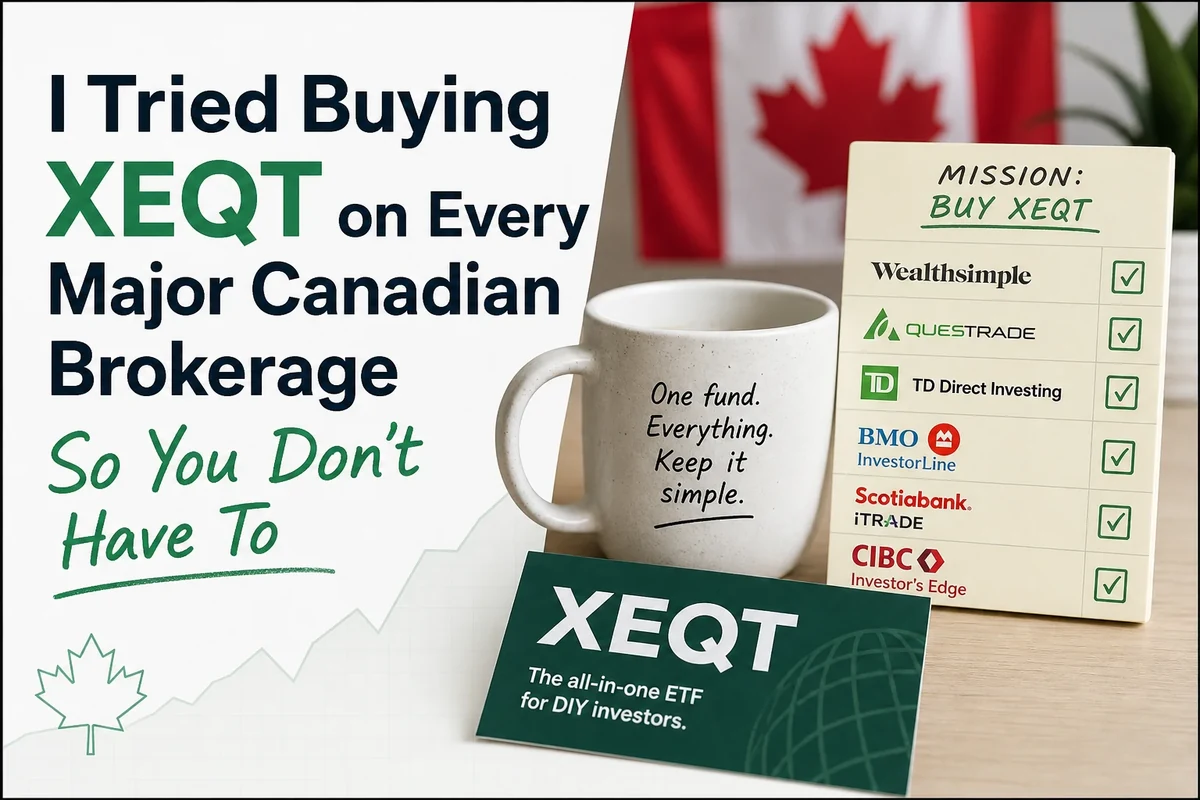
The headline on nearly every Canadian brokerage’s homepage says some version of the same thing: free ETF trading. No commissions. Zero fees. What those headlines don’t mention is the $9.99 sell-side charge hiding in the fine print, the $25 quarterly maintenance fee waived only if you hold $15,000, the ECN costs that appear at checkout like a surprise airport tax, or the three-business-day delay before you can buy anything at all. I went through the account-opening flow, funded accounts, and placed actual buy orders for XEQT across five of Canada’s most commonly recommended brokerages to find out where the friction actually lives. The differences are not trivial. Compounded across a decade of biweekly $500 contributions, the wrong brokerage choice costs more than most Canadians realize.
Why “Free ETF Trading” Is a Marketing Claim, Not a Promise
The race to zero commissions is real, but it is not complete. Canadian brokerages have cut buy-side commissions to attract accounts, but several still profit through other mechanisms: sell-side fees, quarterly maintenance charges, ECN pass-through costs, currency conversion spreads on US holdings, and account transfer fees designed to make leaving painful. For a passive XEQT investor contributing regularly to a TFSA or RRSP, the relevant costs are not the ones on the features page. They are the ones you encounter the third time you log in, or the first time you try to take money out.
The good news is that XEQT itself is one of the most liquid ETFs on the Toronto Stock Exchange. Its bid-ask spread typically sits between one and three cents, which is narrow enough that market orders are generally safe for most investors. The bad news is that the spread is only one of several cost layers, and for a $500 trade it is among the least of your worries compared to what some platforms charge on the sell side.
The brokerage decision matters more than most people think, but not for the reason most people think. It is not about finding the cheapest stock commissions. It is about finding the fewest hidden checkpoints between you and your next XEQT purchase.
Wealthsimple: The Smoothest Onramp, With a Catch You Should Know
Wealthsimple is genuinely the easiest place to start. Account opening is entirely digital, TFSA and RRSP setup takes under 15 minutes, and the platform accepts instant deposits up to $5,000. You can buy XEQT on day one, which matters more than it sounds. Every day your cash sits uninvested is a day you are earning nothing on money meant to compound for decades.
Wealthsimple allows fractional share purchases, which means you can deploy every dollar of a $500 contribution rather than buying whole units of XEQT and leaving a small residual sitting idle until next month. For someone contributing $250 or $300 biweekly, this is a real convenience. The buy and sell sides are both commission-free. There are no quarterly maintenance fees regardless of account balance.
The catch is structural. Wealthsimple operates a payment-for-order-flow model, which means it earns revenue by routing your trade data to market makers. This does not directly cost you a stated fee, but it is worth understanding: the platform’s business model is funded partly by the value of your trading activity, not just by obvious charges. For a buy-and-hold XEQT investor placing a handful of trades per year, this is unlikely to move the needle in any measurable way, but it is worth knowing.
Where Wealthsimple can fall short is for investors who eventually want to transfer out. Account transfer-out processing can be slower than pure discount brokerages, and large registered account transfers require manual handling. If you are in the accumulation phase and plan to stay put, none of that matters. If you are the type to optimize obsessively, keep it in mind.
Wealthsimple at a transaction level: Zero commissions on buy and sell. Fractional shares available. No maintenance fees. Instant deposits up to $5,000. Account open same day. Payment for order flow model. Best for beginners and small regular contributions.
Questrade: The Power User Pick, Now With Fewer Asterisks
Questrade spent years being recommended with a significant caveat: free to buy ETFs, but you pay around $5 to sell them. That asymmetry penalized investors who were dollar-cost averaging into XEQT because eventually you sell, whether to rebalance, withdraw in retirement, or transfer to another account. That caveat is now gone. As of early 2026, Questrade charges $0 on both buy and sell sides for ETF trades. The only cost that remains is ECN fees, which are pass-through charges from the exchange’s electronic communication network. For most XEQT trades these amount to fractions of a cent per unit and are effectively invisible on a $500 trade.
The wrinkle that remains is the $1,000 minimum balance required before you can start trading. You can open the account and fund it for less, but you cannot place your first order until you have hit that threshold. For a 22-year-old opening their first TFSA with $300, this is a real friction point. Wealthsimple lets you invest $50 if that is what you have. Questrade makes you wait.
On the other side of the ledger, Questrade’s platform is meaningfully more capable than Wealthsimple’s for investors who want to place limit orders, view depth of book, or run more detailed portfolio analysis. The Questmobile app is clean and functional. Desktop WebBroker is stronger than anything Wealthsimple offers for the investor who wants to dig into XEQT’s underlying holdings or compare it against other all-in-one ETFs. Questrade also reimburses incoming transfer fees up to $150 per account, which is useful if you are moving a TFSA from TD or a bank brokerage.
Questrade at a transaction level: $0 ETF buy and sell (ECN fees apply, typically negligible). $1,000 minimum to place first trade. No fractional shares on Canadian ETFs. Strong desktop and mobile. Best for investors past their first $1,000 who want a real platform.
TD Direct Investing: Excellent Platform, Genuinely Punishing Fees
TD Direct Investing is Canada’s largest online brokerage by assets and has the research tools to prove it. WebBroker is polished and data-rich. The mobile app is solid. The account setup is fully digital, and TD’s support is responsive when you need it. If you are an active trader running complex strategies, the platform is worth paying for.
For a passive XEQT investor, it is not. Every ETF trade on TD Direct Investing costs $9.99. That drops to $7.00 only if you place 150 or more trades per quarter, which no rational XEQT investor will ever do. A $500 biweekly XEQT contribution costs $9.99 to execute, meaning you are immediately paying roughly 2% on that contribution before the market has moved a tick. Over 26 contributions per year, that works out to approximately $260 in annual commission charges on top of XEQT’s 0.20% MER. Every major independent brokerage charges nothing for the same trades.
There is also a $25 quarterly maintenance fee unless your household account balance exceeds $15,000. A new investor starting with $3,000 in a TFSA pays $100 per year in maintenance before placing a single trade. The transfer-out fee is $150 per account. These are real costs that show up in your account.
TD does offer a separate product called TD Easy Trade, which provides commission-free access for up to 50 stock trades per year and unlimited commission-free trading on TD-branded ETFs. XEQT is an iShares product, not a TD ETF, so it does not qualify for the unlimited tier. You would get up to 50 free trades on it annually, which covers biweekly contributions for roughly half a year. After that, the per-trade fee applies. For a dedicated XEQT investor, this is still not a clean solution.
TD’s platform is excellent. Its fee structure is designed for a different investor than the one reading this article. If you are buying XEQT every two weeks and plan to do it for decades, you are the wrong customer for TD Direct Investing.
Qtrade: The Quiet Winner That Nobody Talks About Enough
Qtrade consistently ranks first among Canadian online brokerages in Globe and Mail surveys and MoneySense reviews, and yet it rarely leads the conversation in personal finance forums the way Wealthsimple and Questrade do. That is largely a marketing gap, not a quality gap.
Qtrade now offers commission-free buying and selling on all Canadian-listed stocks and ETFs, including XEQT. Critically, unlike Questrade, Qtrade does not pass along ECN fees to retail clients. The total transaction cost for buying or selling XEQT on Qtrade is zero. There are no quarterly maintenance fees, no account minimums to start trading, and no sell-side charges waiting to appear years from now when you finally withdraw.
The platform’s desktop interface is more capable than Wealthsimple’s and on par with Questrade’s for most passive investors. The mobile app is strong. Customer service, per multiple independent reviews, is responsive in ways that matter when something goes wrong: a contribution limit question, a beneficiary designation issue, a confusion about RRSP room. TFSA, RRSP, and FHSA accounts are all available and can be opened fully online.
The gap is name recognition. Qtrade does not have Wealthsimple’s marketing budget or Questrade’s community presence. For investors who make their brokerage decision based on Reddit threads and social media momentum, Qtrade will feel like a left-field suggestion. It should not. If you are committed to buying XEQT regularly for the next decade, Qtrade’s combination of zero total transaction costs and institutional-quality platform is genuinely hard to beat.
The Big Bank Brokerages: Convenient by Design, Costly by Design
RBC Direct Investing, BMO InvestorLine, CIBC Investor’s Edge, and Scotia iTrade all follow a similar logic: they exist as revenue centres within their parent banks, not as cost-minimization tools for DIY investors. That shapes every decision about fee structure.
RBC Direct Investing has historically charged $9.95 per ETF trade, though MoneySense reported in mid-2025 that RBC was beginning to adopt commission-free ETF trading, worth confirming directly on RBC’s site before opening an account. BMO InvestorLine offers free buying and selling on a curated list of roughly 80 ETFs, and XEQT’s inclusion on that list is worth verifying before assuming it qualifies. CIBC Investor’s Edge charges $6.95 per trade, with free trading for investors aged 18 to 24. Scotia iTrade charges $9.95 per trade. All of these brokerages charge between $100 and $150 to transfer your account out, and most have quarterly maintenance fees waived only at higher balance thresholds.
The argument for staying at your bank brokerage is convenience: your chequing account, your mortgage, and your investments are all visible on one login. That convenience is real, but it has a price tag most investors never explicitly calculate. Contributing $500 every two weeks at $9.99 per trade costs approximately $260 per year in commissions that every major independent brokerage now charges nothing for. The math compounds in the wrong direction over time.
The annual commission gap: At $9.99 per trade, 26 annual XEQT purchases cost approximately $260 in commissions. Qtrade, Questrade, and Wealthsimple charge $0 for the same trades. That $260 stays invested and compounding in your portfolio every single year you use a zero-commission platform instead.
Settlement, Cash Drag, and the Clock Nobody Mentions
All ETF trades in Canada settle on T+2: you buy Monday, the trade settles Wednesday. This is standardized across every brokerage and is not a competitive differentiator. What does differ is how fast cash flows from your bank into your brokerage in the first place, and what happens when you eventually want to move on.
Wealthsimple offers instant deposits up to $5,000, meaning you can move money from your bank and buy XEQT the same day. Questrade also offers instant deposits for verified accounts but at lower initial limits for new clients. TD Direct Investing typically processes electronic fund transfers within one to three business days, meaning a contribution initiated on Monday may not be deployable until Wednesday or Thursday. Over years of monthly contributions, even a consistent two-day cash drag on each deposit represents a real reduction in total time in market.
Transfer-out processing is where this gap becomes most pronounced. Moving a $50,000 TFSA from TD to Questrade carries TD’s $150 transfer-out fee as the obvious cost. The less obvious cost is the five to ten business days your XEQT units sit in transit, during which you hold neither market exposure nor cash. Questrade and Qtrade both offer to reimburse incoming transfer fees up to $150 per account, which offsets the cash cost but does nothing about the market exposure gap during transit.
Mobile vs. Desktop: Where the Real Friction Hides
Most first-time XEQT buyers are doing it on their phone. That makes the mobile experience more consequential than brokerage comparison sites typically acknowledge, because those sites are written for the desktop power user and ranked on criteria like options trading and research depth rather than whether you can place a TFSA XEQT buy in under two minutes.
Wealthsimple’s mobile app is excellent for this use case. The buy flow is: search XEQT, enter a dollar amount, confirm. The interface deliberately simplifies order types in favour of speed, which is the right call for its target user. If you want a limit order on Wealthsimple, you need to look for it deliberately.
Questrade’s Questmobile app requires you to enter share quantity rather than dollar amount for Canadian ETFs, which adds one mental calculation step. If XEQT is trading at $31.20 and you have $500 to invest, you need to determine how many whole units that buys before placing the order. It is not a dealbreaker, but it is friction that does not exist on Wealthsimple. The platform handles limit orders cleanly and displays real-time quotes without requiring extra confirmations.
TD’s mobile app is functional but requires more navigation to reach an ETF buy order. The experience has improved meaningfully in recent years, but the workflow still reflects a platform designed around stock trading and advisory relationships rather than single-ETF passive investing. Qtrade’s mobile app receives consistently strong marks in independent reviews on both iOS and Android.
The Fractional Share Trade-Off
Wealthsimple’s fractional share offering for XEQT lets you deploy every dollar of a contribution with zero idle cash between purchases. Questrade does not offer fractional shares for Canadian-listed ETFs, though fractional shares are available for US-listed securities.
The practical difference is modest for investors contributing in larger amounts. On a $500 biweekly contribution, the whole-unit residual is typically $10 to $20 depending on XEQT’s price at the time of purchase. Over a year of biweekly contributions, that stranded cash represents a relatively small amount sitting idle in your account unless you actively sweep it into your next purchase cycle.
Where fractional shares matter most is for very small contributions ($100 to $150 per deposit) where the residual represents a meaningful percentage of the trade, and at the end of the accumulation phase when you are trying to deploy a specific lump sum with maximum precision. For most regular contributors in the $300 to $1,000 per contribution range, the difference between fractional and whole-unit purchasing is unlikely to be a deciding factor in brokerage selection.
For a deeper look at how XEQT is structured and why these per-unit mechanics matter less than most new investors expect, the complete XEQT guide covers the fund’s composition and mechanics in full. If you are also evaluating the ongoing cost of the ETF itself, separate from brokerage transaction costs, the XEQT fee breakdown is worth reading alongside this one.
The Verdict: Where to Actually Buy XEQT
There is no single right answer for everyone, but the honest ranking based on total cost and friction for a typical XEQT investor looks like this.
Qtrade is the lowest-friction, lowest-cost option for investors past the beginner stage. Zero commissions on both sides, no ECN pass-through fees, no maintenance fees, strong platform on desktop and mobile, and a track record of service reliability that shorter-lived fintech platforms cannot yet match. If you are contributing regularly and plan to hold XEQT for decades, Qtrade costs you nothing on transactions and gives you a platform that does not penalize you for growing your account.
Wealthsimple is the right answer for investors starting with small amounts, those who want the smoothest onboarding experience, or anyone whose primary investing device is a phone. The fractional share feature is genuinely useful at smaller contribution sizes. The payment-for-order-flow model is worth knowing about, but it is not a compelling reason to avoid the platform for a passive investor placing a few dozen trades per year.
Questrade sits in the middle: better than bank brokerages, slightly behind Qtrade on total transaction cost because of ECN fees, and worth choosing if you want more platform capability than Wealthsimple offers and are comfortable with the $1,000 minimum and whole-unit purchasing for Canadian ETFs.
TD Direct Investing and the other bank brokerages are not well-suited for buying XEQT regularly. They are designed for a customer who wants integrated banking, live support, and does not mind paying per trade. Know what you are paying before assuming convenience is free, because the commissions accumulate quietly and the opportunity cost compounds in the wrong direction.
The best brokerage for buying XEQT is whichever one removes every possible obstacle between you and your next contribution. Cost matters. Interface matters. But momentum matters most, and any friction that makes you delay or skip a contribution costs you more than any fee structure.
Frequently Asked Questions
Can I buy XEQT for free on Questrade? As of early 2026, yes. Questrade now charges $0 commission on both buy and sell sides for ETF trades. A small ECN fee may apply on some orders, but for most XEQT purchases it amounts to a fraction of a cent per unit and is negligible on typical contribution amounts. You do need a minimum $1,000 account balance before you can place your first trade.
Does Wealthsimple charge to sell XEQT? No. Wealthsimple charges $0 to buy and $0 to sell ETFs including XEQT. This applies to TFSA, RRSP, and FHSA account types held on the platform. There are no quarterly maintenance fees regardless of account size.
Is there a brokerage account minimum to buy XEQT in Canada? It depends on the platform. Wealthsimple has no minimum, you can invest with as little as $1 using fractional shares. Questrade requires $1,000 in the account before placing any trade. TD Direct Investing has no hard trading minimum but charges a $25 quarterly maintenance fee unless your household balance exceeds $15,000. Qtrade has no trading minimum and no maintenance fee.
Which Canadian brokerage is best for a TFSA holding XEQT? For most Canadians, Qtrade or Wealthsimple is the practical answer. Both allow you to open a TFSA online, fund it, and buy XEQT without paying any commission on either the buy or sell side. If you are also holding XEQT in an RRSP, note that the RRSP eliminates US dividend withholding tax entirely (0% versus roughly 15% in a TFSA under the Canada-US tax treaty), which is a separate efficiency consideration from brokerage fees altogether.