
OAS Clawback Threshold 2026: How Much You Lose (and How XEQT Holders Can Protect Their Pension)
August 21, 2026

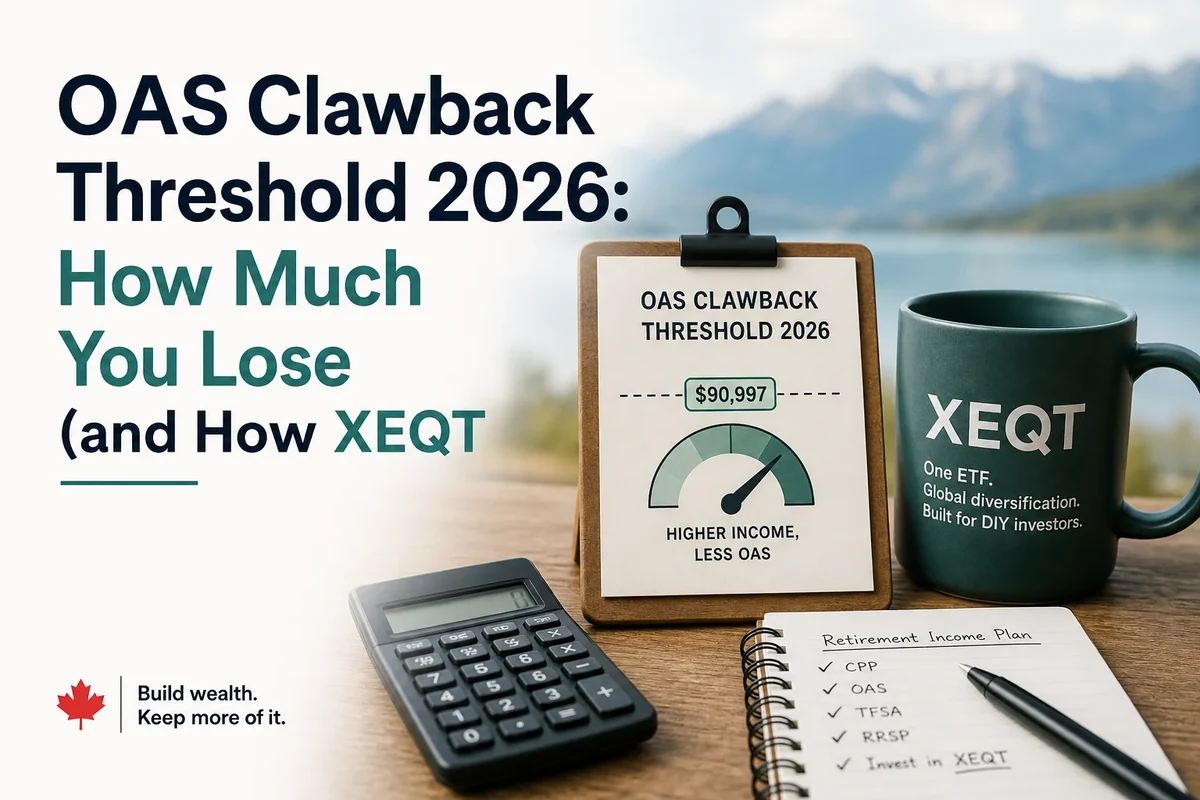
The OAS clawback threshold for the July 2026 benefit year sits at $93,454 of net world income. The 15% recovery tax applies to every dollar you report above that line, not as extra income tax, but as pension income you simply stop receiving. For a retiree collecting the full OAS monthly benefit, crossing that threshold by $20,000 means forfeiting roughly $3,000 in pension payments. Cross it by $40,000 and OAS is almost entirely clawed back.
What most retirees don’t realize until it shows up on their Notice of Assessment: the threshold feels much lower than $93,454 in practice. The gross-up rules for Canadian dividends, mandatory RRIF withdrawals, and CPP income all conspire to push your reportable income well above what you actually received in cash. You can be living on $75,000 a year and still lose OAS, not because you’re wealthy, but because of how the tax slip math works.
The $93,454 Threshold and Why It Feels Lower Than It Is
The OAS recovery tax is calculated on your net income as reported on line 23400 of your T1, before the personal exemption, before credits, before anything reduces it. This is your gross reportable income from all sources: CPP, RRIF withdrawals, pension income, non-registered investment income, rental income, and anything else CRA can see.
The 15% recovery tax is not a marginal tax rate layered on top of your existing taxes. It is a separate clawback mechanism that reduces the pension benefit you receive the following July. CRA calculates the excess, you remit it either through quarterly instalments or through your T1 return, and your monthly OAS cheque is reduced accordingly. If your income stays high year after year, OAS effectively disappears from your retirement income plan entirely.
2026 OAS clawback mechanics: The threshold for the July 2026 benefit year is approximately $93,454 of net world income (line 23400). The recovery tax rate is 15% on every dollar above that threshold. Full OAS clawback occurs at approximately $151,000 of income, at which point the maximum annual OAS benefit is entirely eliminated.
The reason that $93,454 feels lower than it should: most retirees with meaningful savings are stacking several income streams simultaneously. CPP at 65 might add $12,000 to $18,000 per year. A defined benefit pension from a former employer adds more. RRIF mandatory minimum withdrawals, which begin the year after you convert your RRSP at age 71, can easily contribute $30,000 to $60,000 or more depending on the account size. And if you hold dividend-paying stocks or ETFs in a non-registered account, the gross-up rules inflate that income further on paper. The threshold isn’t really $93,454 in practice when you’re a retiree with a decent savings history. It’s whatever income level you’d expect to hit anyway, minus a comfortable buffer that may not exist.
The Dividend Gross-Up Trap: Why $10,000 in Dividends Costs You $3,800 in OAS
This is the mechanism that catches the most retirees off guard, and it is worth slowing down to understand it properly.
When a Canadian corporation pays you an eligible dividend, the kind paid by most large Canadian banks and blue-chip companies, CRA grosses up that dividend by 38% before calculating your taxable income. The rationale is tax integration: the corporation already paid corporate tax on those profits, and the gross-up is designed to equalize the total tax burden across corporate and personal tax. The dividend tax credit then offsets some of what you owe on your actual tax bill.
That sounds fine in theory. The problem surfaces when your income is near the OAS clawback threshold, because the gross-up inflates your reportable income on line 23400 without giving you proportional cash. As Tawcan’s detailed Canadian tax analysis confirms: $10,000 in eligible dividends received in cash becomes $13,800 of taxable income on your return. That extra $3,800 of paper income counts against your OAS threshold even though no one sent you a cheque for it.
The dividend gross-up is a mechanism designed to prevent double taxation on corporate profits. But for retirees near the OAS clawback line, it produces a frustrating outcome: you report income you never received in cash, and your pension is reduced accordingly.
Walk through a concrete scenario. A retiree has $85,000 in actual cash income: $14,000 in CPP, $9,000 in OAS, $42,000 in RRIF withdrawals, and $20,000 in eligible dividends from a Canadian bank stock portfolio held in a non-registered account. On paper, they’re living below the $93,454 threshold, by $8,454, which sounds like a comfortable margin. But the dividend gross-up adds $7,600 to the reported figure (38% of $20,000), pushing taxable income to $92,600. They are now $854 below the clawback line. One extra distribution, one surprise RRIF withdrawal, a capital gain from selling anything, and they’re over. The margin they thought they had wasn’t real.
Non-eligible dividends carry a gross-up of 15%, and while the offsetting tax credit is smaller, the income inflation on line 23400 still counts toward the clawback threshold. Foreign dividends from US or international stocks held in a non-registered account have no gross-up, but they are also fully included in taxable income with no offsetting credit.
RRIF and Pension Income Make It Worse
Mandatory RRIF withdrawals are the second major mechanism pushing retirees over the threshold. When you convert your RRSP to a RRIF, which must happen by December 31 of the year you turn 71, you are required to withdraw a minimum percentage of the account balance each year. The withdrawal rate starts at 5.28% at age 71 and increases gradually with age.
On a $700,000 RRIF, the minimum withdrawal at age 71 is approximately $37,000. Every dollar of that is fully taxable as ordinary income, the same treatment as employment income, with no preferential rates. Combine that with CPP of $14,000, OAS of $9,000, and even modest non-registered investment income, and many retirees with reasonably sized RRSPs find themselves at or above the $93,454 threshold in their early RRIF years without having planned for it.
The compounding problem in the 65 to 75 age window is that these income streams tend to arrive all at once. You start CPP. You start OAS. You hit 71 and RRIF mandatory withdrawals kick in. Meanwhile your non-registered portfolio, built during decades of dividend reinvestment, keeps generating gross-up-inflated taxable income. Each individual stream seems manageable. Together, they routinely push total reported income into clawback territory.
Income stacking at age 71: A retiree with a $700,000 RRIF, full CPP, OAS, and $50,000 in a non-registered dividend portfolio can easily report $110,000 or more in taxable income. At $110,000, the OAS clawback alone costs approximately $2,469 in pension income annually, and that figure rises every year as mandatory RRIF withdrawal rates increase with age.
Why Non-Registered Dividend Portfolios Trigger the Clawback (And TFSA Doesn’t)
A non-registered account holding dividend stocks generates taxable income every quarter whether you need the cash or not. You cannot control the timing. You cannot defer the income to a lower-income year. Every distribution gets reported on a T3 or T5 slip, grossed up where applicable, and added to line 23400.
Capital gains work differently, and this is a genuine advantage for total-return investors. A capital gain in a non-registered account is only triggered when you sell, and only 50% of the gain is included in taxable income for gains below the $250,000 annual threshold. This gives you control. You can choose when to realize gains, smooth them across years, and time them to lower-income periods. A retiree who sells $30,000 worth of ETF units realizes a taxable capital gain of perhaps $8,000 to $12,000 depending on adjusted cost base, far less than $30,000 in dividend income would generate on line 23400 after the gross-up.
A TFSA generates zero taxable income. Nothing from a TFSA appears on your tax return. TFSA withdrawals are not income-tested for OAS or GIS purposes. You can withdraw $50,000 from a TFSA in a given year, spend it freely, and your OAS calculation is completely unaffected. This is the single most powerful structural advantage a TFSA offers retirees near the clawback threshold.
A TFSA withdrawal of $50,000 costs you nothing in OAS. The same $50,000 taken from a RRIF costs you $7,500 in OAS clawback alone, on top of the marginal income tax you owe. That difference is one of the most consequential numbers in Canadian retirement planning.
XEQT held inside a TFSA captures this advantage completely. Because XEQT is a total-return fund with a trailing distribution yield of approximately 1.56%, driven mostly by capital appreciation rather than high dividend payouts, and because all of that growth is sheltered inside a TFSA, retirees holding XEQT in a TFSA enjoy broad global equity exposure without generating a single dollar of OAS-threatening taxable income. The fund rebalances automatically across roughly 9,000 global stocks at an MER of 0.20%, with no tax consequences inside the shelter. For a full breakdown of how XEQT is structured and what it actually holds, the complete XEQT guide covers the underlying ETFs and allocation in detail.
TFSA-Held XEQT as the Primary Defence: Contribution Strategy for 2026
The 2026 TFSA annual contribution limit is $7,000. For anyone who has been 18 or older and a Canadian resident since the TFSA launched in 2009, the cumulative lifetime room is $109,000, assuming no contributions have ever been made. Many retirees approaching their late 60s have significant unused capacity that is quietly going to waste.
The single highest-leverage move available to a retiree facing potential OAS clawback is shifting non-registered assets into a TFSA as contribution room allows. Every dollar moved from a dividend-generating non-registered account into a TFSA removes that income permanently from line 23400. The shift does not require selling at a bad time: contribute cash to the TFSA, buy XEQT, and manage the non-registered account separately. Over several years, consistent contributions reshape the income picture meaningfully.
For married couples, the math doubles. Each spouse has individual TFSA room. Two retirees who are both 67 and have each used $50,000 in TFSA room collectively have $118,000 in remaining room between them. At a 4% non-registered dividend yield, shifting that capital into TFSA-held XEQT removes nearly $5,000 in annual dividend income, and roughly $6,900 in grossed-up income, from their joint tax picture permanently.
For equity-focused retirees facing clawback risk, TFSA contributions take precedence for assets that would otherwise sit in a dividend-generating non-registered account. New cash goes into the TFSA. Income from the TFSA stays invisible to CRA. The RRSP and RRIF are managed for withdrawal sequencing, covered below.
The Withdrawal Sequencing Rule That Keeps You Below the Threshold
The order in which you draw down your accounts in retirement determines far more of your net income than the market returns you earn. A retiree who withdraws from accounts in the wrong sequence can pay significantly more in taxes and OAS clawbacks over a 20-year retirement than one with identical assets who sequences correctly.
TFSA withdrawals come out first for discretionary spending, large one-time purchases, or any year where other income is already running high. A TFSA withdrawal adds nothing to your taxable income. If you need an extra $15,000 for a new vehicle or a family trip, pulling it from the TFSA leaves your OAS completely untouched.
When TFSA room is limited or exhausted, capital gains realizations in non-registered accounts are the next-best option. Sell ETF units or appreciated positions strategically, ideally in smaller amounts spread across years, and you control both the timing and the inclusion rate. At 50% inclusion, a $20,000 realized gain adds only $10,000 to line 23400. That is substantially less damaging to your OAS position than $20,000 in dividends, which would add $27,600 after the eligible dividend gross-up.
RRIF withdrawals, RRSP withdrawals, and pension income should be managed last in the sequencing framework. They are fully taxable at your marginal rate and you have the least control over them. The mandatory RRIF minimum is non-negotiable. But beyond the minimum, avoid discretionary RRIF withdrawals in years where other income sources are already pushing you close to $93,454. Save above-minimum RRIF withdrawals for years where income from other sources is lower, or where TFSA room is exhausted and you genuinely need to draw from the registered pool.
Think of the TFSA as the first tap to open and the RRIF as the last. In between, capital gains from a non-registered account act as a variable valve, you control how much flows through and when. That sequencing, maintained consistently over a decade, is the difference between losing a portion of your OAS and keeping all of it.
Common Mistakes That Accelerate the Clawback
Holding excess cash in GICs inside a non-registered account is one of the most common and overlooked mistakes among Canadian retirees. GIC interest is taxed at your full marginal rate, there is no gross-up, but there is also no offsetting tax credit. Every dollar of GIC interest in a non-registered account lands on line 23400 at 100 cents on the dollar, treated identically to employment income. A retiree with $200,000 in a 4% non-registered GIC generates $8,000 in interest income that counts fully against the OAS threshold. GICs belong in registered accounts, TFSA first, RRSP or RRIF if room exists, where the interest compounds without CRA visibility until withdrawal.
Holding high-dividend stocks in a non-registered account rather than lower-yield total-return funds compounds the problem. A portfolio of Canadian bank stocks yielding 5% generates more gross-up-inflated taxable income than the same capital in XEQT, which carries a trailing distribution yield of approximately 1.56%. The evidence that high-dividend strategies outperform total-return strategies on a risk-adjusted basis is thin, but the tax disadvantage of holding them in a non-registered account near the OAS clawback line is concrete and measurable.
Taking large discretionary RRIF withdrawals to “get ahead of taxes” can backfire badly if it pushes income over $93,454. The instinct is understandable, forced RRIF withdrawals grow each year, so some retirees pull extra amounts early to reduce the future balance. But if those early discretionary withdrawals push you into clawback territory, you are paying both marginal income tax and a 15% OAS recovery tax simultaneously. Any RRIF meltdown strategy needs to be modelled carefully, ideally keeping withdrawals below the clawback threshold each year.
Delaying TFSA contributions because the market doesn’t feel safe is perhaps the most costly behavioural mistake in this category. Every year of unused TFSA room is a year where non-registered income that could have been sheltered stays exposed to OAS clawback. The market-timing instinct, which is already counterproductive for accumulators, is doubly damaging for retirees who have a concrete and time-sensitive reason to shelter income now.
Your 2026 Action Checklist
Log into CRA My Account and confirm your exact available TFSA contribution room. The number on the CRA portal is the most reliable source, it reflects any over-contributions, withdrawals that restored room, and the 2026 annual addition of $7,000. Do not estimate this from memory, many Canadians underestimate their available room significantly.
Once you have that number, audit your non-registered account for dividend yield. Look at the actual cash dividends received last year and gross up the eligible portion by 38%. That grossed-up figure is what CRA sees on line 23400. If that number, combined with your CPP, RRIF minimums, and any pension income, would push you above or near $93,454, you have a clawback risk that TFSA contributions can directly reduce.
Model a withdrawal plan using tax software, Wealthsimple Tax handles this well and is free, or work through a session with a fee-only planner. Input your expected income sources for the next five years. Watch what happens to line 23400 when you layer in mandatory RRIF minimums that grow each year. If the projection shows OAS clawback beginning within five years, that is your planning window.
From there, consider shifting away from high-dividend concentration in non-registered accounts toward total-return holdings like XEQT as TFSA room allows. This is not about chasing higher returns. It is about the same capital generating dramatically less OAS-threatening taxable income. Where your portfolio lives matters as much as what it holds.
TFSA room for older retirees: A Canadian who turned 18 before 2009 and has never contributed to a TFSA has $109,000 in accumulated room as of 2026. A couple in that position has $218,000 in combined shelter. Even partial use of that room, shifting $50,000 of a non-registered dividend portfolio into TFSA-held XEQT, can remove meaningful grossed-up dividend income from CRA’s view annually, protecting a real portion of OAS.
Frequently Asked Questions
What is the OAS clawback threshold for 2026?
The OAS recovery tax applies to net world income above $93,454 for the July 2026 benefit period. For every dollar above that threshold, 15 cents is recovered from your OAS payments. The clawback is based on your previous year’s income as reported on line 23400 of your T1 return.
Does TFSA income count toward the OAS clawback threshold?
No. TFSA withdrawals and any income earned inside a TFSA do not appear on your tax return and do not count toward the OAS clawback threshold. This makes the TFSA the most powerful account available to retirees managing income below the $93,454 line. RRIF withdrawals, dividend income from non-registered accounts, and CPP payments all count toward the threshold, TFSA withdrawals do not.
Why does XEQT in a TFSA help with OAS clawback?
XEQT held in a TFSA grows and compounds completely outside CRA’s view of your income. Its trailing distribution yield of approximately 1.56% stays sheltered inside the account, you never report it. Compare this to holding Canadian bank stocks in a non-registered account: a 5% dividend yield generates gross-up-inflated taxable income every quarter, pushing you closer to or over the $93,454 threshold. TFSA-held XEQT provides equivalent long-run equity exposure with none of that OAS exposure.
Can I still hold dividend stocks without triggering OAS clawback?
Yes, if they are held inside a TFSA or RRSP rather than a non-registered account. In those registered accounts, dividend income is sheltered from CRA until you make RRSP or RRIF withdrawals. The problem arises specifically when dividend stocks sit in non-registered accounts and generate grossed-up income that stacks on top of CPP, pension, and RRIF income. If you’re close to the $93,454 threshold, relocating dividend-heavy holdings from non-registered to TFSA as room allows is the most direct fix available.