
The CRA Doesn’t Care That You Lost Money: XEQT and Capital Gains Tax in a Taxable Account
October 2, 2026

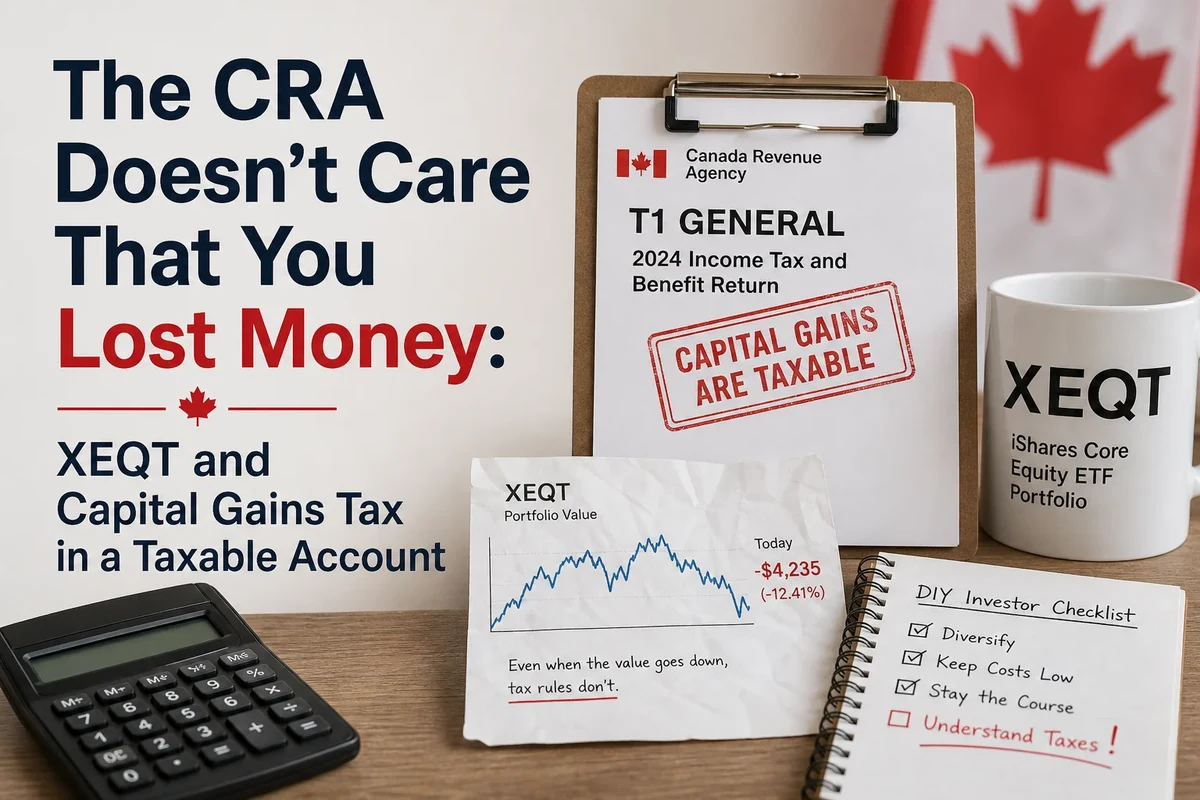
In a non-registered account, the CRA taxes what you realize and what XEQT pays out, not how your portfolio feels. Every quarterly distribution is taxable in the year you receive it, selling triggers tax on half of any gain, and a loss only helps once you sell and have gains to apply it against. A paper loss earns you nothing. As of late 2026 the capital gains inclusion rate is still 50%, because the federal government cancelled the proposed increase in March 2025.
Most XEQT guides assume your money lives in a TFSA, where none of this applies. That is a sensible default, and if you have unused room in a TFSA, RRSP or FHSA you should generally fill those first. But once they are full, or if you have been investing in a taxable account at Wealthsimple or Questrade for years, these rules decide what you actually keep. For this article I pulled XEQT’s distribution history, worked each example below by hand, and cross-checked the rules against published Canadian tax commentary.
Why Your XEQT Losses Don’t Erase Your Tax Bill
Say you put $20,000 into XEQT and a bad year leaves it worth $16,000. You are down $4,000 on paper. The CRA sees nothing, because no disposition has occurred. An unrealized loss does not reduce your tax bill, does not offset gains elsewhere in your portfolio, and does not touch your employment income.
Once you sell, the loss becomes a capital loss, and capital losses can generally only be applied against capital gains. They do not reduce your salary, your rental income or your interest. As the Living Off Dividends series lays out, the CRA gives you three ways to use a realized loss: apply it against gains in the current year, carry it back up to three years against gains you already paid tax on, or carry it forward indefinitely. The carry-back requires a separate request on your return, which is why most people skip it and carry the loss forward instead.
Timing matters too. A loss belongs to the year the trade settles, not the year you pressed the button. If you want a 2026 loss, the sale has to settle by December 31, so do not leave it to the last trading day of the year.
A loss you haven’t realized is a feeling. A loss you’ve realized and reported is a tax asset you can carry forward for the rest of your life.
How XEQT’s Distributions Create Taxable Events You Can’t Control
XEQT pays distributions in March, June, September and December, and the CRA taxes them in your hands whether the unit price is up or down. The last four payments, from December 2025 through September 2026, were $0.2050, $0.0910, $0.3220 and $0.1020 per unit. That adds up to $0.72 per unit, roughly 1.58% of the $45.46 price as of late 2026. On a $50,000 position, that is about $790 of taxable income in a year when your balance may have fallen.
The payments arrive on a T3 slip, not a T5, because XEQT is a trust and not a corporation. What the T3 reports varies by year. It can include Canadian dividends, foreign income and capital gains passed through from the underlying funds, and each type is taxed differently. You cannot choose the mix or the timing. You can check the current payout pattern on the XEQT monthly data page.
The taxable account has one genuine advantage. XEQT holds foreign stocks, and foreign countries withhold tax on dividends before they reach the fund. Inside a TFSA or RRSP that withholding is lost. The Canadian Portfolio Manager Blog’s calculator estimates the drag at about 0.22% in registered accounts and about 0.01% in a taxable account, because you can claim foreign tax credits. That 0.21 point gap is worth about $105 a year on $50,000. It does not beat the TFSA, because even a 30% marginal rate on $790 of distributions could cost up to about $237, depending on the mix. It does mean the foreign withholding is not a reason to avoid a taxable account.
The fund’s internal rebalancing does not create a sale on your tax return, which is covered in the piece on why XEQT rebalances itself. If the fund realizes net gains, though, they can be passed through to you on the T3.
The 50% Inclusion Rule: How Much of an XEQT Gain Is Actually Taxable?
Only half of a capital gain is added to your income, and that half is taxed at your marginal rate. Suppose you bought $30,000 of XEQT and sell it for $40,000. The gain is $10,000, the taxable portion is $5,000, and at an illustrative 30% marginal rate the tax is $1,500. That is an effective 15% on the gain, far gentler than interest from a GIC, which is fully taxable. Inside a TFSA the same sale costs nothing.
Capital gains inclusion rate as of late 2026: The inclusion rate for individuals is 50% on all gains. The proposed increase to two-thirds on gains above $250,000 was cancelled in March 2025 and never took effect.
Because the gain is taxed in the year you realize it, you can plan around it. Retirees with low income before CPP and OAS begin sometimes sell a slice of a winning position in a low-income year and rebuy immediately, which raises the adjusted cost base and shrinks future gains. This is sometimes called gain harvesting. There is no trick to deferring a gain by rebuying, though. As the Living Off Dividends discussion put it, there is no such thing as a superficial gain: the gain is taxable in the year of sale even if you repurchase the same day. Large realized gains also raise your net income, which can pull you toward the OAS clawback threshold, so size them deliberately.
Capital Loss Harvesting: The One Legitimate Tax Move in a Taxable XEQT Portfolio
If you hold XEQT at a loss and have gains elsewhere, selling the loser can lower your bill. A $4,000 realized loss applied against a $10,000 gain leaves a $6,000 net gain. Your taxable income falls by $2,000, which at a 30% rate saves about $600. If you have no gains this year, the loss carries forward and waits for a future sale.
Harvesting does not create wealth, though. If you sell and rebuy, your adjusted cost base resets lower, which means a bigger gain later. You have deferred tax, not erased it. It works best when you hold a loss while holding a gain you need to offset, or when you want to bank a loss against a future sale.
Superficial loss window: The CRA denies your loss if you, your spouse or another affiliated person buys the same or an identical property in the 30 days before or after your sale and still holds it 30 days after the sale. That covers a 61-day window, and it includes purchases inside your own TFSA or RRSP.
When the rule applies to a repurchase in a taxable account, the denied loss is added to the cost base of the new units. When the repurchase happens inside a TFSA or RRSP, the loss is simply gone. A quiet automatic purchase is the usual culprit. A monthly contribution to XEQT in your TFSA, or a spouse’s pre-authorized purchase, can wipe out a harvest you thought was clean.
The usual workaround is selling XEQT and buying a similar but different fund for 31 days. Many Canadian tax writers treat two different all-in-one ETFs tracking different indexes as not identical, but the CRA has no blanket ruling on that, so confirm with an accountant before harvesting a large loss. For a typical investor holding XEQT for decades, the simpler choice is to harvest rarely and mostly not at all.
The ACB Trap: Why Reinvesting Distributions Complicates Your Tax Math
Your adjusted cost base is the total you paid for your units, including every reinvested distribution, and it is what the CRA subtracts from your sale proceeds. The trap is that reinvested distributions are taxed as income the year you receive them, and they also increase your cost base. If you forget to add them, you pay tax on the same money twice.
Take an investor who buys 500 units at $40, for $20,000. Over a few years, $720 of distributions are reinvested at an average price of $45, buying 16 more units. The adjusted cost base is now $20,720 on 516 units. Selling all 516 at $50 brings in $25,800 and a gain of $5,080, so $2,540 is taxable. If the investor had used only the original $20,000, the reported gain would be $5,800 and the taxable amount $2,900. That is $360 of extra income, about $108 of unnecessary tax at 30%, from one small oversight.
The cost base is an average across all your units of the same fund, not tracked lot by lot. With quarterly reinvestment over twenty years, you end up with dozens of small purchases. Your broker’s book value is usually correct, but it can go wrong after a transfer between brokerages, a transfer in kind, or if the T3 reports a return of capital, which reduces your ACB. Check it against your own records before you sell. The CRA holds you responsible for the number on your return, not the broker.
Does Moving XEQT From a Taxable Account to a TFSA Trigger Capital Gains Tax?
Yes. Moving XEQT in kind from a taxable account into a TFSA, RRSP or FHSA is treated as a sale at fair market value on the transfer date. Any gain is taxable that year, and any loss is denied, so you cannot claim it.
Where there is a gain, selling first and contributing cash gives the same tax result as an in-kind transfer. The in-kind route keeps you invested the whole time and saves two trades, so it is usually the easier choice. Either way, the value moved counts against your contribution room, so confirm you have the room before you move anything. Contributing too much to a TFSA brings a penalty of 1% per month on the excess.
Where there is a loss, the order matters. Transferring in kind loses the loss entirely. Selling in the taxable account first realizes it, but if you then buy XEQT in your TFSA within 30 days, the superficial loss rule denies it anyway. The workable path is to sell, wait out the 30 days or buy a different fund, and then contribute cash to the registered account.
This is why the order of operations matters so much for a long-term holder. New contributions should go to the TFSA, FHSA or RRSP first, so you are not forced into transfers like this later. The fee side of that decision is covered in the full breakdown of XEQT’s costs.
Your Tax Filing Checklist for XEQT in a Taxable Account
Your broker will send a T3 slip for XEQT’s distributions, normally by the end of March. Report the amounts from it on your personal return, which is due April 30 for the 2026 tax year. If you sold units, your broker also issues a T5008 showing proceeds. Match it against your own records, because the cost figures on it are not always complete.
Gains and losses go on Schedule 3, and you must report a sale even when you owe nothing. If you want to carry a net loss back to an earlier year, you file Form T1A. Foreign tax paid, shown on the T3, is claimed on Form T2209. The T776 you may see mentioned online is for rental income, not for XEQT, so you do not need it.
Keep every trade confirmation, every distribution notice and a running ACB record. The CRA expects you to keep records for six years after the end of the tax year they relate to, and for ACB purposes that clock starts when you sell, not when you buy. A simple spreadsheet updated each quarter, with the date, units bought, price and new cost base, costs you ten minutes and prevents hours of reconstruction later.
2026 registered account room: The TFSA limit is $7,000, the FHSA limit is $8,000 per year up to $40,000 lifetime, and the RRSP limit is 18% of prior-year earned income up to $32,490. Money that fits in these accounts avoids everything above.
Frequently Asked Questions
Can I deduct an XEQT loss from my salary?
No. Capital losses can generally only be applied against capital gains. You can use a realized loss against gains in the current year, carry it back three years, or carry it forward indefinitely.
Do I pay tax on XEQT distributions if I reinvest them?
Yes. Distributions are taxable in the year you receive them, whether you take cash or reinvest through a DRIP. Reinvested amounts then increase your adjusted cost base, which lowers the gain when you eventually sell.
What is the capital gains inclusion rate in 2026?
It is 50% for individuals as of late 2026. Only half of a capital gain is added to your income. The proposed increase to two-thirds was cancelled in March 2025.
Can I sell XEQT at a loss and buy it back right away?
Not if you want to claim the loss. Buying XEQT, or an identical property, within 30 days before or after the sale triggers the superficial loss rule, and that includes purchases in your TFSA, your RRSP or your spouse’s account. The loss is denied until you wait out the window or switch to a different fund.