
How Much Do You Actually Need to Retire in Canada? The FIRE Number With CPP and OAS Included
October 5, 2026

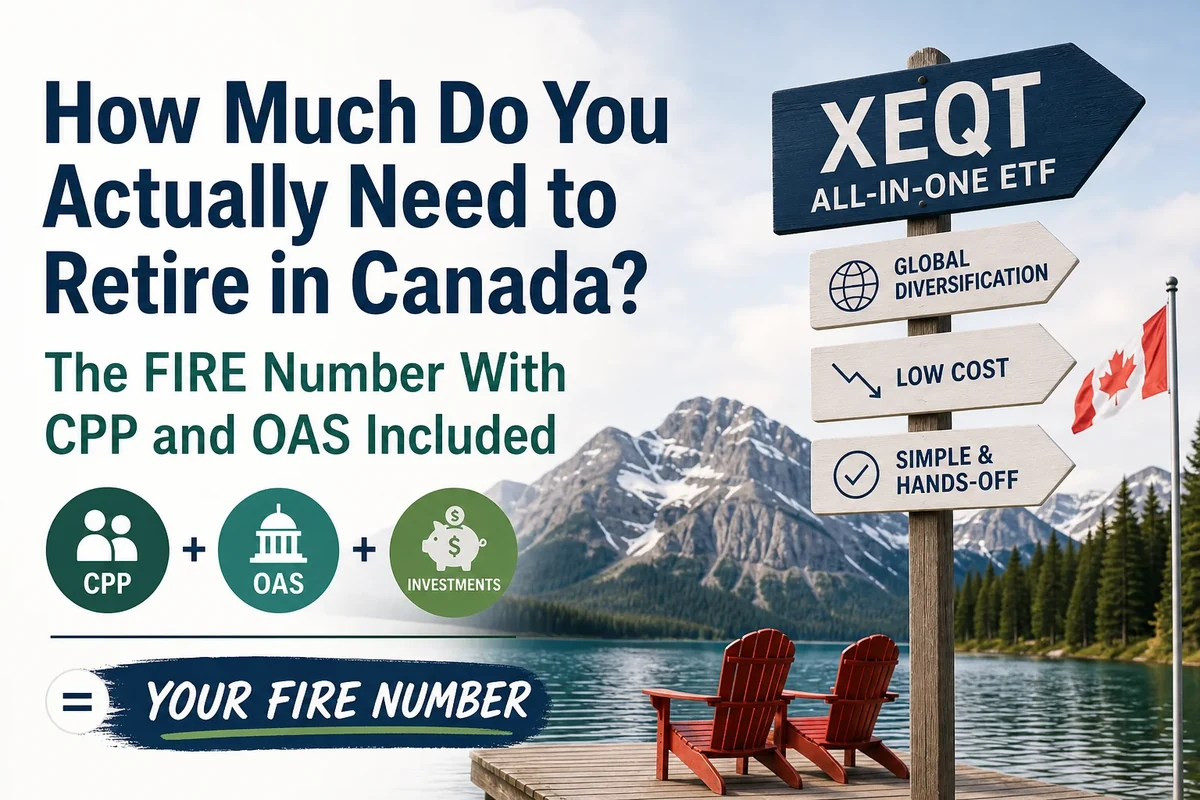
Many Canadian couples with a normal CPP record need closer to $850,000 than $1.7 million to stop working full time, because CPP and OAS cover roughly half of a $72,000 pre-tax retirement income before your portfolio does anything. The American shortcut of annual spending times 25 ignores those benefits completely. For a retirement that starts at 65, your portfolio only has to fund the gap. For an early retirement, it has to fund a bridge until CPP (available from 60) and OAS (from 65) begin, and that bridge decade is where your real FIRE number lives. I rebuilt the arithmetic below from published Canadian withdrawal research, CRA account limits and live XEQT data, and I flag where common online claims don’t hold up.
Why the US 25x Rule Breaks in Canada
The 4% rule comes from a 1994 study by American advisor William Bengen, who looked at roughly 80 years of US market history and found that a 60/40 or 50/50 portfolio could sustain a 4% first-year withdrawal, adjusted for inflation, over 30 years. Multiply your spending by 25 and you have the rule. It was built for a household with no CPP, no OAS and no tax-free account.
Kyle Prevost, writing on safe withdrawal rates for Canadians at Million Dollar Journey, ran the numbers for a couple retiring around age 40. Their combined CPP and OAS at 65, in today’s dollars, was roughly $27,000 a year. On a $1,000,000 portfolio funding $40,000 of spending, that is a benefit stream worth about 2.5% of the portfolio, even though it starts 25 years away, and it added roughly 0.4 percentage points to the safe withdrawal rate. On a $1,500,000 portfolio funding $60,000, the benefits add about 0.3.
Those are extreme early retirees whose CPP is tiny because they stopped contributing at 40. The effect is much larger for anyone retiring in their late 50s or at 65. You will also see “benefits kick in at 55” in some FIRE posts, but CPP cannot start before 60 and OAS starts at 65. Planning around the wrong age is an expensive mistake.
The cautious side deserves a hearing. Ben Felix and PWL Capital argue that fees, taxes and a 50-year horizon make 4% risky for early retirees, largely because forward returns may be lower than the last century’s. Prevost replies that they underweighted TFSAs, RRSPs and dividend tax treatment. Both points are fair, which is why I plan around 4%, not higher. Our guide to how much XEQT you need to retire goes deeper.
How Much Do You Need to Retire in Canada? The Real FIRE Number
The Canadian FIRE number is your annual spending, minus guaranteed government income, divided by a safe withdrawal rate, then adjusted for the years before those benefits begin. For anyone with a normal CPP record, that lands far below spending times 25.
The clearest worked example is Monica and Jaime, from Prevost’s work on retiring and collecting pensions in Canada. They want about $75,000 of pre-tax income, have no employer pension and hold about $850,000 in investable assets. At a 4% withdrawal, that generates $34,000. Their combined maximum OAS at 65 is about $16,500 and their combined CPP is about $21,600. Together that is $72,100 of pre-tax income, while the 25x rule would have told them to save $1.8 million.
That is the 65-year-old case. Early retirement is harder because the portfolio carries the full load until benefits start.
The bridge-decade number: Take a couple who retires at 55 spending $60,000 a year. At 65, assume they collect about $38,100 in CPP and OAS (the Monica and Jaime figures), so the portfolio only needs to produce $21,900, which takes about $547,500 at 4%. Funding ten years of $60,000 withdrawals first requires roughly $857,000 at the start if the portfolio earns 4% above inflation, or about $1.15 million if it earns nothing in real terms. This is a simplified, pre-tax illustration of my own, not a forecast.
The bridge years, not the retirement as a whole, drive the number, so shortening the bridge by a couple of years can matter as much as adding another $100,000 of savings. You can test your own ages and spending in our XEQT retirement calculator.
TFSA Withdrawals, XEQT Returns and the 5.5% Myth
You will see claims online that TFSA withdrawals let early retirees safely pull 5.5% or more. Half of that is true. TFSA withdrawals are not taxable income, are not counted in the OAS clawback and do not reduce the Canada Child Benefit for FIRE parents, so $40,000 from a TFSA really is $40,000 of spending. The other half is wrong. Tax-free money does not last longer, because survival depends on returns and the order they arrive in. Prevost flags a withdrawal above 5% of the portfolio in the first twenty or so years as a warning trigger, since that is where sequence-of-returns risk can shrink a nest egg quickly.
That matters because XEQT is 100% equity. It holds Canadian, US, international developed and emerging market stocks through four underlying ETFs, at a 0.20% MER. As of 2026 it trades around $46, near the top of a 52-week range of roughly $38.55 to $46.48, a swing of about 20% in a single year. It launched in 2019, so it has no 40-year record of its own. The long-run case rests on global equity markets, and Prevost warns that a stock-heavy retiree must be ready to watch nearly half the nest egg disappear during a bad two- to five-year stretch.
Government benefits do not make a 100% equity portfolio safer in the first decade. They make it safer after 65, when guaranteed income covers around half of spending or more and the portfolio is no longer your only paycheque.
The fix is not abandoning XEQT. Hold one to two years of spending in a high-interest savings account or GICs for the bridge, be willing to trim spending by about 10% in a bad year, or earn a little part-time income. On account location, the RRSP avoids US dividend withholding entirely, while XEQT in a TFSA or non-registered account loses about 15% of US dividends to foreign withholding. That friction is real but small next to tax-free growth. Our XEQT withdrawal strategy guide covers drawdown order in detail.
The Victory Lap: Part-Time Work Plus Deferred Pensions
The cheapest way to lower your FIRE number is to keep a small income stream while your pensions grow. Prevost calls it a “victory lap,” and the Monica and Jaime example shows why it works.
Their baseline of $72,100 uses CPP at 65. If they work part time instead, they can delay CPP. In Prevost’s scenario, forty 15-hour weeks a year produces about $12,000 each, which bridges them to nearly $74,000 of income while CPP waits. When they turn 70 and start the larger payment, their pre-tax income reaches $76,500 in today’s dollars, inflation-protected for life.
Every month you delay CPP after 65 raises the payment by 0.7%, which is 8.4% a year or about 42% by age 70. One Canadian planner frames that as a guaranteed return that is very hard for a portfolio to match without taking on market risk. Bonnie-Jeanne MacDonald of the National Institute on Ageing has shown that claiming at 60 instead of 70 leaves more than $100,000 of secure income on the table for the average Canadian, yet over 90% of Canadians claim at 65 or earlier and fewer than 5% wait until 70.
Part-time work also softens sequence risk. If markets fall early, a few thousand dollars of work income means selling fewer XEQT units at a loss. If you collect CPP while working between 65 and 70, you can opt out of further contributions with Form CPT30, and after 70 contributions stop automatically.
What Is the OAS Clawback Threshold? Your FIRE Guardrails
As of 2026, the OAS recovery tax starts at roughly $93,454 of net income per person, indexed each year, and it takes back 15 cents of OAS for every dollar above that line. It applies to individuals, not households, so a couple can have well over $180,000 of combined income before either partner loses OAS, provided it is split sensibly. Older figures like $86,000 that still circulate are out of date.
Three things push people over the line. Eligible dividends in non-registered accounts are grossed up by 38% for income testing, so $40,000 in dividends looks like about $55,000 on your return. Mandatory RRIF withdrawals start the year after you turn 71 at 5.4% of the balance, so a $1 million RRSP forces $54,000 of taxable income before CPP and OAS. And an unmanaged RRSP can turn a modest retirement into a high-income one at the worst time.
OAS clawback line: About $93,454 of net income per person as of 2026, with a 15% recovery tax on the excess. TFSA withdrawals do not count toward it, but RRSP, RRIF, CPP and grossed-up dividends all do.
The solution is to use the low-income early years. Spend non-registered income first, draw down the RRSP in modest annual amounts while your tax rate is low (the “RRSP meltdown”), and keep the TFSA as your flexible bucket for last. After 65, RRIF income can be split with a spouse. Living off RRSP money also lets you defer CPP and, if you wish, OAS, which can be postponed up to five years for an increase of as much as 36%.
The $1.7 Million Disconnect
BMO’s annual retirement survey, cited regularly by Million Dollar Journey, has found that Canadians believe they need about $1.7 million to retire. That is exactly double the $850,000 Monica and Jaime hold. At a 4% withdrawal, $1.7 million produces $68,000 a year, about what they already get from a portfolio half that size plus CPP and OAS.
Part of the gap is spending, since a mortgage-free household needs far less than one still carrying debt. Part of it is that people estimate with no benefit income at all, the same mistake the 25x rule makes. And part of it is that a number that large keeps you reliant on whoever sells you the plan.
Many Canadians have less of a savings problem than a benefits-blindness problem. Subtract CPP and OAS from your target income before you multiply anything.
Couples who clear their targets with $600,000 to $850,000 tend to have no mortgage, a TFSA-heavy bridge, a willingness to earn modest income for a few years, and a plan to defer CPP.
Geography Arbitrage and the Expat FIRE Exit
Moving abroad lowers living costs but changes your tax position, so confirm the rules below with a cross-border accountant before you go.
Leaving Canada triggers a deemed sale of non-registered investments, so unrealized gains are taxed at departure, while RRSPs and TFSAs are exempt from that rule. As a non-resident you cannot contribute to a TFSA, new room stops accruing, and contributions made while non-resident attract a penalty tax. Canada does not tax TFSA withdrawals, but your new country may.
CPP and OAS can be paid abroad. Canada withholds 25% by default, reduced to 15% under a tax treaty, which includes Portugal, and RRSP and RRIF withdrawals face the same 15% or 25%. A Section 217 election lets non-residents file a Canadian return on certain pension income so tax is calculated at graduated rates, which can produce a refund when your income is low. OAS paid abroad generally requires at least 20 years of Canadian residence after age 18, so check your record first.
Portugal’s D7 visa asks for steady passive income of at least the Portuguese minimum wage, about €870 a month in 2025, which works out to about $16,800 CAD a year for a single applicant and roughly $25,200 CAD for a couple. CPP, OAS, RRIF withdrawals and dividends generally count. Portugal’s old flat 10% pension regime is gone, so Canadians now pay regular progressive rates, with the treaty preventing double taxation. Spain offers a similar residency route for retirees with passive income. Many couples plan on a budget of a few thousand dollars a month outside the priciest cities, but test that against your own lifestyle, healthcare and exchange rate. XEQT is not currency hedged, so see why XEQT doesn’t hedge currency before you commit.
Frequently Asked Questions
How much money do you need to retire in Canada? A couple who wants $72,000 of pre-tax income at 65 needs about $850,000 invested, because roughly $38,100 comes from CPP and OAS and the portfolio generates the rest at a 4% withdrawal rate. The 25x rule would say $1.8 million.
Can you retire at 55 in Canada with about $1 million? In a simplified illustration with $60,000 of annual spending, a couple needs roughly $857,000 to $1.15 million to bridge to age 65, depending on whether the portfolio earns 4% above inflation or nothing. Taxes, healthcare and a bad early market can push you past that range.
Do TFSA withdrawals count toward the OAS clawback? No. TFSA withdrawals are not taxable income and are not included in the net income used to calculate the OAS recovery tax, which starts at about $93,454 per person as of 2026. RRSP, RRIF, CPP and grossed-up dividend income all count.
Should I defer CPP to 70 if I plan to retire early? If your portfolio or part-time income can cover your spending, delaying CPP raises the payment by 0.7% per month after 65, or about 42% by 70, indexed to inflation for life. Poor health or a short expected lifespan can change that math.