Is XEQT Still the Right Call in 2026? An Honest Review
April 25, 2026

Why We Do This Every Year
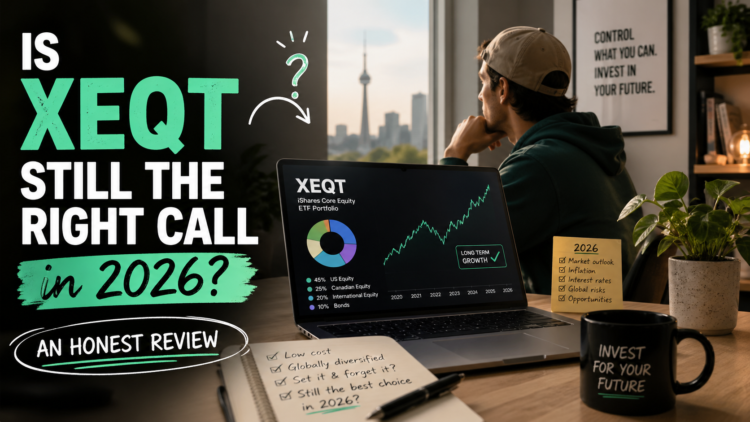
Every January, the same questions land in the inbox. “Is XEQT still good?” “Should I switch to something else now that markets have moved?” “I heard someone on a podcast say XEQT is overexposed to the US. Should I be worried?” These are fair questions, and they deserve a real answer rather than a cheerful “just keep buying” non-response. So here is an honest annual review of the iShares Core Equity ETF Portfolio, ticker XEQT, for 2026. We will look at what the fund actually is, how it is structured, what changed, what did not, and whether the core thesis still holds.
The short answer is yes. The slightly longer answer is worth reading, especially if you are new to XEQT or if you are second-guessing yourself after a choppy market period.
What XEQT Actually Is (And Is Not)
XEQT is a fund-of-funds from BlackRock Canada. It holds four underlying iShares ETFs and gives you exposure to roughly 9,000 companies across Canada, the United States, developed international markets, and emerging markets. The target allocation is approximately 45% US equities, 25% Canadian equities, 25% international developed markets, and 5% emerging markets. It is 100% equities, which means it carries full stock market risk and is designed for investors with a long time horizon who do not need to draw down funds in the near term.
What XEQT is not: it is not a balanced fund. It does not hold bonds. It will drop hard in a market downturn, because that is what 100% equity funds do. If you are within five years of needing the money, or if a 30% drawdown would cause you to panic-sell, XEQT is not the right fit. XGRO (80% equity) or XBAL (60% equity) may serve you better. But for investors with a 10-plus year horizon, XEQT remains the most straightforward route to broad global equity exposure at a very low cost.
MER: XEQT carries a management expense ratio of approximately 0.20% per year. On a $100,000 portfolio, that is about $200 annually. The average Canadian mutual fund charges closer to 2%, which would cost you $2,000 on the same balance. Over 30 years, that difference compounds into a significant drag on your retirement.
The Case for Global Diversification Is Still Intact
One of the recurring criticisms of XEQT in 2024 and into 2026 has been the US weighting. When US markets are booming, Canadians sometimes feel like their Canadian and international allocations are dragging. When US markets correct, people suddenly appreciate the cushion from the rest of the world. This is exactly how diversification is supposed to feel: slightly uncomfortable in both directions.
Diversification means you will almost always have something in your portfolio that is underperforming. That is not a flaw. That is the point. If everything moves together, you are not diversified.
The research backing global diversification remains strong. Vanguard research has consistently shown that home-country bias, which is the tendency to overweight domestic stocks, reduces risk-adjusted returns over long periods. Canada represents roughly 3% of global market capitalization. Holding 25% in Canadian stocks is already a significant home-country tilt, but it is a deliberate one that provides some currency hedge and reduces tracking error for Canadian investors. XEQT’s allocation reflects a reasonable, evidence-based compromise.
The 2026 environment has added complexity. Tariff uncertainty and US political volatility created a rough patch in spring 2026, with equity markets experiencing meaningful short-term drawdowns. For investors holding XEQT through that period, the international and Canadian allocations provided meaningful relative support when US markets led the selloff. This is not a reason to change your allocation based on what just happened. It is a reason to appreciate that the diversification structure works as intended.
What Actually Changed in 2026
The fundamentals of XEQT did not change in 2026. BlackRock made no significant structural changes to the fund. The underlying holdings, the rebalancing methodology, and the fee structure remained consistent. The fund continues to rebalance automatically back to its target weights, which means you do not have to do anything to maintain your allocation. That is one of the most underrated features of an all-in-one ETF.
What did change is the environment around the fund. Canadian TFSA contribution room increased to $7,000 per year for 2026, consistent with the prior year. FHSA accounts continue to accept up to $8,000 per year with a $40,000 lifetime maximum, and XEQT is an eligible holding in both. RRSP contribution room remains at 18% of prior year earned income, subject to the annual ceiling. For most Canadians accumulating wealth, the account structure is more important than the fund selection, and XEQT fits neatly inside every registered account available to you.
2026 Account Limits: TFSA: $7,000/year contribution room. FHSA: $8,000/year, $40,000 lifetime. RRSP: 18% of prior year earned income. All three accounts can hold XEQT directly through Wealthsimple or Questrade with no trading commissions.
The Biggest Mistake XEQT Investors Made in 2026
It was not picking the wrong fund. It was not having the wrong allocation. The biggest mistake was selling during the volatility in spring 2026, locking in losses, and then either sitting in cash or trying to re-enter at a better price. Markets do not wait for you to feel comfortable. Research on investor behaviour consistently shows that the return gap between what a fund earns and what the average investor in that fund earns is substantial, often 1 to 2 percentage points per year, because investors tend to buy after gains and sell after losses.
The fund does not fail investors. Investors fail themselves by treating a long-term vehicle like a short-term trade.
If you sold XEQT during the April 2026 tariff-driven correction and are now wondering whether to get back in, the answer is the same as it always is: the best time to invest is as soon as you have the money. Trying to time re-entry based on how you feel about the economic news cycle is not a strategy. It is expensive hesitation dressed up as caution.
How XEQT Compares to the Alternatives in 2026
The most common comparison is XEQT versus VEQT, the Vanguard Canada equivalent. VEQT has a slightly different geographic allocation, a marginally higher Canadian weighting, and a nearly identical MER. The honest answer is that both are excellent and the difference in long-term outcomes will be trivial. If you already own one, stay in it. If you are starting fresh, either works. The choice of brokerage matters more than the choice between these two.
The more important comparison is XEQT versus actively managed mutual funds. The average Canadian equity mutual fund charges roughly 2% per year in fees. Actively managed funds, as a category, have failed to consistently beat their benchmarks over 10 to 20 year periods, a finding confirmed by the S&P SPIVA Canada scorecard year after year. The 2024 SPIVA Canada report found that the majority of actively managed Canadian equity funds underperformed their benchmark over a 10-year period. Paying more for a product that delivers less is not a conservative choice. It is an expensive one.
Stock picking is the other alternative some investors consider, especially after a year where specific sectors or names performed well. But individual stock selection introduces concentration risk, requires research time, creates tax complexity, and exposes you to the very real possibility that your judgment about a company’s future is wrong. XEQT owns thousands of companies. You cannot be catastrophically wrong on any single position because no single position controls your outcome.
Who XEQT Is Right For in 2026
XEQT is the right choice for an investor who is still in the accumulation phase, has at least 10 years before needing the funds, does not want to spend hours managing a portfolio, and wants to own the world’s productive capacity at a low cost. That describes the majority of working Canadians between their 20s and early 50s. It also describes a significant portion of investors in their late 50s and early 60s who are still growing capital and do not plan to liquidate everything at once in retirement.
XEQT is not right for someone who needs to access the money within five years, someone who will panic-sell in a downturn, or someone who has a specific income need that requires a bond allocation. If you are approaching retirement and need predictable income, a gradual shift toward XGRO or a mix of XEQT and a short-term bond ETF makes sense. But that transition should happen based on your actual needs, not based on market fear.
The right fund is the one you will hold through a 30% decline without selling. For most Canadians under 55 with stable income, XEQT qualifies.
The Practical Checklist for 2026
If you own XEQT and are doing your annual review, here is a simple checklist. First, confirm you have maximized your TFSA contribution room before investing in a taxable account. The 2026 limit is $7,000, and if you have been a Canadian resident since 2009, your cumulative room could be $95,000 or more. Second, if you are saving for a first home, open an FHSA if you have not already. The $8,000 annual contribution is tax-deductible and grows tax-free, and XEQT can sit inside it. Third, check whether you are using automatic purchases. Both Wealthsimple and Questrade allow you to set up recurring buys, which removes the temptation to time the market. Fourth, do not check your balance more than quarterly. Monthly monitoring increases anxiety without improving outcomes.
If you are new to XEQT and are reading this before your first purchase, the process is straightforward. Open a Wealthsimple or Questrade account, select either a TFSA or RRSP depending on your situation, fund the account, and buy XEQT. There is no minimum holding period, no load fee, and no complexity. You own the global equity market from day one.
Bottom Line: XEQT in 2026 is the same fund it has always been: low-cost, globally diversified, 100% equities, and designed to be held for decades. Nothing that happened in 2026 changes that. The evidence for owning it is the same. The case against paying 2% MER to an active manager who will likely underperform is stronger than ever.
Frequently Asked Questions
Is XEQT still a good buy in 2026 after recent market volatility? Yes. Market volatility does not change the fundamental case for owning a broadly diversified, low-cost equity ETF. XEQT’s structure means short-term drops are spread across thousands of companies in multiple countries. Selling during volatility and waiting for calm typically results in buying back at higher prices. Staying invested is the historically supported response to short-term drawdowns.
Should I hold XEQT in my TFSA, RRSP, or FHSA? The priority order for most Canadians is: fill your FHSA first if you are saving for a first home, then maximize your TFSA, then contribute to your RRSP. XEQT is eligible in all three. In a taxable account, US dividends are subject to a 15% withholding tax that you cannot fully recover, so registered accounts are strongly preferred. For a taxable account with a large balance, some investors hold US ETFs directly in an RRSP for treaty protection, but for most people starting out, XEQT in a TFSA is the simplest and most effective approach.
What is the difference between XEQT and VEQT in 2026? Both are all-equity, all-in-one ETFs from large, reputable providers. XEQT is from BlackRock Canada and VEQT is from Vanguard Canada. Their geographic allocations differ slightly, with VEQT carrying a larger Canadian weighting. Their MERs are nearly identical at around 0.20%. Over a 30-year investment horizon, the performance difference is expected to be minimal. If you already own one, there is no meaningful reason to switch. If you are starting fresh, either is an excellent choice.
What if I want to add bonds to reduce volatility? If you genuinely cannot stomach a 30% to 40% drawdown in a severe market correction, a 100% equity fund may not match your actual risk tolerance. XGRO (approximately 80% equity, 20% bonds) or XBAL (approximately 60% equity, 40% bonds) are the natural alternatives within the same iShares family. The trade-off is lower expected long-term returns in exchange for smaller peak-to-trough declines. The right choice depends on your time horizon, your income stability, and your genuine behavioural response to seeing your portfolio drop significantly in value.