Just Got Your First Real Paycheque. Here’s the Only Investing Move That Matters Right Now.
June 12, 2026

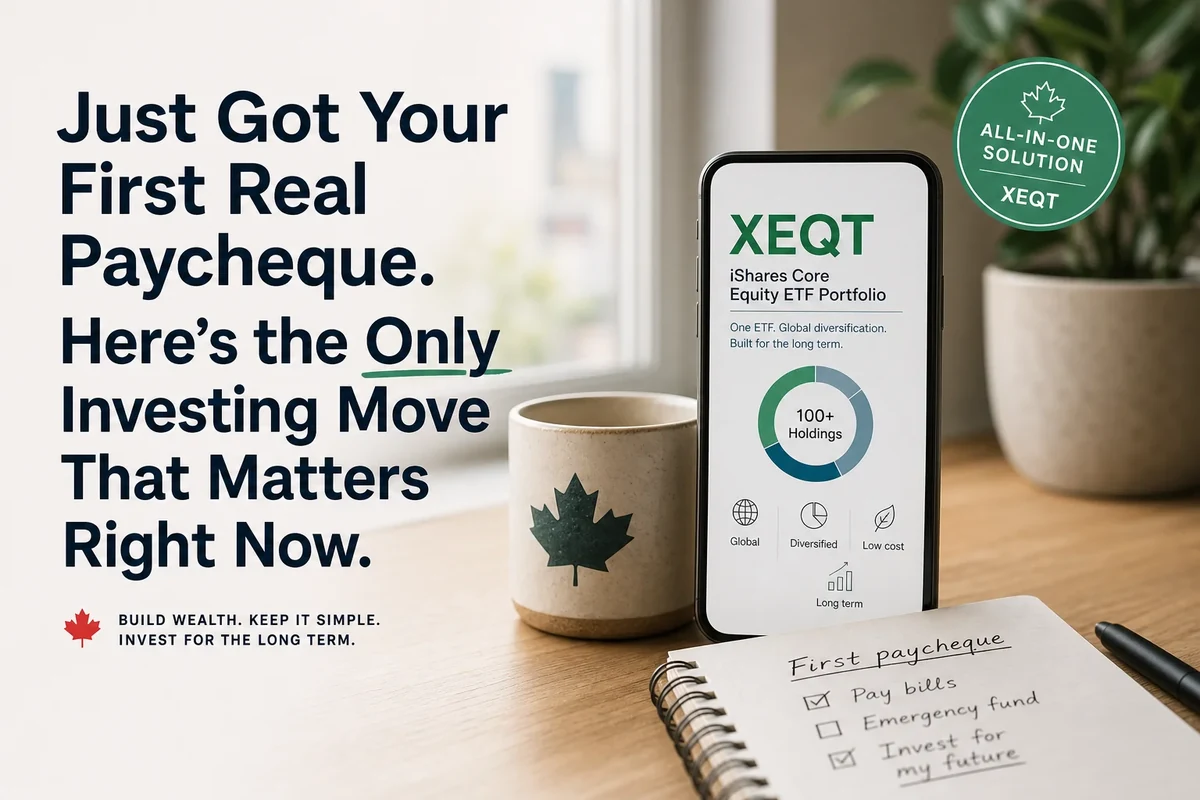
Your first real paycheque is not just money. It is the starting point of a 40-year compounding engine, and the single most important decision you will make about it has nothing to do with which stock to pick or what the market is doing. The decision is whether you act today or spend six more months researching. Because the research is already in: the people who start immediately, with whatever amount they can manage, end up in a categorically different financial position than the people who wait for the perfect conditions that never arrive.
This article is for the person who just landed their first real job, has money hitting their account for the first time, and is genuinely unsure where to begin. No mutual fund jargon. No advisor-speak. One concrete move, explained fully, so you can do it today.
Your First Paycheque Is a Compounding Weapon
Compounding is the process where your investment returns generate their own returns. It sounds straightforward until you actually run the numbers, at which point it becomes almost unsettling how much your 20s matter.
A Canadian who invests $300 a month starting at 25 and never increases that amount will build a more substantial portfolio than one who invests $800 a month starting at 38. That is not a motivational poster. That is the math of compounding, and it is consistent with every serious analysis of long-run investment returns. Time in the market is the compounding engine. The monthly contribution is the fuel.
The reason the early starter wins despite contributing far less per month is that the front-loaded years do the heaviest lifting. Compounding works exponentially: the growth in year 35 of an investment dwarfs the growth in year five, and every year you delay shifts that whole curve forward. Starting 13 years later does not mean you miss 13 years of growth in isolation. It means every single subsequent year of contributions loses those 13 years of compounding behind them.
The first $100,000 you accumulate is the hardest to build and the most valuable over the long run, because it becomes the base that all future compounding multiplies against. Early savers who put their first $100,000 into the market in their 20s while peers were buying car loans and carrying consumer debt found themselves in an exponentially different position by the time they hit their 30s. Not because they earned more, but because the money had longer to work.
Time in the market is the compounding engine. The monthly contribution is just the fuel. Investing $300 a month at 25 beats $800 a month at 38, not because $300 is a lot, but because 13 years of compounding at the front end is irreplaceable.
The Paralysis Trap: Researching Is Costing You Money Right Now
Here is the pattern that plays out for almost every first-job investor in Canada. You know you should invest. You open a few browser tabs. You read about TFSAs and RRSPs. Someone mentions the FHSA. You see a Reddit thread debating XEQT versus VEQT. You watch a YouTube video comparing five different all-in-one ETFs. Three weeks later, nothing has changed except that you have a lot of browser tabs open and slightly more anxiety about making the wrong choice.
This is called analysis paralysis, and it is one of the most expensive habits in personal finance. Not because the research is bad. Because the cost of inaction is real and it compounds silently, without ever sending you a bill.
Every month you sit in cash or a basic savings account at age 22 is a month of compounding you will never recover. Even modest monthly contributions left uninvested for a year in your early 20s translate to a meaningful gap in your final portfolio balance, because that delay compounds forward across a 40-year timeline. That is not a scare tactic. That is what a long time horizon does to early inaction.
The brutal truth about the decision paralysis around fund choice, account type, and broker selection is that all three of those decisions are reversible and none of them are as important as simply starting. You can switch brokers. You can change funds. You can open an RRSP later. You cannot get back the months you spent in analysis mode while the market was quietly compounding for everyone else who had already clicked buy.
The One Move: Automate a Monthly Buy Into a TFSA on Payday
If you take nothing else from this article, take this: open a TFSA, link your bank account, set up a recurring monthly transfer on payday, and buy one all-equity ETF. That is the entire move.
The most important word in that sentence is “recurring.” Research on savings behaviour is consistent on this point: people who automate their investment contributions accumulate significantly more wealth than those who invest whatever is left at the end of the month. The reason is simple: most months, nothing is left. Once the money is in your account, it gets absorbed by coffee, subscriptions, a weekend trip, something. Automating the transfer means the investment happens before your spending patterns get a vote.
This is called paying yourself first. Set the transfer for the day your paycheque hits. Even $200 or $300 a month. The specific amount matters far less than the consistency. And once you have the automation in place, the single hardest part of building wealth in your 20s is done.
2026 TFSA limit: $7,000 in new contribution room this year. To max it, you need roughly $583 per month. If that is out of reach right now, start with whatever you can, $200 or $300 is a perfectly valid starting point. You can increase the amount as your income grows. The habit matters more than the dollar figure.
For the fund choice: XEQT is a globally diversified, all-equity ETF from iShares that holds roughly 9,000 companies across Canada, the US, international developed markets, and emerging markets in a single ticker. Its management expense ratio is 0.20% per year, which means you pay about $2 per year for every $1,000 invested. It rebalances automatically. You never need to adjust the underlying holdings. It is the practical definition of a set-it-and-forget-it investment for someone who wants to build wealth without making investing a part-time job.
Why TFSA First (Not RRSP, Not Yet)
For most Canadians in their first job, the TFSA is the right account to prioritize. The reason comes down to income and tax brackets. The RRSP’s advantage is that your contributions reduce your taxable income today, and you defer the tax until retirement when your income is presumably lower. That math works best when your current income is high. On an entry-level salary, your tax rate is already relatively low, so the RRSP deduction delivers a smaller benefit than it will later in your career.
The TFSA has three properties that make it ideal for first-job investors. Growth inside the account is completely tax-free. Withdrawals are completely tax-free. And the contribution room you withdraw comes back the following January 1, so you are not permanently giving up room if you need to access the money. For someone in their 20s who might need the funds for a down payment, a career change, or any number of life events, that flexibility is genuinely valuable.
The RRSP starts making more sense once your income reaches a level where the immediate tax deduction is worth capturing, roughly around $80,000 or higher depending on your province, or once your TFSA is fully maxed and you need additional registered shelter. If you are earning $55,000 on your first job, that threshold is not today. Put the TFSA first, automate it, and revisit the RRSP question in a year or two as your income grows.
The TFSA is not a savings account. It is a tax shelter with a self-directed investing component. The name has misled an entire generation of Canadians into keeping their TFSA money in a 1.5% savings product while their peers’ TFSAs compound at equity market rates.
One note on the FHSA: if you are a first-time home buyer or think you might be, the FHSA is a genuinely excellent account that combines the upfront tax deduction of an RRSP with the tax-free withdrawal benefit of a TFSA for qualifying home purchases. At $8,000 per year up to a $40,000 lifetime limit, it deserves a spot in your account setup, but it is a second step. TFSA first, then layer in the FHSA if the home-buying timeline fits.
The 10-Minute Setup That Changes Everything
The two most beginner-friendly platforms for Canadian investors are Wealthsimple and Questrade. Both support commission-free ETF purchases. Both support registered accounts including TFSAs, RRSPs, and FHSAs. Both are regulated Canadian institutions.
Wealthsimple is the easier starting point for most first-job investors. The app is designed with simplicity in mind, the account opening process takes about ten minutes on your phone, and the recurring buy feature lets you set a fixed dollar amount to automatically purchase a chosen ETF on a schedule you define. You set it once and it runs every payday without any further input from you. That automation is the entire point.
Questrade requires slightly more manual setup for recurring purchases but supports pre-authorized contributions and has a well-designed platform for investors who want a bit more control. Either platform is a sound choice. The best broker is the one you will actually open and use.
The setup sequence is: create an account, verify your identity with a government ID, link your Canadian bank account, open a TFSA inside the platform, set up a recurring transfer from your bank on payday, select XEQT as the fund, and confirm. The whole process takes about ten to fifteen minutes the first time. After that, it runs on autopilot.
Quick setup checklist: Choose Wealthsimple or Questrade. Open a TFSA. Link your chequing account. Set a recurring buy for payday (even $200 to start). Select XEQT. Done. You do not need to understand every detail of the fund before you buy it, you need to understand that you are buying a diversified slice of the global economy at 0.20% per year, and that is enough to begin.
What Happens in Year Two (And Why You Do Not Rethink This)
After your first year of automated investing, something will happen that trips up a lot of young investors: the market will do something alarming. It will drop 10%. Or a friend will tell you about a stock that tripled. Or you will read a breathless article about how everything is overvalued. At that point, the single most important decision you will make is to do nothing.
XEQT is a globally diversified fund holding roughly 9,000 companies across every major economy. When you own it, you own a piece of Canadian banks, US technology companies, European industrials, and emerging market manufacturers simultaneously. When the market drops 10%, you are not watching your money disappear. You are watching a temporary repricing of long-duration assets. Investors who have stayed through drops of 30% or more have historically ended up wealthier for having stayed rather than sold.
The only question worth asking in year two is whether you can afford to increase your monthly contribution. If your income has gone up, bump the transfer from $300 to $400. That is the entire optimization required. No rebalancing, because XEQT handles that automatically. No fund-switching, because you already own a globally diversified portfolio. No checking on it obsessively, because the whole point is that the system runs without your constant attention.
For a deeper look at how to size your contributions as your career and income progress, the Canadian monthly investing framework is worth reading in your second year, once the habit is already locked in.
The Real Risk Is Staying in Cash While You Decide
Most first-job investors conceptualize risk as market volatility: the chance that their investment goes down. That framing is understandable, but it is backwards for someone in their 20s with a 40-year time horizon. Short-term volatility is noise. The actual risk is inflation and opportunity cost eroding the purchasing power of money that sits idle while you finish deciding.
Inflation has historically averaged around 2 to 3% per year in Canada over long periods. That means cash in a chequing account loses real value every year. A high-interest savings account helps, but it does not come close to matching long-run equity returns. The gap between money sitting in cash and money invested in global equities widens with every passing year, and that gap is permanent. There is no catching up to 40 years of compounding by starting at 35.
The investor who waited one year at age 22 before starting does not just lose one year of growth. Every single subsequent contribution also loses those 12 additional months of compounding behind it, because the entire timeline shifts forward. The cost is quiet, invisible, and real.
The counterintuitive truth about a volatile market in your 20s is that it is not necessarily bad news. When XEQT drops 15%, your automatic monthly buy purchases more units at a lower price. You are accumulating the asset when it is cheaper. This is dollar-cost averaging, and it is a structural benefit of automated monthly investing that disappears the moment you try to time your entries.
If you want the data on what waiting actually costs in concrete terms, the analysis of market-timing delays for Canadian investors makes it clear: the cost of waiting for the perfect moment is almost always higher than the cost of any market downturn you were trying to avoid.
Frequently Asked Questions
How much should I invest from my first paycheque? Start with whatever you can automate without disrupting your essential expenses and emergency fund. Even $200 a month at 25 is a meaningful start. The number that matters most is not the dollar figure but the consistency, automating $250 on payday beats manually trying to invest $1,000 whenever you get around to it, because most months you will not get around to it. As your income grows, increase the amount.
Should I open a TFSA or an RRSP first? For most Canadians in their first job, the TFSA is the right starting point. Your income is likely in a lower tax bracket, which reduces the immediate advantage of the RRSP deduction. The TFSA gives you tax-free growth, tax-free withdrawals, and the flexibility to access the money without permanent consequences if your circumstances change. The RRSP becomes the stronger priority once you are earning above roughly $80,000, or once you have fully used your available TFSA room.
Why XEQT specifically, and not something else? XEQT gives you global diversification across roughly 9,000 companies in one ticker, at a cost of 0.20% per year. It rebalances automatically and requires no ongoing decisions about asset allocation or geographic weighting. For a first-job investor whose goal is to build long-term wealth without making investing a second job, that simplicity is the point. There are other solid all-in-one ETFs available to Canadians, but XEQT is a well-supported default that you are unlikely to ever need to second-guess.
What if I need the money before retirement? That is exactly why the TFSA is the recommended starting account. TFSA withdrawals are tax-free at any time for any reason, and the contribution room you withdraw comes back the following January 1. If you need the money in three years for a down payment or a career change, you can access it without a tax hit. The only caveat: if your time horizon for a specific goal is shorter than five years, consider keeping that portion in a high-interest savings account rather than equities, since markets can drop significantly over short windows and you do not want to be forced to sell at the wrong time.