My Parents Kept Pushing Their Advisor on Me. Here’s What I Found When I Actually Looked at the Numbers
July 24, 2026

My parents have had the same financial advisor for over two decades. He has a warm handshake, a framed photo with their kids on his desk, and a gift card that arrives every Christmas. They trust him completely. And for a long time, that trust was enough for them to want me to trust him too. “He’s looked after us,” my mom said. “Just sit down with him.” So I did. And then I went home and ran the numbers. What I found was one of the most expensive referrals anyone has ever tried to give me.
The Advisor Nobody Explains to You
Most Canadians don’t choose their first financial advisor. The advisor chooses them, usually through a parent, a referral from a bank branch, or an insurance contact. The result is a relationship that feels like a professional endorsement but is structured very differently from one.
The majority of advisors in Canada are compensated through a commission-based or assets-under-management model. Under the commission model, the advisor earns a fee, often embedded in the mutual fund itself, every time you buy and every year you hold. Under the AUM model, the advisor charges a percentage of your invested assets directly, typically between 0.75% and 1.5% per year on top of whatever the underlying funds cost. Neither of these structures requires the advisor to act as a fiduciary, meaning they are legally required only to sell you something “suitable,” not necessarily what is optimal for your situation.
This isn’t a scandal. It’s just how most of the industry is structured. But it does mean that when your parents’ advisor recommends a particular mutual fund, the question worth asking is not “is this good?” but “who benefits most from this recommendation, and by how much?”
Advisors who advocate active strategies are typically not being dishonest: they have genuinely convinced themselves they are among the few who can earn market-beating returns. The problem is the math doesn’t support that belief, and you’re the one paying for it either way.
What My Parents’ Advisor Was Actually Charging
When I asked to see the fee structure, I got a vague answer about “management fees built into the fund.” That’s how it works for most Canadians: the fees are real, they compound every year, and they never show up as a line item on a statement.
Here’s the actual fee stack in a typical advisor-sold mutual fund portfolio in Canada. The fund itself carries an embedded Management Expense Ratio, or MER, that typically runs between 1.8% and 2.5% for Canadian balanced or equity mutual funds, according to Morningstar data. That MER includes what’s called a “trailer fee,” which is a portion of the fund’s annual cost paid back to the advisor for as long as you stay invested. If the advisor also charges a separate AUM fee on top, which fee-based advisors increasingly do, you can add another 0.75% to 1.5% on top of that. Depending on how the accounts are structured, the blended cost can reach 2.5% to 3% per year.
None of this appears as a single dollar amount on your statement. You see a portfolio balance. You see a return. You don’t see how much lower that return would have been without the fee load. Canada carries some of the highest mutual fund fees in the world, a fact that should embarrass the industry but rarely gets mentioned in a client meeting.
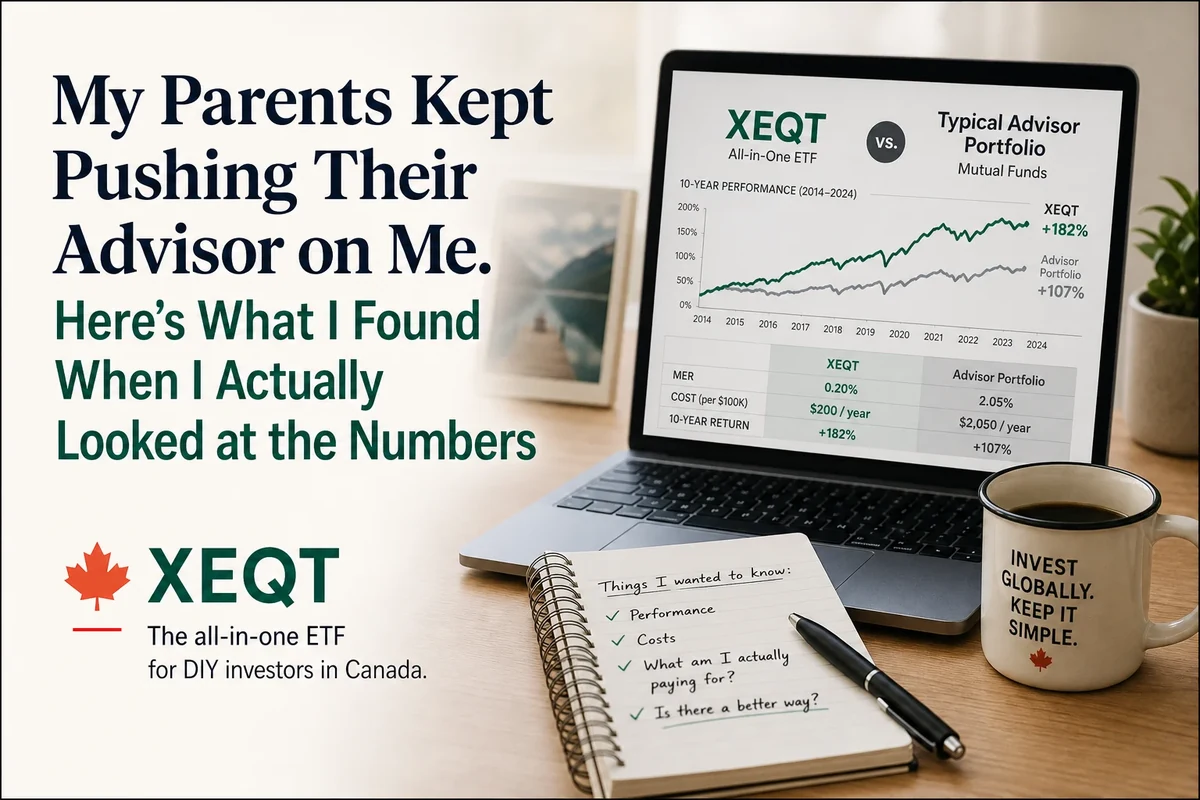
The blended fee stack: A typical advisor-sold portfolio in Canada carries 1.8, 2.5% in embedded mutual fund MERs, plus 0, 1.5% in AUM or trailer fees, for a total blended drag of 2%, 3% annually. XEQT’s all-in MER is 0.20%, with no advisor fee on top.
The 30-Year Number That Changed My Mind
Take $100,000 invested at age 30. Assume a gross market return of 7% per year, a reasonable long-run assumption for a globally diversified equity portfolio. Run two scenarios side by side.
With XEQT, your net return after the 0.20% MER is approximately 6.80% per year. After 30 years, that $100,000 grows to roughly $726,000. With a commission-based advisor selling you a balanced mutual fund at a 2.0% blended fee, your net return drops to around 5.0%. After 30 years, the same $100,000 grows to roughly $432,000. That’s a difference of approximately $294,000, on an identical starting amount, with identical gross market performance. The only variable is the annual fee. These figures are consistent with the long-run fee-drag modelling published in XEQT’s own MER analysis on this site.
Push the blended fee to 2.5%, which is common once you include both the embedded trailer and a separate advisor charge, and the 30-year ending balance drops to around $375,000. Now you’ve surrendered more than $350,000 to fees over a working lifetime. That’s not a rounding error. That’s a house down payment, a decade of retirement spending, or your kids’ university education, quietly extracted year by year from an account you thought was growing for you.
The fee doesn’t feel painful because it’s never deducted visibly. If someone handed you a bill for $12,000 at the end of every year for managing your $600,000 retirement portfolio, you’d ask hard questions. Instead, the fund reports a net-of-fee return, the balance grows more slowly than it should, and nobody says a word.
The damage is worst right before retirement, when your portfolio is largest. On a $600,000 portfolio, a 2% blended fee means $12,000 per year leaving the account. XEQT at 0.20% costs $1,200 on that same balance. The $10,800 annual difference at that stage, compounding for even five more years, represents a meaningful portion of your retirement runway.
Why a Single ETF Actually Solved the Problem
When I sat down with the numbers, my first instinct wasn’t “great, I’ll just buy one ETF.” My instinct was “this can’t be right, surely a professional portfolio is doing something I can’t replicate.” That feeling is worth examining, because it’s exactly what the commission structure is designed to produce.
XEQT holds approximately 9,000 individual stocks across roughly 50 countries. Its underlying components cover US equities through a broad market index, international developed markets, Canadian equities, and emerging markets. The verified asset mix sits at approximately 45% US, 25% international developed, 25% Canada, and 5% emerging markets. It rebalances automatically. It requires no intervention from you. And it costs 0.20% per year, charged against the fund’s net asset value, with no additional layer of advisor fees on top.
The “reassurance” argument for managed portfolios, that a professional is watching your money and making smart decisions, doesn’t hold up against the long-run evidence on active management. Independent research consistently shows that the majority of actively managed funds underperform their benchmarks over 15-year periods, once fees are included. Your advisor isn’t selecting from a pool of managers who reliably beat the market. He’s selecting from a pool that, on average, charges you more than it delivers.
For a deeper look at what XEQT actually contains and why its structure works for long-term investors, the complete XEQT guide covers the underlying ETFs, auto-rebalancing mechanics, and long-run rationale in full detail.
The Conversation I Had to Have With My Parents
Telling your parents that their trusted advisor of twenty years has been overcharging them is not a comfortable conversation. I didn’t lead with “you’ve been ripped off.” I led with math.
The first thing I acknowledged is that their advisor probably did add real value at specific moments: helping them figure out their RRSP contribution strategy when tax rules felt confusing, navigating their accounts when my dad changed jobs, giving them a reassuring phone call in March 2020 when everything dropped sharply. That kind of behavioural coaching has genuine worth, especially for investors who might otherwise panic-sell at exactly the wrong moment. Canadian Couch Potato’s writing on when to use an advisor has made this point clearly for years: for some investors, the cost of advice is justified by the cost of bad decisions it prevents.
But my parents are in their early sixties with a relatively simple situation: two RRSPs, two TFSAs, and a non-registered account. They have CPP and OAS coming. Their estate is straightforward. There’s no business income, no complex trust structure, no cross-border tax issue. For that situation, paying 2% or more per year on a $400,000 portfolio, which amounts to roughly $8,000 annually extracted from their retirement savings, is hard to defend on any basis except inertia.
The honest breakdown is this: there is a real case for professional advice when your financial situation involves genuine complexity. An estate with multiple beneficiaries, a sudden windfall or inheritance, a divorce, a business sale, or a disability that changes your drawdown strategy. For any of those situations, an hourly fee-only planner charging $300 to $500 per hour, or a flat engagement of $2,000 to $5,000, is money well spent. You get the advice you need, you pay for it transparently, and you don’t carry an ongoing percentage drag for the next three decades on assets that no longer need active management.
Where Fee Drag Hits Hardest in Canada
For Canadian investors specifically, the registered account structure changes the fee calculation in a way most people overlook. Inside a TFSA, every dollar of return is permanently tax-free. That’s the account’s core advantage. But because there’s no tax deduction on contributions, there’s also no tax benefit to offset MER costs. High fees inside a TFSA are pure destruction of tax-sheltered wealth, with no mitigating factor.
Consider a $200,000 TFSA held in advisor-sold mutual funds at a 2.0% blended fee. You’re paying approximately $4,000 per year in fees, deducted silently from what should be your most protected growth account. With XEQT at 0.20%, that same $200,000 costs $400 per year. The $3,600 annual difference stays in your account and compounds tax-free rather than being distributed to fund companies and advisors. Over a decade, that’s $36,000 in direct fee savings before accounting for what that money would have compounded into, inside the most tax-sheltered account structure Canada offers.
2026 TFSA room: Canadians eligible since 2009 have accumulated up to $109,000 in lifetime TFSA contribution room, with an annual limit of $7,000. Paying 2%+ in fees inside this account is especially damaging because there is no tax deduction to partially offset the drag, every basis point of fee is pure lost compounding.
Inside an RRSP, the calculation differs slightly. The tax deduction on contributions means some fee drag is offset by the reduced tax bill upfront. But the RRSP does carry one genuine advantage for XEQT holders: the Canada-US tax treaty fully exempts RRSP accounts from US dividend withholding tax, so you pay 0% on that withholding rather than the 15% that applies in a TFSA. That makes the RRSP, in most cases, the more tax-efficient account for holding XEQT when you have both options available, a nuance that fee-based advisors rarely walk clients through because it doesn’t change what they charge you.
What Actually Justified Keeping an Advisor
After going through all of this, it’s worth being honest about where professional advice still earns its fee, because the answer isn’t “nowhere.”
A fee-only or advice-only planner charges you directly for their time rather than earning a commission on what they sell you. In Canada, these planners typically charge $250 to $500 per hour, or flat project fees in the $2,000 to $5,000 range for a comprehensive financial plan. They have no incentive to recommend higher-cost products because they don’t earn anything from the products at all. The advice is the product.
This model makes sense at specific life moments: the year you retire and need to map out CPP timing, RRSP-to-RRIF conversion, and OAS deferral strategy, when you receive an inheritance and need help thinking through tax implications and account structure, when you’re self-employed and balancing an incorporated business with personal registered accounts. Pay $3,000 to $5,000 for a plan that addresses that complexity once. Then implement it yourself with low-cost ETFs and let compounding do the rest.
What doesn’t justify an ongoing AUM relationship is a straightforward salaried Canadian with RRSP and TFSA room, a long time horizon, and no unusual tax complexity. For that person, a well-structured all-in-one ETF handles the diversification, the rebalancing, and the long-term compounding without the annual fee leak. If you want to understand how XEQT compares to other all-in-one options before deciding, the best all-in-one ETF guide for Canada lays out the full comparison clearly.
Paying $3,000 once for a comprehensive retirement plan from a fee-only planner is smart. Paying $8,000 every single year to hold the same mutual funds you could replace with a single ETF is not advice. It’s a subscription you never agreed to.
How to Actually Move the Money
Once you’ve decided to make the switch, the mechanics are more straightforward than most people expect. The phrase “in-kind transfer” is your friend here. It means you move your existing holdings from the advisor’s firm to a discount brokerage like Wealthsimple or Questrade without triggering a sale. Because no sale occurs, there’s no taxable event inside your RRSP or TFSA. The assets simply move to the new account, your contribution room is unaffected, and you can then sell the mutual funds and buy XEQT at zero trading commission on either platform.
For non-registered accounts, an in-kind transfer is still possible, but you’ll need to track your adjusted cost base carefully. When you eventually sell the mutual funds in the new account, any capital gains realized from your original purchase price will be taxable. That’s worth calculating before you move, not after, because a large unrealized gain might shift your timing. If you have substantial gains in a non-registered account, one hour of paid advice from a fee-only planner on the transfer strategy is money well spent.
The transfer itself typically takes one to three weeks. Wealthsimple handles these requests regularly and will often reimburse the transfer-out fee charged by the outgoing institution for accounts above a certain threshold. Questrade offers similar programs. You fill out a transfer form at the new brokerage, they contact the old institution on your behalf, and the assets move. You don’t need to call the advisor first. The paperwork handles it.
The harder part isn’t the paperwork. It’s the phone call you’ll likely receive from the advisor asking why you’re leaving. That call will probably sound like concern for your financial wellbeing. The most useful response is a simple one: “I’ve done the math on fees and I’m going to manage this myself.” You don’t owe a more detailed explanation than that.
Frequently Asked Questions
How do I calculate what I’m actually paying my advisor? Your mutual fund’s MER is listed on the fund’s fact sheet, available on the fund company’s website or through the Fund Facts document your advisor is required to provide under Canadian securities regulation. Add any separate AUM fee your advisor charges. Multiply the combined percentage by your portfolio value to see the dollar amount leaving your account each year. Most people find this number significantly larger than they expected.
Is it worth keeping an advisor if my portfolio is small? If your portfolio is under $100,000 and your situation is straightforward, a fee-only planner for a one-time plan is almost always better value than an ongoing AUM relationship. Many fee-only planners in Canada work with clients at any asset level. Once you have a plan, platforms like Wealthsimple and Questrade let you execute it with XEQT at zero trading commission and the full 0.20% MER, with nothing additional on top.
What happens to my RRSP contribution room when I transfer an account? Nothing. A direct transfer between registered accounts of the same type, such as RRSP to RRSP or TFSA to TFSA, is not a withdrawal and does not affect your contribution room in any way. The CRA treats it as a direct transfer, not a redemption. Only a cash withdrawal from a registered account reduces contribution room, and even then, TFSA room is fully restored the following January 1.
My parents’ advisor handled complex situations for them, does that mean I need one too? Not unless your situation is genuinely complex in the same ways. A salaried employee maximizing TFSA and RRSP contributions, investing in a globally diversified ETF, and planning to retire with CPP and OAS has very little that requires ongoing professional management. A one-time financial plan every few years, paid for directly, covers most of what you actually need at that stage.