
What the Heck Is XEQT and Why Is Everyone Telling Me to Just Buy It?
June 5, 2026

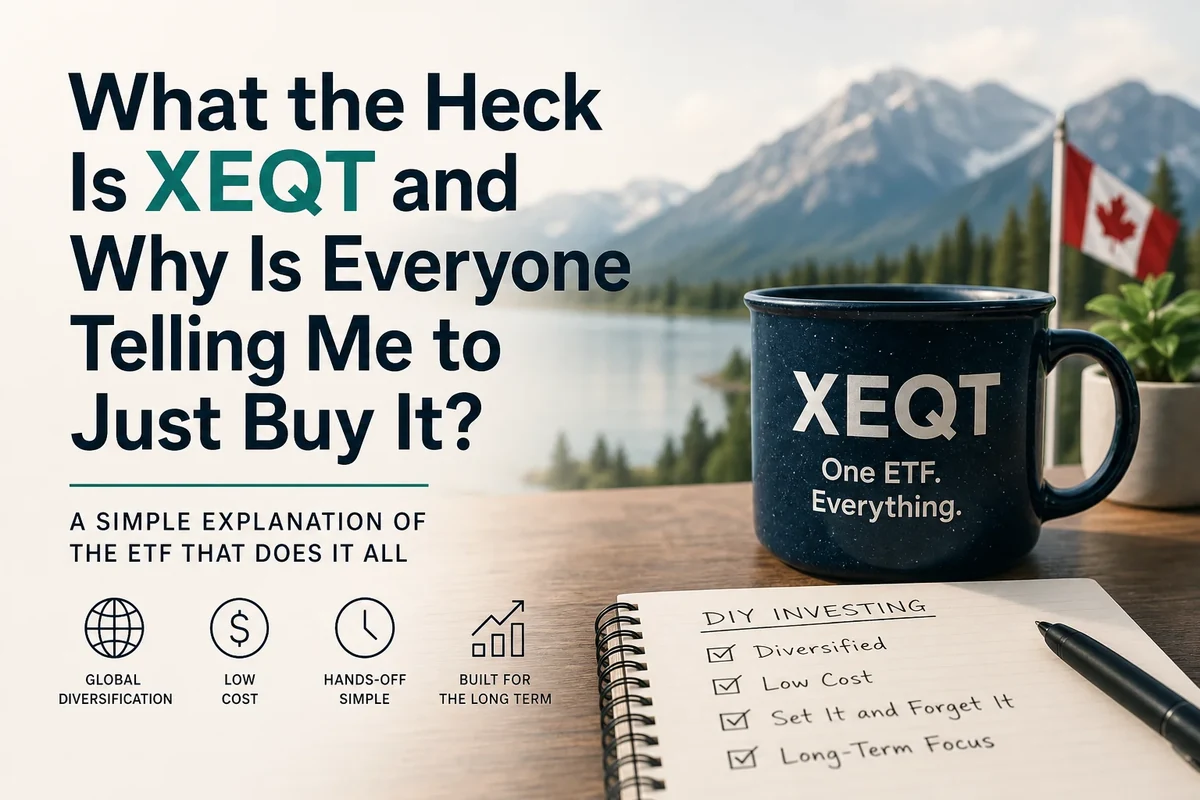
You’re at brunch. Someone mentions they’ve been investing in something called XEQT. You nod like you know what it is. You don’t. You go home, type it into Google, and end up on a page full of MERs and basis points and “fund-of-funds structures” that somehow makes you feel dumber than when you started. This article is for that moment.
Here is what XEQT actually is, explained the way a knowledgeable friend would explain it over coffee, without the jargon wall.
Let’s Start With What an ETF Even Is
Before XEQT makes sense, you need to know what an ETF is. An ETF, or exchange-traded fund, is essentially a basket of investments you can buy as a single unit on the stock market. Instead of buying shares of Apple, and then Microsoft, and then Shopify, and then 9,000 other companies one by one, you buy one ETF and it holds all of them for you. The price moves with the value of everything inside it.
Think of it like buying a fruit basket instead of picking out individual oranges. You get the whole thing, in the right proportions, for a single price.
ETFs have been around for decades, but they went from niche financial instrument to mainstream investing tool in the 2010s, partly because the fees got extremely low and partly because study after study showed that simply owning the market beats trying to outsmart it. That second point matters a lot for understanding why XEQT exists.
Okay, So What Actually Is XEQT?
XEQT is the ticker symbol for the iShares Core Equity ETF Portfolio, a fund managed by BlackRock Canada, which is the Canadian arm of the world’s largest asset manager. It trades on the Toronto Stock Exchange in Canadian dollars, and it does one thing extremely well: it gives you ownership of thousands of companies across the entire globe, in a single purchase, for a cost so low it borders on embarrassing.
When you buy one share of XEQT, you are buying a sliver of roughly 9,000 companies spread across Canada, the United States, Europe, Japan, emerging markets, and more. Companies like Royal Bank of Canada, Apple, Nestlé, Toyota, Samsung, and thousands of smaller firms you have never heard of. You own a tiny piece of all of them, automatically, without researching a single one.
What’s inside XEQT: ~45% U.S. equities, ~25% Canadian equities, ~25% international developed markets (Europe, Japan, Australia, etc.), ~5% emerging markets (China, India, Brazil, etc.). MER: 0.20% per year. Current price: approximately $45 CAD per share.
Under the hood, XEQT holds four underlying iShares ETFs: XUU for U.S. stocks, XIC for Canadian stocks, XEF for international developed markets, and XEC for emerging markets. BlackRock bundles these together and automatically keeps them in the right proportions. You never have to touch any of it. That is genuinely the whole job.
Why Does Everyone Keep Saying “Just Buy XEQT”?
If you have spent any time on Canadian personal finance forums, especially Reddit’s r/PersonalFinanceCanada, you’ve seen this phrase used constantly. Someone asks what stocks to pick, someone else says “just buy XEQT.” Someone asks how to start investing with $500, the answer is “just buy XEQT.” Someone panics about a market crash, the reply is, predictably, “just buy XEQT.”
It sounds dismissive. It is actually solid advice dressed up in meme clothes.
The reason it resonates is that most of the complexity in investing is a trap. Picking individual stocks sounds sophisticated, but decades of research show that most professional fund managers can’t consistently beat a simple index fund over a 10- to 20-year horizon. The S&P SPIVA Canada scorecard, which tracks this every year, has consistently found that the majority of actively managed Canadian equity funds underperform their benchmark over a 10-year period. If the professionals can’t do it reliably, the odds that you’ll do it in your spare time are not great.
The “just buy XEQT” crowd isn’t saying investing is simple. They’re saying the smartest version of investing is simpler than the finance industry wants you to believe.
XEQT is the product that embodies this philosophy. You buy it, you hold it, you keep adding money, you don’t touch it when markets drop, and you let decades of compounding do the work. The appeal to younger Canadians specifically comes from the fact that simplicity is a feature, not a flaw, especially when you’re managing rent, a mortgage, student loans, and everything else life throws at you in your 20s and 30s.
How Is This Different From What My Bank Sells Me?
This is the part where it gets a little uncomfortable. Your bank probably has a financial advisor who has offered you mutual funds. These funds do roughly the same thing XEQT does, in the sense that they hold a collection of stocks or bonds. The difference is in the cost, and the cost difference is staggering.
According to Morningstar data, the average management expense ratio (MER) for Canadian equity mutual funds has historically been between 2% and 2.5% per year. XEQT’s MER is 0.20%. That difference, which sounds small in percentage terms, turns into a very large number over time.
On a $100,000 portfolio, a 2% MER costs you $2,000 per year. XEQT’s 0.20% costs you $200 per year. That $1,800 annual gap, compounded over 30 years, represents a genuinely significant chunk of your retirement savings, quietly handed to fund companies and advisors instead of sitting in your account. If you want to understand the full math, there’s a detailed breakdown of what XEQT’s fees actually cost in real dollars, and the numbers are worth sitting with.
The other difference is that your bank’s actively managed mutual funds employ analysts trying to pick winning stocks and time the market. Research consistently shows this does not work reliably over long periods. You pay more for a service that, on average, delivers less. That is not a cynical take, it is a well-documented finding that shows up in the data year after year.
The fee gap in real dollars: On a $250,000 portfolio, XEQT’s 0.20% MER costs roughly $500/year. A typical Canadian mutual fund at 2% MER costs $5,000/year. Same money. Same market. Very different outcome over 30 years.
What Accounts Can I Hold XEQT In?
This is where Canadians have a significant advantage, because our registered account system is genuinely excellent and XEQT works inside all of it.
The TFSA, or Tax-Free Savings Account, is the most obvious place to start. You can contribute $7,000 per year in 2026, and any growth inside the account is completely tax-free when you withdraw. You don’t pay capital gains tax on a $50,000 profit if it happened inside your TFSA. That is an enormous benefit, and holding a growth-oriented fund like XEQT inside it makes that benefit count.
The RRSP, or Registered Retirement Savings Plan, is the other major account. You can contribute 18% of your prior year’s earned income, up to a maximum of $32,490 for 2026. Contributions reduce your taxable income today, meaning you get a tax refund now, and you pay tax only when you withdraw in retirement, presumably at a lower rate than your working years. For XEQT specifically, the RRSP also eliminates the 15% withholding tax on U.S. dividends under the Canada-U.S. tax treaty, which is a small but real efficiency gain that the TFSA doesn’t offer.
If you’re saving for your first home, the FHSA, or First Home Savings Account, lets you contribute $8,000 per year up to a $40,000 lifetime limit. You get the tax deduction on the way in and tax-free withdrawal when you buy your first home. Holding XEQT in an FHSA while you save is a reasonable approach if your home purchase timeline is at least a few years away.
What Does “Automatic Rebalancing” Mean, and Why Should I Care?
This is one of XEQT’s genuinely underappreciated features, and it matters more than it sounds. When you hold multiple investments, their values drift over time. If U.S. stocks have a great year, your U.S. allocation might swell from 45% of your portfolio to 55%. Technically, you should sell some U.S. holdings and buy more of the underperforming parts to get back to your target mix. This is called rebalancing, and it is one of the things that most investors either forget to do, do wrong, or do at exactly the wrong emotional moment.
XEQT handles this automatically. BlackRock’s team monitors the underlying allocations and rebalances continuously, at the fund level, without you taking any action. You never have to decide whether now is a good time to shift from U.S. to Canadian stocks. You never have to place multiple trades to maintain a ratio. You just hold the fund.
Most investing mistakes happen during the moments when you feel most compelled to act. A fund that requires no action removes a surprising number of those moments.
This structural simplicity has real behavioural value. Studies on investor behaviour, including work by Vanguard, consistently show that the average investor earns meaningfully less than the funds they hold, because they buy and sell at the wrong times. A one-fund portfolio with nothing to tinker with is a genuine protection against your own worst instincts.
Is XEQT Actually Safe? What Happens If It Drops?
Two different questions, and worth answering separately.
XEQT is not “safe” in the sense that a savings account or GIC is safe. It is 100% equities, meaning it holds only stocks and no bonds. When global stock markets fall, XEQT falls with them. BlackRock’s own published return data shows XEQT was down 10.93% in 2022, then up 17.05% in 2023, up 24.67% in 2024, and up 20.45% in 2025. Those swings are normal for a fully invested equity portfolio. If you need money in one or two years, XEQT is probably not the right place for it.
But here is the more important point: because XEQT holds roughly 9,000 companies across dozens of countries, it cannot be destroyed by any single company’s failure, or even any single country’s economic problems. Enron collapses, you barely notice. A Canadian bank has a rough year, the portfolio absorbs it. The global diversification is a genuine structural protection that no individual stock position can offer.
The risk with XEQT is broad market risk, meaning the whole world has a bad year financially. That happens. It has always eventually recovered. The investors who got hurt were the ones who sold at the bottom. That is the one real danger, and it is entirely a behavioural risk, not a structural one.
Bottom line on risk: XEQT can and will drop in bad markets. The right response is to keep buying and stop watching. Every market downturn in history has eventually been followed by a recovery. XEQT is only the wrong choice if your time horizon is too short to wait one out.
How Do I Actually Buy XEQT?
You need a brokerage account. In Canada, the two most beginner-friendly options are Wealthsimple and Questrade. Both allow you to open a TFSA or RRSP account online in about 15 minutes, and both let you buy ETFs like XEQT without paying a commission on the trade.
On Wealthsimple, you open an account, transfer money in, search for “XEQT,” enter how many shares you want to buy, and confirm. One share costs around $45 CAD at current prices, so even a modest contribution goes a long way. On Questrade, the process is similar, and ETF purchases are free (though selling does carry a small fee).
Once you own shares of XEQT, you hold them. You set up a regular monthly contribution if you can. You do not check the price every day. You do not sell when the news is scary. You add more when you have more money. That is genuinely the entire strategy, and it is one that has worked remarkably well for the investors patient enough to follow it. If you want to understand why this philosophy resonates so deeply in Canadian finance circles, the history of the “just buy XEQT” mantra is worth reading.
The hardest part of owning XEQT is not picking it. It’s staying in it when everything feels uncertain. That’s where most investors lose the advantage that the fund itself provides.
Frequently Asked Questions
Is XEQT good for beginners? XEQT is arguably the most beginner-appropriate investment available to Canadians. It requires no stock-picking knowledge, no ongoing rebalancing, and costs a fraction of what most alternatives charge. The main requirement is a long enough time horizon, generally five years minimum, but ideally ten or more.
What is the minimum amount needed to buy XEQT? Since XEQT trades as individual shares on the Toronto Stock Exchange, the minimum is the price of one share, currently around $45 CAD. Some brokerages, including Wealthsimple, also offer fractional shares, which means you can start with as little as $1. There is no practical barrier to entry for most Canadians.
Does XEQT pay dividends? XEQT does distribute income quarterly, reflecting dividends received from the thousands of companies it holds. These distributions are modest because XEQT is designed primarily for capital growth, not income. If you hold XEQT inside a TFSA or RRSP, those distributions are either tax-free or tax-deferred, depending on the account. Note that XEQT is structured as a trust, so its distributions appear on a T3 slip at tax time, not a T5.
What is the difference between XEQT and VEQT? Both are all-equity, globally diversified, all-in-one ETFs designed for long-term Canadian investors. VEQT is Vanguard’s version, XEQT is BlackRock’s. The main differences are a slightly lower MER on XEQT (0.20% versus 0.25% for VEQT) and a marginally higher allocation to international markets in XEQT compared to VEQT’s heavier Canada weighting. Both are excellent choices. The decision of which to own matters far less than the decision to simply start.