
RRSP or TFSA First? The Decision Tree Canadians Actually Need
July 13, 2026

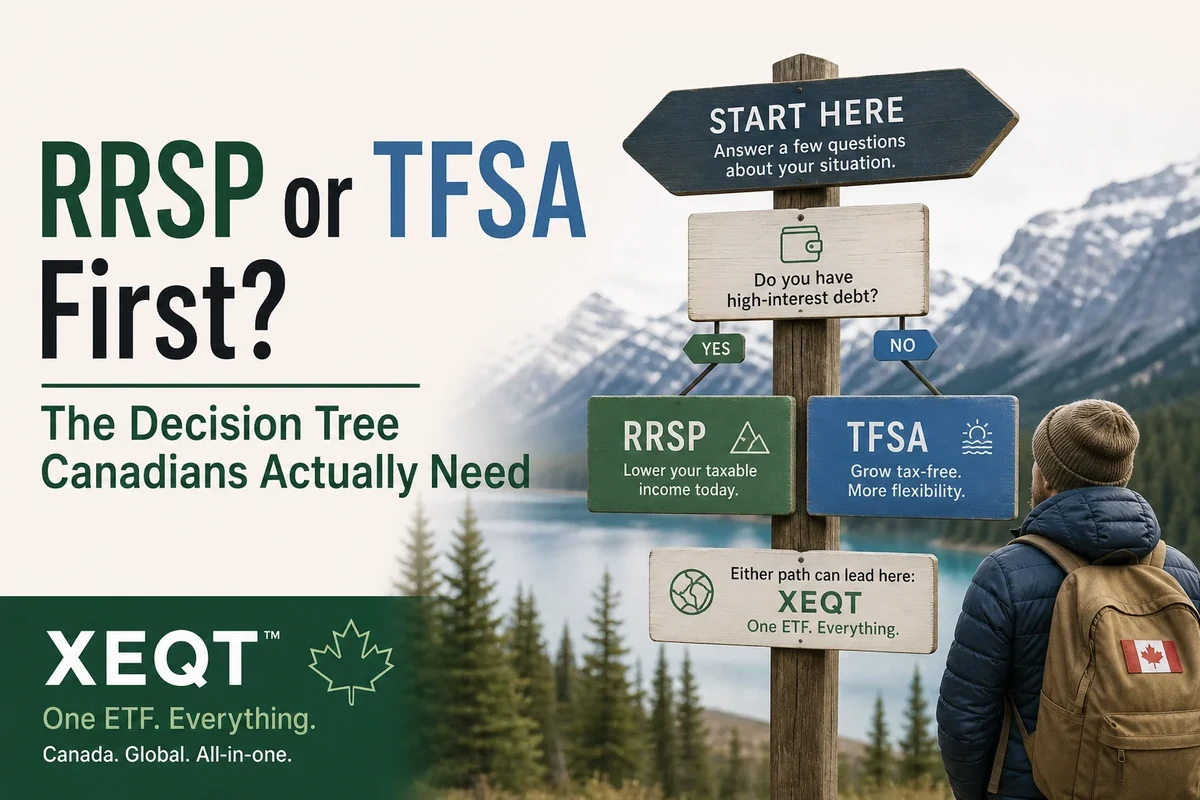
The advice you’ve probably heard goes something like this: if you earn over $75,000, put money in your RRSP first because you’re in a high bracket now and you’ll be in a lower one at retirement. That logic is correct as far as it goes. The problem is that it doesn’t go far enough, it leaves out the variable that flips the answer for millions of Canadians: what your retirement income will actually look like once CPP, OAS, and any workplace pension are stacked on top of your RRSP withdrawals.
The decision between RRSP and TFSA isn’t really about what you earn today. It’s about the gap between your tax rate today and your effective tax rate in retirement. Get that gap right, and the rest of the framework follows naturally.
Why “High Income = RRSP First” Is Incomplete Advice
The standard framing treats your retirement income as a blank slate. You contribute to your RRSP while earning $95,000, get a deduction at your marginal rate, then withdraw in retirement at a much lower rate. Clean arbitrage. Except retirement income in Canada is rarely a blank slate.
By the time most Canadians reach 65, they are collecting CPP, OAS, and potentially a workplace pension. That combination generates meaningful taxable income before you touch a single registered account. Add $30,000 in annual RRSP or RRIF withdrawals on top and you can move through bracket thresholds faster than most people expect. Add another layer and you risk colliding with the OAS clawback, which begins at approximately $95,000 in net income and claws back $0.15 for every dollar above that threshold.
The bracket compression in retirement is real, but it is much smaller than many people assume. For some Canadians, their effective retirement tax rate ends up higher than their rate during working years, particularly those who worked irregular or lower-income years early in their careers, built a substantial RRSP during their peak earning years, and now face RRIF minimum withdrawals that stack uncomfortably with CPP, OAS, and any pension income.
The RRSP is not a tax elimination strategy. It is a tax deferral strategy. The question you need to answer is: what rate will you pay when you finally settle that deferred bill?
The Pension Wildcard: How a DB Plan Changes Everything
If you have a defined benefit pension, and roughly two million Canadians do, primarily in the public sector, the RRSP-first logic often falls apart entirely. Here is why.
Suppose your pension pays $30,000 per year in retirement. That income is already taxable. Now you need another $30,000 to cover living expenses. If that second $30,000 comes from RRSP or RRIF withdrawals, your combined taxable income sits at $60,000, attracting a combined federal and provincial marginal rate that, in Ontario, runs close to 29%. If that same $30,000 comes from your TFSA instead, it is invisible to the CRA. Your taxable income stays at $30,000, your average effective rate on it is substantially lower, and you preserve both OAS eligibility and any GIS buffer. Research based on Ontario tax rates, cited in retirement withdrawal planning literature, suggests the annual after-tax difference between these two scenarios can reach several thousand dollars, a gap that compounds across a 25-year retirement into a very material sum.
DB pensions also reduce your RRSP room directly through the Pension Adjustment. A teacher or federal public servant may find their annual RRSP room reduced to a few hundred dollars or even zero after the PA is applied. If you are in that position, the RRSP-versus-TFSA debate is largely theoretical: your contribution room is already constrained, and the TFSA becomes your primary wealth-building vehicle by default.
DB pension + RRSP withdrawal interaction: A $30K pension combined with $30K in annual RRSP or RRIF withdrawals puts you at $60K in taxable income. The same $30K drawn from a TFSA keeps taxable income at $30K, protecting OAS eligibility and GIS status. Run this number with your own provincial rates before defaulting to RRSP-first.
Your Personal Tax Bracket Map: Current vs. Retirement
Before choosing which account to prioritize, you need two numbers: your current marginal tax rate, and an honest estimate of your retirement marginal tax rate. These are not the same as your average rate, and most Canadians confuse them.
Your current marginal rate is the rate you pay on the last dollar of income you earn. In Ontario in 2026, the combined federal and provincial rate is approximately 29% for income in the middle brackets and rises above 43% for income over $220,000. An RRSP contribution at the 43% rate returns roughly $430 in immediate tax savings for every $1,000 contributed. That is an immediate, guaranteed return that makes RRSP contributions very attractive at high incomes.
Your retirement marginal rate requires more work to estimate. Take what you expect to receive from CPP, OAS, any pension, and any part-time income. That sum tells you the floor of your taxable income in retirement before a single dollar of RRSP is withdrawn. The next layer is your RRIF minimum withdrawals, which become mandatory at 72 and increase each year as a percentage of the account balance. If your RRIF is large, those minimums can force significant taxable income even in years when you do not need the money. The OAS clawback begins at approximately $95,000 in net income, a threshold that catches more retirees than expected when RRIF minimums, CPP, OAS, and pension income collide in the same year.
If your estimated retirement marginal rate is clearly lower than your current rate, lean into the RRSP. If the gap is narrow or uncertain, the TFSA’s flexibility has real value, because tax-free income gives you control over your taxable income in retirement that RRSP money simply cannot provide.
The Three-Layer Framework: How to Stack Your Contributions
For most Canadians who are not first-time home buyers, the contribution order looks like this: employer match, then TFSA, then RRSP scaled to your marginal bracket, then consider the FHSA if eligible.
The employer match, if you have one, comes before everything else. A group RRSP or DPSP match is the only guaranteed 100% return available to a Canadian investor. Leaving it on the table to prioritize a TFSA is a genuine mistake.
After that, the TFSA goes first for most people, particularly anyone earning under $60,000, anyone with a DB pension, or anyone uncertain about their retirement income trajectory. The TFSA is the most structurally flexible account in Canada. Withdrawals do not affect OAS eligibility, do not trigger GIS clawbacks, do not count toward OAS repayment thresholds, and do not interact with income-tested benefits. That flexibility has real dollar value in retirement that no simple spreadsheet comparison captures cleanly.
The RRSP layer then scales with your marginal bracket. If you are firmly in the 40%-plus combined bracket, contributing enough to bring your taxable income down to the next bracket threshold is generally worthwhile. A meaningful RRSP contribution that saves tax today, invested for decades in a low-cost all-in-one ETF like XEQT, which holds over 9,000 global equities at a 0.20% MER and is covered in detail in our guide to Canada’s best all-in-one ETFs, compounds substantially. The deduction at 43% and the withdrawal at 20% is a powerful long-run trade. But contributing to an RRSP at a 29% rate to withdraw at 25% is a much thinner trade, especially given the loss of flexibility.
2026 registered account limits: TFSA: $7,000 per year, $109,000 cumulative lifetime room (since 2009). RRSP: 18% of prior year’s earned income, maximum $32,490. FHSA: $8,000 per year, $40,000 lifetime, with a maximum of $8,000 in carry-forward room per year. Always capture any employer match before funding anything else.
The Carry-Forward Trap: Why “I’ll Max It Later” Costs You
RRSP and TFSA carry-forward rules look similar on the surface, unused room accumulates and you can use it later. But they work differently in practice, and that difference has real consequences for how Canadians behave.
RRSP room is cumulative and unlimited. Statistics Canada found Canadians held over $633 billion in unused RRSP contribution room as of 2012, and that figure has almost certainly grown significantly since. The infinite carry-forward sounds generous, but it creates a behavioural problem: because the room never expires, many people treat RRSP contributions as optional and perpetually deferrable. The opportunity cost of a missed year in your 30s, when compound growth has the most time to work, is not recovered by a larger contribution in your 50s, regardless of how much room you carry forward.
TFSA room also carries forward, but the annual addition of new room each January 1 means the total available room grows every year regardless of your behaviour. Missing a year does not destroy the room, but the growth those dollars would have generated inside the tax shelter is gone permanently. That missed tax-free compounding is a silent cost that never shows up on a statement, which is part of why Canadians chronically underuse TFSAs despite understanding how they work.
The RRSP’s unlimited carry-forward is a design feature that inadvertently trains Canadians to procrastinate. Every year of delay in your 30s is a year of compound growth that you cannot retrieve at any marginal tax rate.
The practical fix is to automate contributions to both accounts at the start of the year, not at the RRSP deadline in February. Deadline contributions are lump sums that have been sitting uninvested, often in a chequing account, for months. A consistent monthly approach, as outlined in our Canadian monthly investing framework, beats deadline scrambling over any multi-decade window.
When the Standard Order Breaks Down
The TFSA-first default does not hold in every situation. Three cases deserve specific attention.
Low-income Canadians who expect to qualify for the Guaranteed Income Supplement in retirement should treat RRSP contributions with particular caution. The GIS is a means-tested benefit for low-income seniors. Once your taxable income exceeds $5,000, GIS begins clawing back at roughly $0.50 for every dollar of taxable income over that threshold. An RRSP withdrawal in retirement counts as taxable income and directly reduces GIS payments. A TFSA withdrawal does not. For a future GIS recipient, even modest RRSP contributions during working years can result in a clawback that neutralizes the original tax deduction. The TFSA is unambiguously the better vehicle in this scenario.
Spousal income splitting changes the RRSP math in the other direction. If you earn $130,000 and your spouse earns $35,000, contributing to a spousal RRSP, up to your own contribution limit, allows the lower-income spouse to withdraw those funds in retirement at their lower marginal rate. Done correctly over several years, this can shift meaningful income from a high bracket to a lower one. It is one of the most effective and underused tax optimization strategies available to Canadian couples, and it makes RRSP prioritization very rational even for high earners with a lower-income partner.
Canadians approaching retirement with a large RRSP and limited TFSA room face a different challenge: forced RRIF withdrawals that push income into clawback territory. If you are between 60 and 71 and in this situation, drawing down the RRSP early in years when your income is temporarily low can reduce future RRIF minimums, preserve OAS, and smooth your tax bill across retirement. This is not an argument against building an RRSP, it is an argument for managing it actively rather than assuming maximum deferral is always optimal.
The FHSA Reorder: Where First-Time Buyers Should Put It
If you are a first-time home buyer, or reasonably expect to become one within the next 15 years, the FHSA belongs above the RRSP in your priority stack, and arguably above the TFSA for the years you are actively building toward a purchase.
The FHSA combines a tax deduction on contributions (like the RRSP) with completely tax-free withdrawals for a qualifying home purchase (like the TFSA). No other registered account in Canada does both simultaneously. For anyone in the 30% to 43% marginal rate range, an $8,000 annual FHSA contribution generates a substantial tax refund in the year of contribution, which can then be reinvested, growing tax-free until withdrawn for a home purchase at zero tax. That compounding of government subsidy at both ends of the transaction is genuinely unusual in the Canadian tax system.
The critical design constraint is the carry-forward cap: unused FHSA room accumulates at a maximum of $8,000 per year. You can never carry forward more than $8,000, regardless of how many years you have left unclaimed. This means opening the account early, even with a token contribution, is the single most important FHSA action, because contribution room only starts accumulating from the year you open the account. Our full guide to the FHSA and what to invest inside it covers the mechanics in detail.
For Canadians who never end up buying a home, the FHSA functions as a de facto bonus RRSP. You can transfer the full balance to your RRSP or RRIF without touching your existing contribution room. There is almost no scenario where an eligible Canadian should not open one.
When Both Shelters Are Full: Non-Registered Accounts
A small fraction of Canadians max both their TFSA and RRSP annually. If you reach that point, the question becomes which assets to hold in a taxable account and how to place them efficiently.
The general principle is to shelter the least tax-efficient assets inside registered accounts and hold the most tax-efficient assets in non-registered. Canadian equities benefit from the dividend tax credit in a non-registered account, making them comparatively efficient to hold outside a shelter. Interest income from bonds or GICs is taxed at your full marginal rate and belongs inside a registered account before almost anything else. US-listed ETFs generate foreign dividends that are taxed as ordinary income in non-registered accounts and lose approximately 15% to withholding tax in a TFSA, but that withholding is fully eliminated in an RRSP, where the Canada-US tax treaty applies.
For most Canadians using a single all-in-one ETF across all accounts, the simplicity benefit outweighs the marginal efficiency gains from detailed asset location. XEQT’s 0.20% MER and automatic rebalancing mean you are not paying for complexity you do not need. The withholding tax friction on US dividends inside a TFSA is real but modest in the context of the overall portfolio, and it does not justify building a multi-account, multi-ETF structure unless your portfolio is very large.
Asset location optimization is the last 5% of the performance picture. Get the first 95% right by maximizing tax-sheltered room, investing consistently, and not selling during corrections. The RRSP versus TFSA order matters. The exact ETF within each account matters far less.
Frequently Asked Questions
Should I prioritize RRSP or TFSA if I earn $80,000 a year?
At $80,000 in Ontario, your combined federal and provincial marginal rate is roughly 31.5%. RRSP contributions are worthwhile to capture deductions at that rate, but the TFSA should not be neglected alongside them. A reasonable approach is to contribute enough to your RRSP to capture any deduction above 30%, then direct remaining savings to your TFSA. If you have a DB pension or expect significant CPP income, lean further toward the TFSA.
Does a defined benefit pension mean I should skip the RRSP entirely?
Not entirely, but DB pensions reduce your RRSP room through the Pension Adjustment and raise your retirement income floor. Both effects make the TFSA relatively more attractive. If your DB pension combined with CPP would already push your retirement taxable income above $50,000 annually, additional RRSP withdrawals in retirement will face meaningful tax. Prioritizing your TFSA room before building a large RRSP balance is a sound approach in this case.
Can I contribute to both RRSP and TFSA in the same year?
Yes, and for most Canadians in the accumulation phase, contributing to both is the right move. The RRSP and TFSA have entirely separate contribution limits, and contributing to one does not reduce your room in the other. The question is which to prioritize with limited dollars, not whether to use one exclusively.
What if I am planning to buy a home in the next five to ten years?
Open an FHSA immediately if you have not already, even with a small contribution. Contribution room begins accumulating from the year you open the account, not from the year you contribute meaningfully. For a purchase within five years, the FHSA should absorb $8,000 per year before additional TFSA or RRSP contributions. For a purchase in the ten to fifteen year range, the FHSA still takes priority, but TFSA contributions in parallel are sensible given the uncertainty of the timeline.