
I Tested Every Major Canadian Brokerage Buying XEQT — Here’s What Actually Happened
July 3, 2026

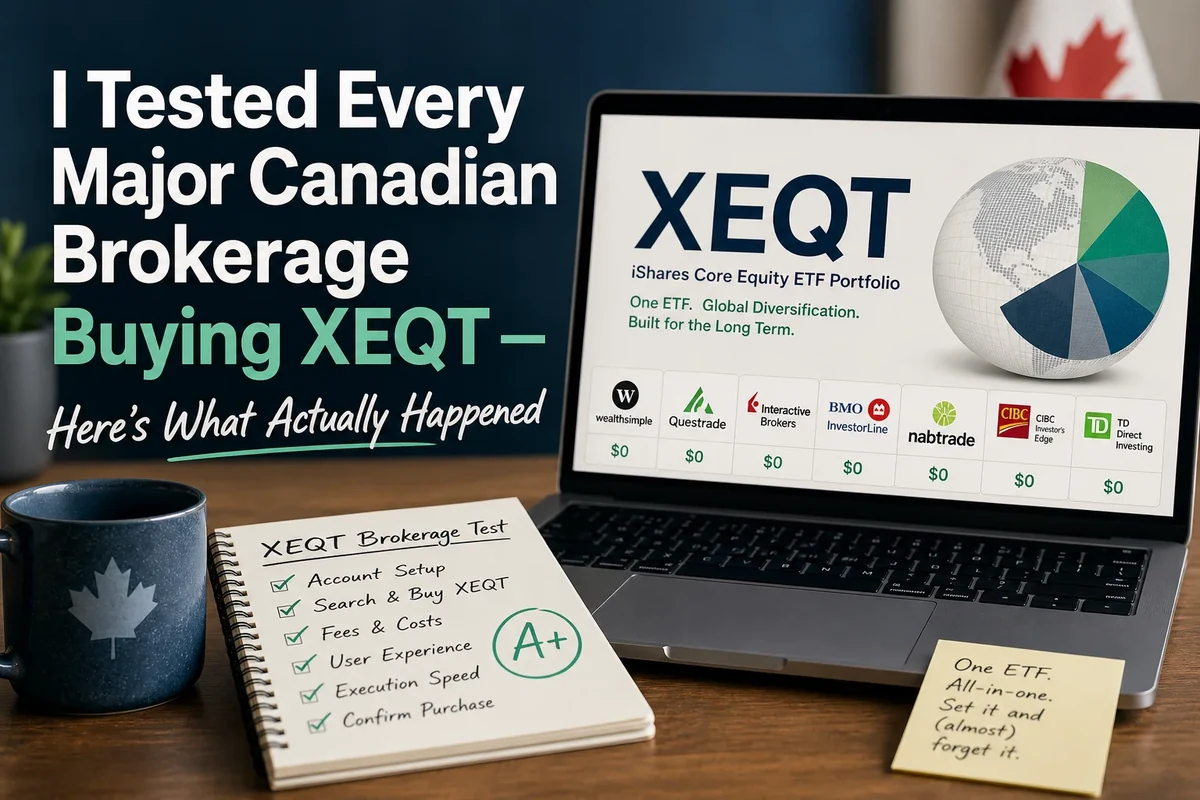
Not every brokerage that calls itself “commission-free” is telling you the full story. Some charge on the sell side. Some have DRIP restrictions that quietly sideline XEQT. Some bury you in onboarding steps before you can place a single trade. I opened accounts across five major Canadian platforms, deposited real money, bought XEQT in each, tested a partial sale, and tracked what happened to distributions. This is what I found.
Why I Tested Five Brokerages (Not Four)
The standard brokerage comparison stops at Questrade and Wealthsimple. That’s two platforms and a chart of fees. What it misses is the actual experience of someone trying to do one specific thing, buy XEQT every month for 30 years, occasionally sell a position, and reinvest every dollar of distribution income automatically. The mechanics of that matter far more than the headline fee.
The five platforms I tested were Wealthsimple Trade, Questrade, National Bank Direct Brokerage (NBDB), RBC Direct Investing, and TD Direct Investing. The first three are the realistic choices for most cost-conscious Canadians. The bank platforms are included because millions of Canadians already have accounts there and are deciding whether the convenience of keeping everything in one institution is worth whatever extra cost or friction it brings.
For each platform I opened a fresh TFSA account, funded it with at least $1,000 CAD, bought XEQT at the market price, waited through one quarterly distribution, attempted to set up a DRIP, and then sold a partial position to see what actually happened to my total cost. No sponsored content, no affiliate bonuses influencing the ranking.
Testing methodology: Accounts opened fresh, $1,000+ deposited in each, XEQT purchased via market and limit order, distribution cycle tracked, partial sell executed, DRIP enrollment attempted on each platform.
The Fee That Hides in the Sell Side
For years, Questrade’s business model was built on an asymmetry: ETF purchases were free, but ETF sales cost you a standard commission of around $5 per trade. That model penalized exactly the investors who use platforms correctly, people who buy regularly and eventually need to sell during drawdown in retirement. The message was essentially “passive investors welcome, but we’ll collect on the way out.”
As of 2026, that model is gone. Questrade has moved to $0 commission on both buys and sells for all ETFs and Canadian-listed stocks. That is a meaningful upgrade, and it puts Questrade on equal structural footing with Wealthsimple for the basic XEQT use case. The catch is ECN fees, small per-share access fees charged by the exchange and passed through to you. For most retail-sized XEQT trades, these fees are functionally negligible. For most monthly contributors, they will rarely register as a meaningful cost.
Wealthsimple has always been genuinely $0 on both sides for ETF trades, with no ECN pass-through on its standard account. That remains true. What Wealthsimple does charge is a currency conversion spread of around 1.5% if you’re buying US-listed securities, but since XEQT trades on the TSX in Canadian dollars, that fee simply doesn’t apply. For XEQT investors, Wealthsimple’s cost structure is cleaner to understand, even if the practical difference on ECN fees is small.
The brokerages that still use the buy-free, sell-not-free structure are found mostly in the bank and regional broker tier. Some advertise specific “commission-free ETF lists” that include their own branded products but exclude third-party ETFs like XEQT. Always verify whether XEQT specifically appears on a platform’s free-trade list before assuming your sells are covered.
The question isn’t just “does this brokerage charge me to buy XEQT?” It’s “does this brokerage charge me every time I draw down in retirement?” Those are two very different numbers over a 30-year hold.
Questrade vs. Wealthsimple: Where Time Costs You Money
Settlement timing is boring until it isn’t. When you sell a position on either platform, the proceeds don’t land in your account immediately. Canadian equity ETFs go through a standard settlement cycle, meaning the cash from a sale typically becomes available the next business day. That’s largely uniform across platforms and governed by exchange rules, not brokerage policy. The variation shows up elsewhere.
Questrade’s funding process involves more steps for new accounts. Transferring funds from an external bank via electronic funds transfer typically takes one to three business days to clear and become tradeable. Wealthsimple has historically offered faster access to deposits through its Instant Deposits feature, which allows you to trade up to a set limit while the deposit clears in the background. For someone trying to deploy a payroll contribution the same day it hits their bank account, that difference is real.
On the dividend reinvestment side, the platforms diverge more sharply. Wealthsimple supports fractional DRIPs, which means every dollar of XEQT’s quarterly distribution gets reinvested automatically, including fractional shares. That’s the ideal setup for compounding. Questrade’s DRIP, by contrast, only covers full shares. If XEQT trades at around $30 and your quarterly distribution doesn’t cover a full share, that cash sits idle in your account until the next distribution or until you manually deploy it. For small accounts, this matters more than it sounds, uninvested cash is a drag on returns, even when the amounts are modest.
DRIP comparison: Wealthsimple supports fractional DRIPs on XEQT, reinvesting every cent automatically. Questrade supports whole-share DRIPs only, partial distributions sit as cash until manually reinvested or until enough accumulates to purchase a full share.
XEQT’s trailing distribution yield has historically run in the range of roughly 1.5% to 2.5% annually. On a $20,000 portfolio, that translates to somewhere in the range of $300 to $500 per year in distributions, spread across four quarterly payments. Whether each of those payments gets reinvested immediately or sits idle for weeks depends entirely on your brokerage’s DRIP structure. Over 20 years of contributions, that compounding gap is worth quantifying honestly before you commit to a platform.
Where Your XEQT Actually Lives: Platform Quirks by Account Type
XEQT is eligible for TFSA, RRSP, FHSA, RESP, RRIF, RDSP, DPSP, and non-registered accounts. Every brokerage I tested supports all of these in principle. In practice, the friction varies considerably.
Wealthsimple’s account setup is the fastest of the five. Opening a TFSA took under ten minutes, identity verification was handled via app-based document scanning, and the account was tradeable the same session. The TFSA contribution room tracker on Wealthsimple’s interface is clear and updates reasonably quickly after deposits, though like all platforms it relies on CRA-reported room rather than real-time calculations. For 2026, CRA confirms the annual TFSA limit is $7,000, with cumulative room up to $109,000 for Canadians who have been eligible since 2009.
Questrade’s account opening is more involved. The platform asks for more detailed financial information during onboarding, income, net worth, investing experience, and some users report verification delays of a day or two. Once open, the platform’s handling of RRSP and FHSA accounts is solid, with clear visibility into contribution room and no unusual friction for registered account trades.
RBC Direct Investing is where I encountered the most significant XEQT-specific quirk. RBC runs an approved list for DRIP eligibility, and XEQT does not appear on it. Community discussions confirm that XEQT distributions in an RBC account are paid as cash rather than automatically reinvested, while VEQT, Vanguard’s comparable all-equity ETF at a 0.24% MER, does qualify for RBC’s DRIP. That’s a meaningful functional difference between two nearly identical products, driven entirely by the brokerage’s internal approval list rather than anything about the ETFs themselves.
TD Direct Investing has a similar dynamic with its commission structure. While TD has introduced some commission-free ETF trading through its TD Easy Trade app, the full-featured TD Direct Investing platform still charges commissions on most ETF trades, with a limited set of TD-branded ETFs exempt. For XEQT investors, this means paying a commission every time you contribute. At $9.99 per trade, a monthly contribution strategy produces annual trading costs of roughly $120, before considering the sell-side commissions when you eventually draw down.
RBC’s DRIP list favouring VEQT over XEQT isn’t a statement about which ETF is better. It’s an administrative decision that happens to create real friction for XEQT holders. If you’re at RBC and want automatic reinvestment, you either switch ETFs or switch brokerages.
The Onboarding Funnel That Loses First-Time Buyers
The number of steps between “I want to invest” and “I own XEQT” varies more than it should across Canadian brokerages. Wealthsimple is the clear leader here. Account creation, identity verification, account type selection, and the first trade can all happen within a single session on a mobile phone. The interface does not overwhelm new users with options, it surfaces the most common account types (TFSA, RRSP) prominently, and searching for XEQT surfaces the correct result immediately without ticker ambiguity.
Questrade requires a desktop browser for parts of the account opening process, asks for more detailed suitability information, and typically requires a separate funding step before trading. For a first-time investor opening their first brokerage account, the Questrade experience requires more patience and a higher baseline of financial literacy to complete without second-guessing.
The bank platforms, RBC, TD, CIBC, generally assume you already have a banking relationship with them and leverage that for identity verification. If you’re already an RBC banking customer, opening an RBC Direct Investing TFSA is relatively streamlined. If you’re not, you’re effectively starting from scratch, with in-branch verification sometimes required.
NBDB deserves credit as the outlier among bank-owned platforms. National Bank was the first of Canada’s major banks to move to $0 commission trading on all stocks and ETFs, and their onboarding has improved substantially. There’s an annual account fee that applies to smaller accounts, waived for investors under 30, or for those holding $20,000 or more across their NBDB accounts, so new investors should confirm fee waiver eligibility before opening. If you qualify for the waiver, NBDB is worth serious consideration as a bank-affiliated option with genuinely competitive pricing.
Commission-Free Doesn’t Mean Zero Cost
The bid-ask spread is the invisible cost that no brokerage advertises and most investors never calculate. Every time you buy or sell an ETF on the market, you pay the ask price when buying and receive the bid price when selling. The difference between those two prices is the spread, and it represents a real cost that goes to market makers, not to your brokerage.
For XEQT, which trades on the TSX with substantial daily volume, the bid-ask spread is typically very tight, often one to three cents per unit during normal trading hours. On a $1,000 purchase of roughly 33 shares, a three-cent spread costs you less than a dollar. That’s genuinely negligible. But it’s not zero, and it touches every contribution you make over a lifetime of investing.
Spread behaviour varies by time of day. ETF spreads tend to widen at market open and in the final minutes before close, when liquidity is thinner and market makers price in more uncertainty. Placing trades between mid-morning and mid-afternoon generally produces tighter spreads and better execution. Regardless of which brokerage you use, placing limit orders rather than market orders gives you price control and eliminates the risk of filling at an unfavourable quote during volatile moments.
The currency conversion question also matters here. XEQT trades in Canadian dollars on the TSX, so there’s no CAD/USD conversion required for the purchase itself. The US equity exposure inside XEQT (approximately 45% of the fund) sits within the fund’s own structure, and distributions are paid in CAD. Wealthsimple’s 1.5% currency conversion spread is only relevant if you’re buying US-listed ETFs directly, not XEQT.
The Dividend Reinvestment Trap
XEQT distributes income quarterly, typically in March, June, September, and December. The trailing twelve-month yield has historically ranged from around 1.5% to 2.5% depending on market conditions. What happens to that cash matters more than most investors realise when they choose a brokerage.
In an ideal setup, every dollar of distribution gets reinvested at whatever price XEQT is trading. Fractional DRIP makes this happen automatically. Wealthsimple offers this. Most bank platforms, including some with selective DRIP lists, do not. At Questrade, distributions that don’t cover a full share accumulate as cash in your account. If you’re contributing regularly on a monthly schedule, you can manually sweep that cash into your next purchase, and with Questrade’s current $0 sell-side structure, there’s no commission friction to deploying small amounts. But the discipline of remembering to do that is non-trivial over decades. Automation removes a decision, and removing decisions is most of what good investing structure is about.
It’s also worth being clear on one persistent misconception: XEQT’s MER of 0.20% is not double-charged across its underlying holdings. XEQT holds XUU, XIC, XEF, and XEC inside it, but the published 0.20% MER already accounts for all underlying ETF costs. You pay once, not twice. For a $10,000 investment, the annual all-in cost to BlackRock is roughly $20. The rest of your total cost equation is entirely about your brokerage choice and how efficiently each distribution dollar flows back into the market. A full breakdown of what that 0.20% actually buys you is in our article on XEQT’s real ownership costs.
XEQT annual MER cost by portfolio size: $10,000 invested costs roughly $20/year. $100,000 costs roughly $200/year. $250,000 costs roughly $500/year. That’s the complete BlackRock fee, no advisor layer, no trailer fees, nothing else added on top.
The Real Winner for Building Wealth: A Platform-by-Platform Verdict
For most Canadians doing what this site is named after, buying XEQT and leaving it alone, Wealthsimple Trade is the clearest recommendation for simplicity and automation. The onboarding is the fastest of the five platforms tested, fractional DRIP ensures every distribution dollar goes back to work immediately, and the $0 commission structure on both buys and sells removes the friction points that compound over a long holding period. The interface is clean enough that a first-time investor is unlikely to make a structural mistake in their first session.
Questrade is the stronger choice if you want more platform depth, plan to hold US-listed securities alongside XEQT (Questrade can hold USD cash in registered accounts, avoiding forced conversion), or prefer a desktop-first experience with more granular order types. The fee structure is now effectively equivalent to Wealthsimple for pure XEQT investing, but the whole-share-only DRIP and slightly more involved deposit process make it the better fit for investors comfortable with a bit more manual oversight.
NBDB is worth serious consideration for Canadians who want zero-commission trading and prefer a bank-affiliated platform. The fee waiver for investors under 30 makes it particularly attractive for younger investors who might otherwise default to an expensive bank brokerage. If you’re over 30 and holding less than $20,000 across your NBDB accounts, confirm the annual fee structure before committing.
TD Direct Investing and RBC Direct Investing are difficult to recommend for straightforward XEQT accumulation. TD’s commission structure penalizes monthly contributors significantly, and RBC’s selective DRIP list creates specific friction for XEQT holders that doesn’t exist for VEQT holders. These platforms are genuinely well-suited for investors who need advanced research tools, fixed income access, or complex account structures. For someone whose entire strategy is “buy XEQT in a TFSA every month,” that overhead isn’t justified.
For a deeper look at XEQT itself, what it holds, how it rebalances automatically, and whether 100% equity suits your situation, the 2026 XEQT review covers the fund fundamentals in full.
The best brokerage for XEQT is the one you’ll actually use consistently for 20 years. Platform preference is real. But don’t let a familiar bank interface cost you $120 a year in commissions and an automatic reinvestment feature you’ll never recover.
Frequently Asked Questions
Is Wealthsimple or Questrade better for buying XEQT?
For straightforward XEQT accumulation, Wealthsimple has the edge due to fractional DRIP support and the simplest onboarding experience. Questrade is the stronger choice if you plan to hold US-listed securities, want more platform depth, or prefer desktop trading with granular order controls. Both platforms are now $0 commission on XEQT buys and sells as of 2026.
Does Questrade charge to sell XEQT?
As of 2026, no. Questrade moved to $0 commission on ETF and Canadian stock sells, eliminating the old asymmetry where buys were free but sells cost around $5. Small ECN fees may apply but are typically negligible on retail-sized trades.
Can I set up a DRIP for XEQT at any Canadian brokerage?
Not at every brokerage, and not with the same features across platforms. Wealthsimple offers fractional DRIP for XEQT, reinvesting every cent of each distribution automatically. Questrade offers whole-share DRIP only, leaving fractional distributions as uninvested cash. RBC Direct Investing does not include XEQT on its approved DRIP list at all, a quirk that does not apply to VEQT. Always verify DRIP availability and type before choosing a platform for long-term XEQT accumulation.
Should I buy XEQT in a TFSA or RRSP, and does my brokerage affect this decision?
The account type matters more than the brokerage for tax efficiency. XEQT held in an RRSP eliminates US dividend withholding tax entirely under the Canada-US tax treaty, a genuine advantage over TFSA or FHSA, where a 15% withholding rate applies to US dividend income flowing through the fund. The 2026 TFSA annual limit is $7,000, with up to $109,000 in cumulative room available, the RRSP contribution cap is $32,490 or 18% of prior-year earned income, whichever is lower. Any major brokerage supports both account types, but verify your specific platform’s DRIP eligibility and fee structure before committing to a multi-decade strategy.