
XEQT vs a 60/40 Portfolio: The ‘Safer’ Option That’s Actually Riskier for Young Canadians
August 10, 2026

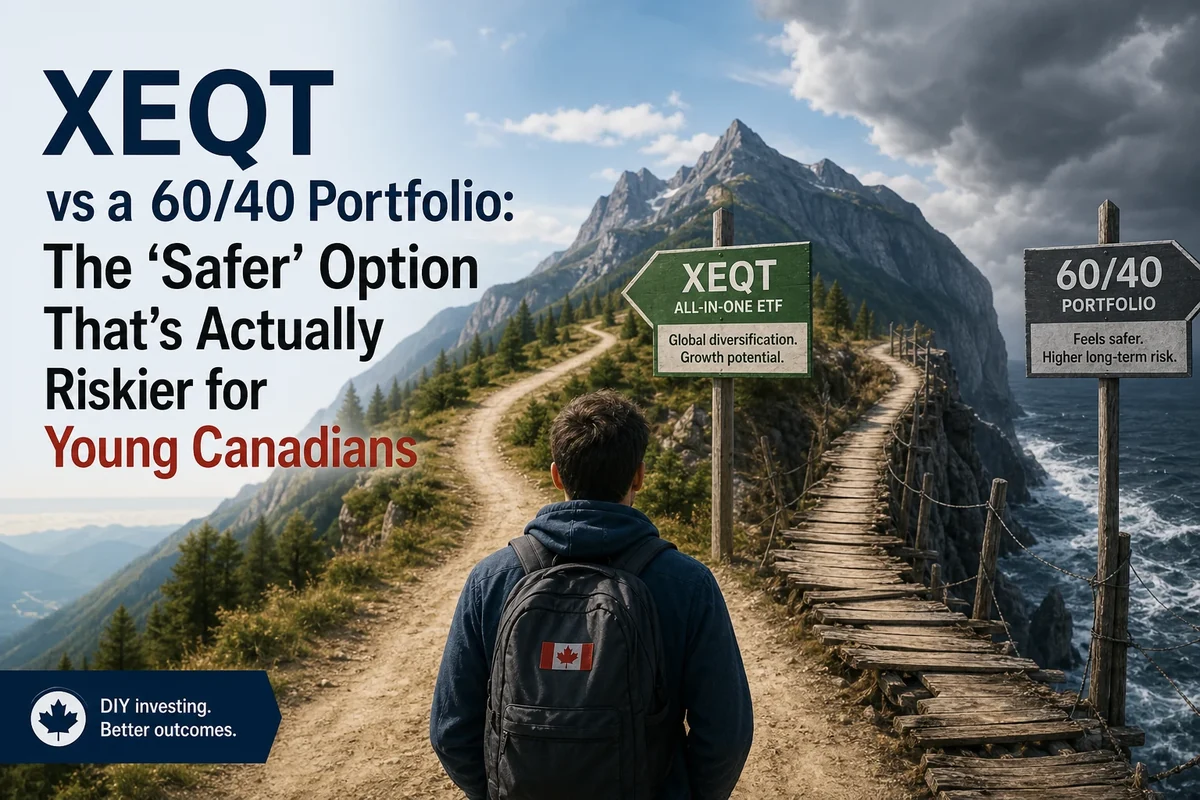
The 60/40 portfolio is one of the most confidently recommended investment strategies in Canadian personal finance. Sixty percent equities, forty percent bonds. Growth with a cushion. You’ll hear it from bank advisors, read it in mainstream publications, and find it embedded in the default settings of most robo-advisors. The problem is that for a 28-year-old with a stable income and a 30-year investing horizon, this “safe” allocation carries a risk that conventional advice almost never names: the mathematical near-certainty of arriving at retirement with a smaller portfolio than you needed.
This isn’t a fringe argument. It follows directly from how bonds work, how inflation compounds, and what the return data across multiple interest rate regimes actually shows. For investors under roughly 45 with consistent income and no imminent need to draw on their portfolio, the safer-feeling choice is quietly the more dangerous one.
Why the 60/40 Portfolio Feels Safe But Isn’t
The psychological appeal of a 60/40 allocation is real and entirely understandable. Bonds are stable. They pay predictable income. During equity sell-offs, they’re supposed to zig when stocks zag. Having 40% of your portfolio in something that “doesn’t crash” creates a feeling of prudence. And feelings matter in investing, because investors who feel comfortable are less likely to panic-sell at the bottom.
The problem is that psychological comfort and financial outcomes are different things, and for young accumulators they often point in opposite directions. The comfort the bond allocation provides comes at a direct cost: reduced exposure to the compounding engine of equities during the exact decades when compounding does its most powerful work. Losing several percentage points of annual return in your 30s is not a cautious trade-off. It’s a permanent reduction in your terminal wealth, multiplied over 30 years.
Volatility is what you feel. Purchasing power shortfall is what you’re left with. For a 30-year-old, the second risk is far larger than the first.
There’s a second trap embedded in the 60/40 structure: it encourages investors to feel protected against sequence-of-returns risk when they don’t actually need that protection yet. Sequence risk matters enormously in the five to ten years immediately surrounding retirement, when large withdrawals combined with a down market can permanently impair a portfolio. For someone with 25 years of contributions ahead of them, sequence risk is largely irrelevant. They’ll experience multiple market cycles. The recoveries will matter more than the crashes.
The Interest Rate Regime Problem: When Bonds Stop Protecting You
The long-term average returns of the 60/40 portfolio are cited frequently to support its legitimacy. But averages conceal the variance, and the variance is severe. Historical analysis of the 60/40 portfolio’s inflation-adjusted performance shows it ran at roughly 1.7% annually between 1947 and 1974, a sustained rising-rate era that lasted nearly three decades. The same portfolio returned 6.1% annually from 1975 to 2025. The long-term average of roughly 4% tells you almost nothing about which era you’re actually investing in.
The mechanism is straightforward. When interest rates rise, existing bond prices fall. A bond fund holding 5% coupon bonds becomes worth less the moment the market can buy new bonds yielding 6%. This isn’t a short-term blip. It’s a sustained capital loss that can last years. During the 2022 rate-hiking cycle, Canadian investors watching their “defensive” bond allocation discovered that bonds were not hedging anything. They were losing money alongside equities.
2022 rate-hike reality check: XEQT (100% equity) fell 10.93% in 2022. XBAL, the iShares 60/40 all-in-one ETF, fell 11.08%. The bond allocation provided essentially zero downside protection while guaranteeing lower returns in every other year of the period.
That result bears repeating. In the one year most often cited as justification for holding bonds, the 40% bond allocation in XBAL delivered worse total returns than the 100% equity XEQT. Bond prices were falling simultaneously with equities as the Bank of Canada hiked rates aggressively to combat inflation. The correlation that the 60/40 framework depends on, bonds moving opposite to stocks, simply didn’t hold. Published analysis of the 60/40 portfolio’s structural weakness identifies this correlation breakdown during rising-rate regimes as its most glaring and recurring vulnerability, one that also appeared across the 1947, 1974 cycle and, to a lesser degree, at other points when inflation ran ahead of central bank targets.
Inflation Quietly Wins Against 60/40 Portfolios
Even setting aside correlation breakdowns during rate hikes, nominal bonds have a persistent structural enemy: inflation. A bond paying a 3% coupon is a reasonable deal when inflation is 1%. It’s a slow leak when inflation runs at 4%. And unlike equities, bonds have no mechanism to grow their earnings in response to rising prices. The purchasing power erosion is silent and cumulative.
Equities, over long periods, have historically delivered real returns that outpace inflation by several percentage points annually. Nominal bonds held in a rising-price environment have frequently delivered real returns near zero or negative. The implication for a 60/40 holder is that a substantial share of their portfolio is working against them in real terms during any sustained inflationary period, while the equity portion carries most of the compounding load.
For a 35-year-old putting $1,000 per month into a TFSA, the practical consequence is meaningful. If the equity portion of a 60/40 portfolio compounds at a long-run historical rate in the range of 7, 8% annually in real terms, and the bond portion compounds at a fraction of that, the blended real return of the overall portfolio will be materially lower than a 100% equity portfolio over 25 years. The gap widens every year, and it is entirely invisible in how the 60/40 portfolio is typically sold.
The Rebalancing Tax Trap No One Mentions
Holding a manually constructed 60/40 portfolio outside of an all-in-one ETF creates an additional friction that erodes returns: rebalancing in taxable accounts triggers capital gains. When equities have a good run and your allocation drifts to 70/30, restoring the 60/40 balance means selling your winners. In a non-registered account, those sales generate taxable capital gains that get added to your income for the year, at a 50% inclusion rate. You pay the tax now, in exchange for the privilege of buying more of your underperforming asset class.
Even inside a registered account, the behavioral dynamic is corrosive. Selling equities during a strong market to buy bonds runs directly against every instinct investors have, and most people simply don’t do it with consistency. They skip a rebalance when markets are hot. They panic-sell bonds to buy more equities at the top. The theoretical benefits of rebalancing require emotional discipline that almost nobody maintains across three full market cycles.
XEQT handles its internal geographic rebalancing automatically, with no tax consequence inside a TFSA or RRSP, and no decision required from you. But the broader point applies to any comparison with a manually managed 60/40: the administrative and behavioral costs of maintaining a fixed bond allocation are real, they are often invisible, and they consistently show up in final portfolio outcomes. As explored in our piece on whether XEQT needs to be rebalanced, the invisible costs of DIY management rarely appear in the spreadsheet comparisons people use to evaluate it.
XEQT’s Volatility Is Not the Risk You Think It Is
The strongest objection to 100% equity for young investors is also the one most easily addressed with data: the volatility feels unbearable. Watching a portfolio drop 20% is genuinely unpleasant. But volatility and risk are not the same thing for an investor with decades ahead of them.
Risk, in the context of long-term wealth building, is the probability of failing to meet your goals. For a 32-year-old accumulating inside a TFSA and RRSP with no intention of touching the money for 25 years, a 20% drawdown in year three is not a risk event. It’s a buying opportunity. The market recovers. It has done so across every major crash in modern financial history. The investors who lost money permanently were the ones who sold.
The verified five-year return history for iShares’ Canadian all-in-one ETFs illustrates this precisely. XEQT returned 19.57% in 2021, fell 10.93% in 2022, then returned 17.05% in 2023, 24.67% in 2024, and 20.45% in 2025. XBAL returned 11.06%, -11.08%, 12.78%, 16.12%, and 13.33% across those same years. XGRO, sitting at 80% equities and 20% bonds, landed in between: 15.17%, -11.00%, 14.92%, 20.46%, and 16.96%.
Five-year return gap (2021, 2025): In 2022, XBAL’s bond allocation offered roughly 0.15% of additional downside protection compared to XEQT. In the four years outside that drawdown, XEQT outpaced XBAL by between 6 and 8 percentage points annually. The “insurance” cost more than it paid out.
The 2022 bond cushion was worth about fifteen basis points of downside protection. The equity premium surrendered in the other four years of that period ran to several thousand dollars on a $100,000 portfolio. Investors holding XBAL instead of XEQT paid a steep and ongoing premium for a form of comfort they barely needed during the accumulation phase.
The Math Across Interest Rate Cycles
Looking at a longer horizon reinforces the pattern. The Lost Decade of 2000 to 2010 is frequently cited as the strongest argument for bond allocation, because equities delivered famously poor returns across that period. And it’s true: in a sustained equity drawdown, a higher bond allocation preserves capital relative to a pure equity portfolio. But the framing is misleading for young accumulators in two important ways.
During the Lost Decade, investors in their 30s who were still making regular contributions were buying equities at depressed prices throughout the downturn. Dollar-cost averaging into a falling market means the recovery, when it came from 2009 onward, was experienced on a much larger number of units than someone who had partially shielded themselves in bonds. The defensive posture that felt protective during the down years actually reduced the number of cheap units an accumulator could purchase, and therefore the size of the recovery they captured.
From 1975 to 2025, inflation-adjusted returns on the 60/40 portfolio ran at 6.1% annually. All-equity portfolios over comparable periods have historically outperformed balanced allocations by a meaningful margin. The long-run arithmetic is consistent: every percentage point shifted from equity to bonds reduces expected return. Whether that trade-off is worth making depends entirely on your timeline and your actual need to draw on the portfolio.
When 60/40 Actually Makes Sense
None of this is an argument that bonds are worthless or that 60/40 is a poor portfolio for everyone. It is a direct argument that for Canadian investors in their 20s, 30s, and early 40s with stable income and a long accumulation horizon, holding 40% bonds is a mathematically expensive form of emotional insurance.
The calculus changes as you approach retirement. In the five to ten years before you plan to start drawing on your portfolio, sequence-of-returns risk becomes genuinely dangerous. A major market decline just before or just after you retire can force you to sell depreciated units to meet living expenses, permanently reducing the portfolio’s ability to recover. This is when a gradual shift toward lower equity exposure makes real sense, not as an emotional preference but as a structural protection against an actual financial risk you now face.
A bond allocation also makes sense if your income is genuinely unstable, if you have a meaningful probability of needing to liquidate investments on short notice, or if you’ve demonstrated across multiple market cycles that you will panic-sell during downturns. That last condition is worth examining honestly. An 80/20 portfolio that you hold through a crash will outperform a 100% equity portfolio that you sell at the bottom. Staying invested matters more than precise allocation.
The question isn’t whether 60/40 is a bad portfolio. The question is whether paying a multi-percentage-point annual return penalty over 25 years is a reasonable price for comfort you may not actually need.
For most Canadians under 45 with a stable paycheque and registered accounts they’re contributing to regularly, the data leans clearly toward 100% equity during the accumulation phase. XEQT’s 0.20% MER, global diversification across approximately 9,000 holdings, and automatic internal rebalancing make it a well-suited vehicle for that phase. For a broader comparison of all-in-one ETF options across different risk tolerances, the complete Canadian all-in-one ETF comparison covers the full spectrum from XCNS to XEQT.
Moving Toward XEQT: The Account-Level Mechanics
If you’re currently holding a 60/40 all-in-one ETF like XBAL inside a registered account, switching to XEQT is operationally simple. Inside a TFSA or RRSP, selling XBAL and buying XEQT triggers no immediate tax event. There’s no capital gains exposure inside a registered account, and your contribution room isn’t affected by switching between ETFs within the account.
Inside a non-registered account, the calculation requires more care. If your XBAL position has appreciated, selling it creates a taxable capital gain. In many cases, holding the existing position and directing all new contributions toward XEQT inside registered accounts is the cleaner path forward.
The 0.20% MER on XEQT is identical to XBAL and XGRO, so there is no fee saving from switching within the iShares family. The return advantage comes entirely from asset allocation: more equity, less bond drag, more time spent in the compounding engine. On the question of where to hold XEQT across registered accounts, the tax mechanics are worth knowing. US dividend withholding tax is fully exempted inside an RRSP under the Canada-US tax treaty (0% withholding), while TFSA and FHSA holders pay approximately 15% on those distributions. For most Canadians building wealth across multiple accounts, the RRSP holds the withholding tax efficiency advantage for foreign-heavy holdings like XEQT.
2026 registered account limits: TFSA annual room is $7,000 (cumulative $109,000 since 2009 for those eligible from inception). RRSP annual limit is $32,490 (18% of prior year earned income, subject to that cap). FHSA is $8,000 per year with a $40,000 lifetime limit for qualifying first-time buyers.
The bigger picture is that the account you hold it in is a second-order question compared to the allocation decision itself. Getting from a 60/40 portfolio to a 100% equity allocation during your accumulation years is likely worth more to your long-term outcome than any account-level tax optimization. For a complete overview of how XEQT is structured and what you’re actually buying, the case for why so many young Canadians have converged on XEQT covers the broader philosophy in detail.
Frequently Asked Questions
Is a 60/40 portfolio too conservative for a 30-year-old Canadian? For most Canadians in their 30s with stable employment income and a 25-plus year horizon before retirement withdrawals begin, a 60/40 allocation is likely too conservative. The 40% bond allocation reduces expected long-run returns while providing downside protection that a young accumulator making regular contributions doesn’t need in the same way a retiree does. The verified return data across the 2021, 2025 period supports a higher equity allocation during the accumulation phase.
Did bonds protect investors in 2022? Barely. XBAL, the iShares 60/40 all-in-one ETF, fell 11.08% in 2022, compared to XEQT’s 10.93% decline. The bond allocation provided roughly 0.15% of downside protection in the one year it was expected to matter most, because bond prices also fell sharply as the Bank of Canada raised rates aggressively. The correlation between bonds and equities that the 60/40 framework depends on broke down exactly when investors needed it most.
What’s the difference between XEQT and XGRO for a young investor? XGRO holds 80% equities and 20% bonds, splitting the difference between XEQT’s 100% equity and XBAL’s 60/40 split. Both carry a 0.20% MER. Over the 2021 to 2025 period, XEQT outperformed XGRO in four of five calendar years. For an investor under 40 with a long accumulation horizon, the 20% bond allocation in XGRO represents a meaningful drag on expected compound returns without a proportional reduction in the risk of portfolio failure over that time frame.
When should I start adding bonds to my portfolio? A reasonable approach is to begin a gradual shift toward lower equity allocation in the five to ten years before planned retirement withdrawals. If you plan to retire at 60, beginning to move from 100% equity toward something like 80/20 or 70/30 around age 50 to 55 gives the bond allocation time to meaningfully reduce sequence-of-returns risk. Before that window, the cost in compounded returns is high and the protective benefit is modest for any investor with a steady income already covering their living expenses.