
Your Financial Advisor Is Probably Charging You 2%. Here’s What That Looks Like Over 30 Years
July 10, 2026

If your money is sitting in a bank-managed mutual fund or an advisor-run portfolio, there is a reasonable chance you are paying somewhere between 2% and 2.5% per year in fees. Not once. Every single year. On every dollar you have invested. Your statement never shows a line item for it. It comes out before returns reach your account, invisibly, in a structure designed so you never feel the sting. The problem is not the 2%. The problem is what 2% becomes after 30 years of compounding against you, and most Canadian investors have never seen that number in actual dollars.
Why “Just 2%” Is the Most Expensive Phrase in Canadian Finance
Percentages are psychologically harmless. Your brain registers “2%” the same way it registers a 2% tip at a restaurant, rounding error, barely worth discussing. That framing is not accidental. The mutual fund industry has spent decades ensuring Canadians think about fees as annual percentages rather than lifetime dollar costs, because one number sounds trivial and the other is genuinely alarming.
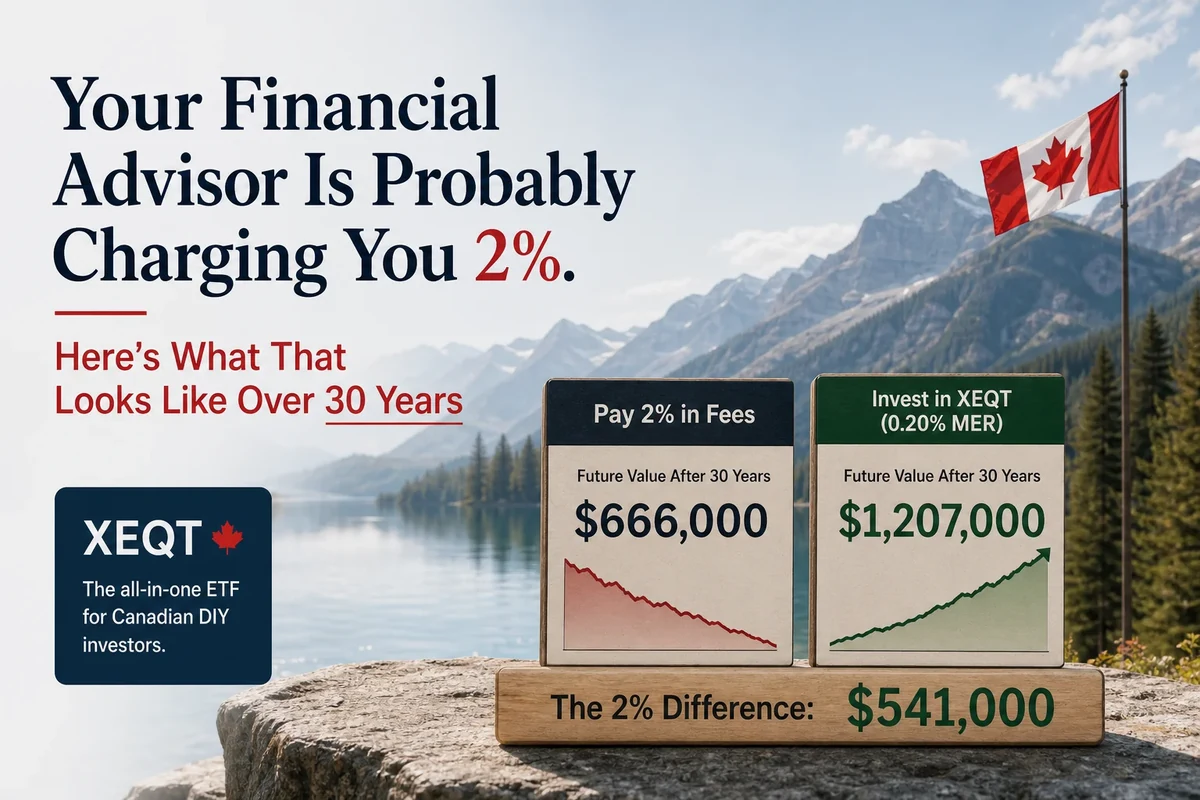
Here is how that gap works in practice. Say you are 35 years old, you invest $1,000 a month consistently, and you do it for 30 years until you retire at 65. You contribute $360,000 in total. Assume a 7% gross annual return from a globally diversified equity portfolio, a reasonable long-run estimate for equities.
At an MER of 0.20% (the cost of holding XEQT), your net return is approximately 6.80%. After 30 years, your portfolio lands at roughly $1,190,000.
At a 2.5% MER, the average retail mutual fund MER that has historically dominated Canadian bank branches and advisor-managed accounts, according to Morningstar data, your net return drops to approximately 4.5%. After the same 30 years, the same contributions, and the same gross market performance, your portfolio reaches roughly $742,000.
The difference is approximately $448,000. On contributions of $360,000. The fees consumed more wealth than you actually put in.
The cruelest part of high-MER investing is that you pay the most in absolute dollar terms precisely when your portfolio is largest, right before retirement, when you can afford to give away the least.
That is not a rounding error. That is not a marginal optimization. That is nearly half a million dollars that would otherwise have been yours, quietly transferred to fund companies and commission-based advisors over three decades without your explicit awareness or consent. These figures use standard compound return calculations and are illustrative, your actual outcome will vary based on contribution timing, market returns, and the specific funds you hold.
The 30-year fee gap: Investing $1,000/month for 30 years at a 7% gross return produces approximately $1,190,000 at 0.20% MER versus approximately $742,000 at 2.5% MER. The illustrative gap of ~$448,000 exceeds total contributions of $360,000. Actual results will vary.
Canada’s Fee Problem Is a Global Outlier
This is not a universal feature of investing. It is a distinctly Canadian problem, and it is worth understanding why.
According to Morningstar data, the average MER for Canadian equity mutual funds has historically sat in the 2% to 2.5% range. By comparison, the average MER for mutual funds in the United States sits around 0.50%, and in the United Kingdom it lands near 0.75%. Canada consistently ranks among the most expensive mutual fund markets in the developed world.
The reason comes down to structure. The Canadian mutual fund industry grew up around embedded commissions, a system where the advisor who sells you the fund receives an ongoing annual “trailer fee” hidden inside the MER. That trailer typically runs between 0.5% and 1% per year, paid from your assets to the advisor, forever, whether they speak to you or not. The fund company keeps the rest. You never see a bill because the whole arrangement is bundled inside a fee that is deducted before your returns are reported.
The mutual fund industry’s own observation, “mutual funds are sold, not bought”, captures the dynamic precisely. Commission-based advisors at banks and credit unions have zero financial incentive to recommend low-cost ETFs, because ETFs carry no embedded trailer fees. There is no kickback. There is nothing to sell. An advisor who moves your account from a 2.5% mutual fund to XEQT at 0.20% has just voluntarily cut their annual income from your account by roughly 90%. The incentive structure makes that an extremely unlikely recommendation.
Canada’s securities regulators banned the deferred sales charge (DSC) commission structure in 2022, a genuine improvement. But the embedded trailer fee model at the core of mutual fund distribution remains intact, and millions of Canadians are still in it.
The Suitability Standard Versus Your Best Interest
There is a distinction buried in Canadian financial regulation that most investors do not know exists, and it matters enormously to your outcome.
Most commission-based advisors in Canada are held to a suitability standard. This means they are legally required to recommend investments that are suitable for your situation, not investments that are necessarily the best available option for you. A mutual fund with a 2.5% MER is legally suitable if it is appropriate for your risk tolerance and time horizon, even if an XEQT portfolio at 0.20% would produce dramatically better net results over the same period. Suitable is not the same as optimal.
A smaller category of professionals, fee-only, advice-only planners, operate differently. They charge you directly for advice (an hourly rate or a flat project fee), hold no investment product licenses, and earn no commissions. Because their compensation is completely decoupled from product sales, they can recommend whatever is actually best for your situation. Organizations like the Fee-Only Network and Money Coaches Canada maintain directories of these planners, though they represent a small fraction of the overall advisory industry in Canada.
A third structure, the fee-based AUM (assets under management) model, sits in between. An advisor charges a percentage of your portfolio directly, often around 0.75% to 1.5%, and may use ETFs as underlying investments. The conflict of interest is reduced compared to commission-based arrangements, but the ongoing percentage fee still compounds against you. At 1% AUM on top of ETF costs, you are still paying meaningfully more than a self-directed approach over a multi-decade horizon.
Three fee structures: Commission-based (trailer fees inside a 2, 2.5% MER, no visible bill, strongest conflict of interest). Fee-based AUM (0.75, 1.5% charged directly, usually ETFs underneath, reduced conflict). Fee-only advice-only (flat or hourly charge, no product commissions, no ongoing percentage drag). Self-directed investors pay only the ETF’s MER, 0.20% for XEQT.
Group RRSPs and Workplace Plans: A Hidden Pricing Advantage
If you are a salaried employee with access to a group RRSP or defined contribution pension plan, you may already have access to investment pricing that most retail investors cannot touch.
Average retail MERs sit around 2.5%, according to Canadian group benefits research. The Investment Management Fees (IMF) charged inside large group plans can fall below 1%, sometimes significantly so, because the employer negotiates institutional pricing on behalf of the entire employee group. The underlying funds are often comparable products, the price difference is simply a function of scale and negotiating leverage.
That gap creates a meaningful lifetime advantage. An employee who leaves a $200,000 group RRSP balance at a previous employer and rolls it into a retail bank RRSP at 2.5% MER has just voluntarily accepted a pricing penalty that compounds for decades. Before making that transfer, it is worth comparing the group plan’s IMF against the retail alternative. In many cases, staying in the group plan, or transferring to a new employer’s plan, produces better long-run outcomes than accepting retail pricing at a bank.
The practical priority: if your group plan offers a low-cost index fund option at sub-1% fees, and your employer matches contributions, maximize that vehicle fully before considering anything else. Employer matching is an immediate return on your money before a single day of market exposure. Very few investment strategies can compete with that baseline.
What Does the 2% Actually Buy You?
The defensible argument for paying an advisor goes like this: yes, the fees are higher, but a skilled advisor helps you avoid behavioral mistakes, stay invested during market crashes, optimize your tax situation, and coordinate complex financial decisions. Done well, that guidance could be worth more than the fee differential.
This argument deserves a serious answer rather than a dismissal, because it is partially true.
The SPIVA Canada research (Standard and Poor’s Indices Versus Active scorecard) has tracked active fund performance against benchmarks for over two decades. One representative finding: just 2.5% of actively managed Canadian equity funds outperformed the S&P/TSX Composite Index during the five years ending in 2010, and the picture has not improved meaningfully in subsequent reports. The investment selection component of the advisor’s service is, on average, not adding value relative to an index ETF. The underperformance is not marginal, funds like the Investors Canadian Equity Fund trailed their benchmark by over 4 percentage points in a single year, while a comparable index ETF lagged by roughly 0.22%.
The genuine value-add sits elsewhere: behavioral coaching that keeps you from selling during a market drawdown, tax-efficient withdrawal planning in retirement (particularly around RRSP drawdown sequencing before OAS and CPP begin), estate coordination, and navigating complex life events like inheritance or divorce. These are real services with real dollar value.
The problem is the delivery mechanism. A commission-based advisor selling 2.5% MER mutual funds bundles these planning services inside a fee structure that makes the investment product the profit centre. You are paying for advice through the fund, which means the recommendations you receive are shaped, consciously or not, by what earns the advisor the most money. That structural reality does not disappear because the advisor is well-intentioned.
You are not paying for advice. You are paying for a product, and the advice comes along as a justification for the fee.
A genuinely useful alternative for Canadians who want professional guidance without the product conflict: hire a fee-only advisor for a one-time financial plan (typically in the range of a few thousand dollars), implement the plan yourself using a low-cost ETF like XEQT inside a TFSA, RRSP, or FHSA on Wealthsimple or Questrade, and revisit with the planner every few years as your situation changes. You get the planning value. You skip the perpetual percentage drag.
Running the Fee Audit on Your Own Accounts
Before you can act, you need to know what you are actually paying. This is harder than it should be, because Canadian financial institutions are not required to express your MER cost as a dollar amount on your statement, only as a percentage buried in the fund’s prospectus or Fund Facts document.
The number you want is your total cost of ownership, not the MER alone. If you hold a mutual fund with a 2% MER and also pay an AUM advisory fee on top, your all-in cost is higher than 2%. If you hold a fee-only advisor’s recommended ETF portfolio, your total cost is the ETF MER plus whatever you paid for the plan.
To find your fund’s MER: log into your account, identify the fund name and series (Series A typically includes the trailer commission, Series F strips it out for fee-based accounts), and search for the Fund Facts document on the fund company’s website or SEDAR. The MER is disclosed there. Multiply it by your account balance to see your annual dollar cost.
The questions worth asking your advisor or institution directly: What is the MER on every fund I hold? Do I pay any advisory fee separately, and if so, at what percentage? Am I in a commission-based or fee-based structure? What is my total all-in cost as a dollar amount this year?
If those questions produce vague answers or defensiveness, that is diagnostic information. A transparent fee structure does not require evasion.
For context on what a genuinely low-cost alternative looks like: XEQT carries a 0.20% MER and holds a globally diversified portfolio across Canada, the US, international developed markets, and emerging markets. On a $200,000 portfolio, that works out to $400 per year, total, with no advisor fee layered on top and no trailer commission. You can read the full breakdown of what XEQT actually costs and why if you want to understand exactly what is and is not included in that number.
The Move Most Canadians Avoid Making
The practical barrier is inertia, and the advisory industry knows it. Switching from a mutual fund at your bank to a self-directed account at Wealthsimple or Questrade requires a few hours of setup, a transfer form, and the willingness to own a decision that used to belong to someone else. Most people never take those hours. The status quo has a powerful psychological hold, and the fee structure is designed to be invisible precisely so it never creates enough discomfort to motivate change.
The math does not care about inertia. Every year you remain in a 2.5% MER fund while a 0.20% alternative exists is a year you have paid roughly 2.3 percentage points of your portfolio to a structure that, on average, is unlikely to outperform the benchmark anyway. On a $300,000 RRSP, that differential is approximately $6,900 per year. After a decade, the compounding of that gap is not a rounding error, it is a car, a university tuition, or a meaningful portion of someone’s retirement security.
The self-directed path is not complicated. Open a Wealthsimple or Questrade account, contribute within your available TFSA room ($7,000 for 2026) and RRSP room (18% of prior year earned income, up to the annual CRA limit shown on your most recent notice of assessment), buy XEQT, set up automatic contributions, and stop watching it daily. That is the entire strategy. If you want to understand the full picture of what this ETF actually holds and how it works, the complete XEQT guide is a good starting point.
The financial advisory industry provides real value to some people in specific situations. Complex estates, blended families, business owners with corporate accounts, retirees managing withdrawal sequencing across multiple account types, these are situations where professional planning can pay for itself. But for the majority of working Canadians steadily building wealth in a TFSA and RRSP over a 20 to 30-year period, the evidence suggests the fee is a cost that compounds against you without a commensurate benefit. By the time you see the final balance, the difference is measured in hundreds of thousands of dollars.
Frequently Asked Questions
What is a typical financial advisor fee in Canada?
Commission-based advisors in Canada typically earn through mutual fund MERs that average 2% to 2.5% annually, according to Morningstar data. These fees are deducted from fund assets before returns reach your account, so you never receive a direct bill. Fee-based AUM advisors charge an additional 0.75% to 1.5% on top of underlying fund costs, while fee-only advice-only planners charge a flat or hourly rate with no ongoing percentage drag.
How much does a 2% MER cost over 30 years?
The dollar impact scales with portfolio size, but the compounding effect is substantial regardless. In an illustrative scenario where someone invests $1,000 per month for 30 years at a 7% gross return, the difference between a 0.20% MER and a 2.5% MER produces an ending gap of approximately $448,000, more than total lifetime contributions of $360,000. The gap widens over time because the fee is charged on the growing total balance, not just new contributions.
Are Canadian mutual fund fees the highest in the world?
Canada consistently ranks among the most expensive mutual fund markets in the developed world. Morningstar data places Canada’s average equity mutual fund MER in the 2% to 2.5% range, compared to roughly 0.50% in the United States and approximately 0.75% in the United Kingdom. The primary driver is the embedded commission (trailer fee) structure that compensates advisors from inside the fund, inflating the total cost without a visible line item on investor statements.
When does paying a financial advisor actually make sense?
Professional advice genuinely earns its cost in situations involving tax complexity, estate planning, retirement withdrawal sequencing across RRSP, TFSA, and non-registered accounts, or major life transitions like divorce or inheritance. The mismatch in Canada is that most people paying advisor-level fees are in straightforward accumulation situations, regular contributions to a TFSA and RRSP over decades, where the planning complexity does not justify a perpetual 2%+ annual drag. A one-time engagement with a fee-only planner, combined with self-directed low-cost ETF investing, often delivers the advice value without the ongoing compounding cost.