
XEQT Holds 9,000+ Stocks. So Why Do People Still Think It’s Risky?
July 8, 2026

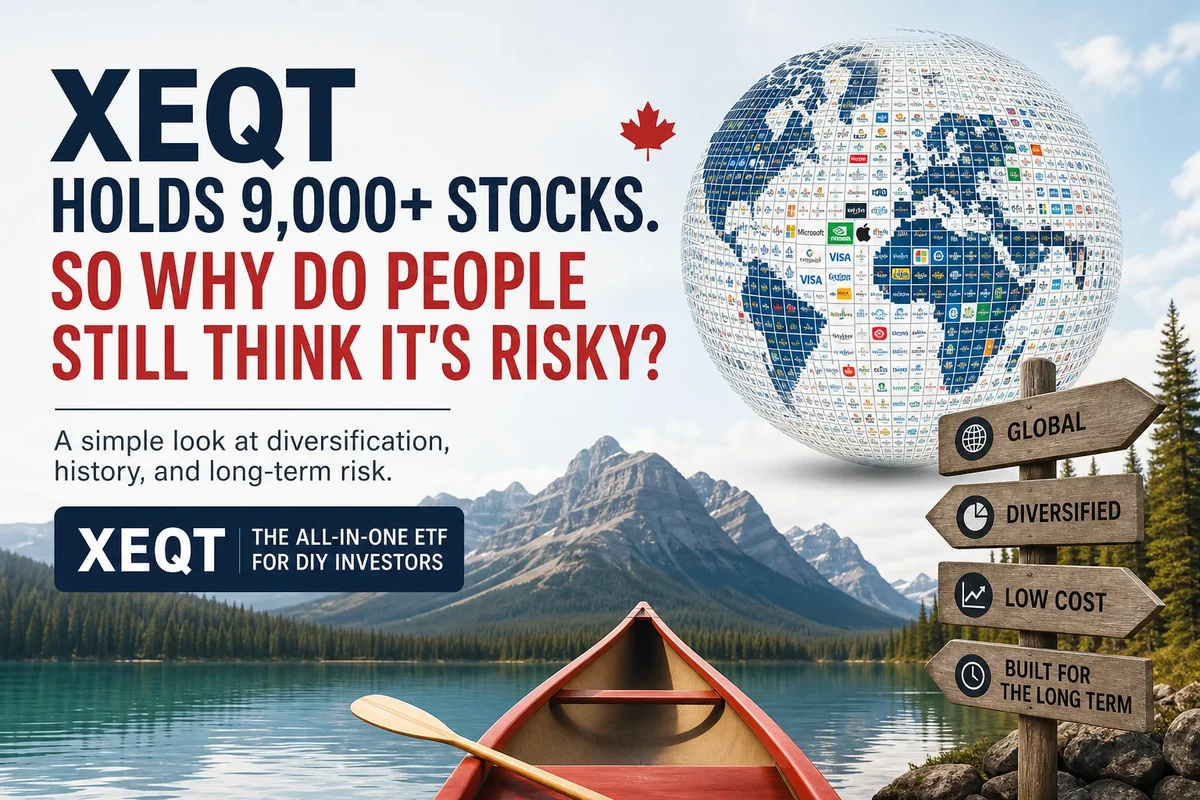
Somewhere in Canada right now, a bank advisor is telling a client that putting everything into one ETF is risky. The client nods, walks out with four mutual funds and a bond sleeve, and pays 2% a year for the privilege. The advisor calls this diversification. The math calls it something else.
XEQT holds over 9,000 companies across 47 countries. Its single largest holding, Apple, makes up roughly 2.5% of the fund. The entire top 10 combined adds up to about 14% of the total. The other 86% is spread across thousands of businesses you have never heard of, doing work in industries and geographies that have nothing to do with each other. If that is concentration, the word has lost its meaning.
The “single ETF is too risky” objection is not a financial analysis. It is a sales pitch. Understanding why requires pulling apart what diversification actually measures, why raw stock counts are almost useless as a metric, and what the word “risk” actually means for someone investing over a 20- or 30-year horizon.
The Objection Financial Advisors Use to Sell You More
The script is remarkably consistent. You mention you want to keep things simple and invest in something like XEQT. The advisor’s face changes. They explain, carefully, that while they appreciate your enthusiasm, investing all your money in a single fund leaves you dangerously concentrated. They produce a pie chart. They talk about the importance of diversification. By the time you leave, you have been signed up for a managed portfolio of eight to twelve funds, each with its own MER, and an annual fee sitting on top for the advisor’s guidance.
The conflict here is not subtle. A product-selling advisor earns commissions, trailing fees, or asset-based compensation tied to what they put you in. A simple, self-managing ETF like XEQT eliminates that fee stream almost entirely. It is not that advisors are lying to you about risk. It is that their definition of risk and yours should not be the same, because your incentives are fundamentally different.
Complexity is not a feature of good investing. It is a feature of advice that needs to justify its cost. The more moving parts in your portfolio, the harder it is for you to evaluate whether you are being served well.
A fee-only financial planner charging a flat rate for a financial plan has no reason to push complexity. An advisor earning a trailer commission on a fund-of-funds very much does. Knowing which one you are talking to is the most important question you can ask before any money moves.
Why Stock Count Is a Misleading Metric
VEQT, Vanguard’s comparable all-equity ETF, lists over 13,000 holdings on its website. XEQT lists roughly 9,000. If you stopped there, you would conclude that VEQT is more diversified. Most people do stop there. That conclusion is wrong.
The Canadian Portfolio Manager blog published a detailed analysis examining exactly this question, and the methodology is worth understanding. Simply counting holdings ignores the most important variable: how much of the portfolio is concentrated in each one. A fund holding 13,000 stocks where one position makes up 80% of the portfolio is less diversified than a fund holding 10 equally weighted stocks. The number is almost irrelevant. Concentration is everything.
The proper measure is called the effective number of stocks. You calculate it by squaring the weight of each holding in the portfolio, summing those squared values, then taking the reciprocal of that sum. The result tells you how many stocks are meaningfully contributing to the portfolio’s behaviour. An equally weighted portfolio of 100 stocks would have an effective number of 100. A portfolio where one stock holds 80% and ninety-nine others share the remaining 20% would have an effective number closer to 1.6.
Effective stock count: Despite holding roughly 3,600 fewer individual stocks than VEQT, XEQT’s effective number of stocks is approximately 198 versus VEQT’s approximately 180, according to Canadian Portfolio Manager Blog analysis using the sum-of-squared-weights methodology. More holdings does not mean better diversification.
The reason XEQT comes out ahead is its allocation mix. VEQT has a heavier weighting toward Canadian equities, where a handful of bank and energy stocks dominate. XEQT’s higher allocation to international developed markets introduces more genuinely independent companies, spreading concentration more evenly across the portfolio. The raw count means almost nothing. The distribution of weight across holdings is what determines how diversified you actually are.
How 9,000 Companies Across 47 Countries Actually Works
XEQT is a fund-of-funds. It holds four underlying iShares ETFs: XUU (US total market), XIC (Canadian equities), XEF (international developed markets), and XEC (emerging markets). Each of those ETFs tracks a broad index, and together they provide exposure to publicly traded companies across virtually every significant economy on earth.
The geographic breakdown looks approximately like this: the United States at roughly 46%, Canada at roughly 23%, Japan at around 6%, the United Kingdom near 3%, Switzerland and China each around 2.3%, France and Germany each around 2%, and Australia and the Netherlands rounding out the top ten countries. The remaining allocation is spread across dozens of additional markets including South Korea, Taiwan, Brazil, and India.
Sectorally, XEQT is also genuinely balanced. Financial services and technology each sit around 17% of the portfolio. Industrials represent roughly 11%, healthcare about 11%, consumer cyclical near 10%, communication services around 8%, and consumer defensive, basic materials, energy, real estate, and utilities fill out the rest. No single sector dominates. No single country comes close to a majority. No single company exceeds about 2.5%.
When your largest holding is 2.5% of the fund and you own pieces of over nine thousand businesses, the question is not whether you are diversified. The question is what more diversification would even look like.
This breadth matters precisely when things go wrong in concentrated ways. When a specific country’s market falls sharply, when a sector faces a regulatory shock, when a particular currency weakens, XEQT absorbs that through the thousands of other holdings that were unaffected. That absorption is the entire point of global diversification, and it works not because you hold more stocks but because those stocks are genuinely independent from each other.
The Effective Diversification Math: XEQT Comes Out Ahead
VEQT’s inflated stock count is partly a data artifact. The Canadian Portfolio Manager analysis noted something curious: when comparing VEQT’s listed holdings against the actual indexes its underlying ETFs track, the emerging markets component appears to list over 1,100 more stocks than the indexes themselves contain. Sorting those holdings reveals tiny duplicate positions at fractional weights that contribute nothing meaningful to diversification but inflate the headline number significantly.
The practical result is that VEQT’s 13,000 holdings are not 13,000 meaningfully independent bets. Many of those extra positions are negligible slices of the same underlying companies, counted once per underlying fund. When you adjust for actual concentration using the effective number of stocks calculation, XEQT’s more intentional allocation structure produces a genuinely more diversified portfolio despite the smaller nominal count.
XEQT also carries a lower MER at 0.20% versus VEQT’s 0.24%. When held in a TFSA, RRSP, or FHSA, the Canadian Portfolio Manager’s foreign withholding tax analysis puts XEQT’s total cost drag at roughly 0.42% in registered accounts versus VEQT’s slightly higher figure, a consequence of how the underlying fund structures handle US dividend withholding. The difference in any single year is small. Compounded over 30 years on a large portfolio, it adds up in XEQT’s favour. For a detailed breakdown of what that 0.20% actually costs you in dollar terms across different portfolio sizes, the full XEQT fee breakdown covers that ground thoroughly.
What “Risk” Actually Means Over 20 to 30 Years
When an advisor calls XEQT risky, they are usually referring to volatility: the fact that XEQT is 100% equities and will drop sharply in a market downturn. This is true and worth knowing. XEQT fell meaningfully during the 2020 pandemic selloff and experienced real drawdowns during 2022 and the tariff-related turbulence of 2026. Anyone watching their account value during those periods felt it.
But volatility and risk are not the same thing for a long-term investor. The distinction matters enormously. Volatility is the day-to-day, month-to-month fluctuation in your portfolio’s value. Risk, in the sense that actually threatens your financial future, is the permanent loss of capital or the failure to reach your retirement goals.
A 30% drawdown in XEQT is not permanent capital loss as long as you do not sell. Every major equity market drawdown in modern history has been followed by a recovery, and broad global diversification has proven more durable than concentrated bets precisely because no single economy, sector, or company drives the outcome. What creates permanent capital loss is selling during that drawdown, paying 2% a year in fees that silently consume your compounding over three decades, or concentrating your savings in a handful of Canadian bank stocks because they feel safe.
The real fee drag: On a $250,000 portfolio growing at 7% annually over 30 years, a 0.20% MER leaves you with roughly $135,000 more than an equivalent portfolio running at a 2.00% MER. The market exposure is identical. The fee drag is not.
Currency fluctuations, short-term drawdowns, and the fact that some parts of XEQT’s portfolio will underperform in any given year are features, not flaws. They are the mechanism through which diversification works. The actual long-term risk for most Canadians is not market volatility. It is paying too much, for too little, for too long.
The Hidden Cost of Complexity: Why More ETFs Does Not Mean Better
The alternative to XEQT that advisors often propose is a multi-ETF portfolio: perhaps XIC for Canadian equities, a combination of XEF and XEC for international exposure, and XUU for US markets, with a bond ETF layered on top. You can absolutely build something like this yourself. The blended MER of those underlying components might come out around 0.09% to 0.12%, which is genuinely lower than XEQT’s 0.20%.
What you are not accounting for in that comparison are the friction costs. Every time markets drift and your allocation moves off target, you need to rebalance. That means calculating how much each position has shifted, placing multiple trades, and if you are doing this across a TFSA, an RRSP, and possibly an FHSA, tracking which lots are held where for tax purposes. In a non-registered account, selling to rebalance triggers capital gains. The tax drag on those distributions is real and cumulative. The time cost is real. The behavioural cost, which is the risk that you delay rebalancing, panic during a drawdown, or make an asymmetric decision to cut an underperforming sleeve, is the highest cost of all and the hardest to quantify.
XEQT rebalances automatically. When US equities run ahead and the allocation drifts above target, the fund corrects internally. You do not do anything. You do not even know it happened. The 0.20% MER you pay includes that service, and for most Canadians it is worth every basis point.
When advisors add their own fee on top of a multi-ETF structure, the comparison shifts further. A typical advisor fee of 0.50% to 1.00% of assets under management, added to the underlying fund MERs, takes your total cost to roughly 0.65% to 1.20% per year. A full-service mutual fund portfolio through a major Canadian bank commonly runs 2.00% to 2.75%. Against those numbers, XEQT at 0.20% is not a risk. It is a structural advantage.
When Advisors Call It Risky, What They Are Actually Selling
An advisor who earns compensation tied to what products you hold has a direct financial interest in your portfolio being complex. Not complex because complexity serves you better, but complex because it requires ongoing management that justifies their presence in the relationship.
XEQT removes that justification almost entirely. A self-managing, globally diversified, automatically rebalancing ETF with a 0.20% MER does not need an advisor to monitor it, rebalance it, explain its components, or produce quarterly reports. It just runs. That is a feature for you. It is a problem for anyone whose compensation depends on your engagement with the process.
A fee-only financial planner, who charges a flat or hourly rate for a financial plan rather than a percentage of your assets, is a genuinely different arrangement. That kind of advice, covering account structure, TFSA versus RRSP prioritization, FHSA eligibility, withdrawal sequencing in retirement, and estate considerations, has real value and does not require you to hold complicated products. The advice is separable from the product. In commission-based arrangements, it rarely is.
The question to ask any advisor recommending a complex multi-fund solution over a single all-in-one ETF is simple: how do you get paid? The answer tells you almost everything about whose interests are being served.
None of this means every advisor is acting in bad faith. Many believe genuinely in the portfolios they construct. But the structural incentive exists regardless of individual intentions, and you should understand it before accepting any recommendation that adds cost and complexity to something that works fine without either.
The 9,000-Stock Reality Check
Reducing risk in practice means owning a piece of the global economy in proportion to its actual market value. It means not betting on Canadian banks outperforming indefinitely, not betting on the US market continuing its decade of dominance, not betting on any single sector, theme, or geography. It means owning all of them, weighted by their size, letting the market sort out who wins over the next 30 years, and keeping your costs low enough that compounding can do its work.
XEQT does that in a single ticker. You buy it through Wealthsimple or Questrade at zero commission. You put it inside your TFSA, your RRSP, your FHSA, or all three. You set up automatic contributions. You do not rebalance, because the fund does it for you. You do not check the geographic allocation quarterly, because it adjusts automatically. You do not wonder whether Japan is pulling its weight, because the market itself is making that determination in real time.
The 9,000 companies are not a liability. They are 9,000 independent bets on human economic activity across 47 countries, spread so broadly that no single failure can meaningfully damage the portfolio. If that sounds boring, it should. Boring investing, done consistently over a long period with minimal cost, is how most Canadians will actually build wealth. For a complete picture of what XEQT is, how it is structured, and whether it fits your situation, the 2026 XEQT review covers the fund in full detail.
Frequently Asked Questions
Is XEQT actually safe to hold as your only investment?
For investors with a long time horizon of 10 years or more who do not need to draw down the money in the near term, XEQT provides genuinely broad global diversification at a very low cost. It will experience volatility, including significant short-term drawdowns. That volatility is not the same as permanent capital loss, which is the risk that actually matters over a long horizon. The primary concern with holding XEQT as your only investment is that 100% equities may be inappropriate if your timeline is short, not that the fund is concentrated or poorly constructed.
Why does XEQT have fewer stocks than VEQT but better diversification?
Raw stock count ignores concentration. VEQT’s higher Canadian equity weighting means more of its portfolio is concentrated in a smaller number of Canadian banks and energy companies. XEQT’s higher international allocation distributes weight more evenly across independent companies. When you calculate the effective number of stocks, which adjusts for concentration using a sum-of-squared-weights method, XEQT scores approximately 198 versus VEQT’s approximately 180, according to Canadian Portfolio Manager Blog analysis.
Does holding a single ETF expose you to more risk than a multi-ETF portfolio?
Not in any meaningful sense for a long-term investor. A multi-ETF portfolio built from the same underlying indexes as XEQT carries nearly identical market exposure. The practical differences are that XEQT automatically rebalances, requires no manual tracking across accounts, and eliminates the behavioural risk of making asymmetric decisions about individual sleeves during a drawdown. Where multi-ETF portfolios add advisor fees on top, the total cost comparison is not even close.
What kind of risk is XEQT actually exposed to?
XEQT is 100% equities, so it carries full market risk and will fall meaningfully in broad market downturns. It holds no bonds to cushion drawdowns. It carries currency exposure because roughly 77% of its holdings are in non-Canadian companies, though research suggests this is appropriate and beneficial over a long horizon. What it does not carry is meaningful concentration risk at the company, sector, or single-country level, because its holdings are spread too broadly for any individual failure to matter much.