XEQT’s 0.20% MER: What You Actually Pay and Why It Matters
April 28, 2026

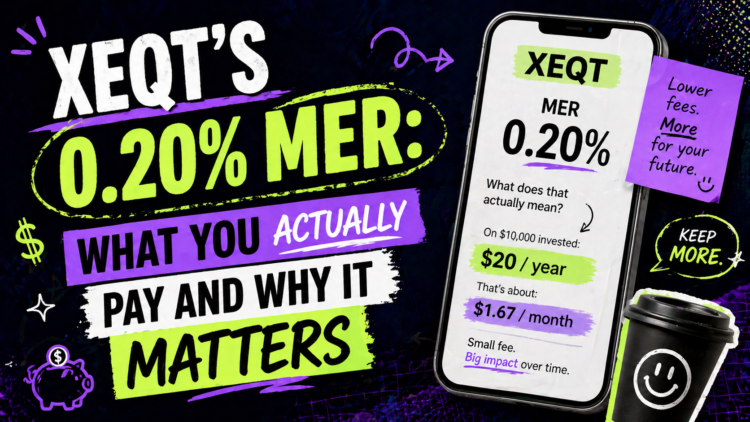
Most Canadians have no idea what they’re paying to invest. Not even roughly. They know their bank manages their money somehow, they see a balance go up and down, and somewhere in the fine print there’s a percentage that gets quietly skimmed off the top every single year. That percentage is the MER, the Management Expense Ratio, and for a lot of Canadian investors, it’s doing serious damage they’ve never actually calculated.
XEQT’s MER is 0.20%. That number needs context to mean anything. So let’s give it some.
What the MER Actually Is
The Management Expense Ratio is the total annual cost of owning a fund, expressed as a percentage of your assets. It covers the fund manager’s fee, operating costs, and any taxes associated with running the fund. You don’t receive a bill for it. It’s deducted from the fund’s net asset value continuously throughout the year, which means you never see it leave your account, it just quietly reduces your returns.
For XEQT specifically, the management fee is 0.18% and the MER lands at 0.20% once all operating costs are included. That small gap between the management fee and the MER is normal and expected. It’s worth knowing that when iShares advertises 0.18%, they’re not being deceptive, the final all-in cost is 0.20%, and that’s the number you should use for any real comparison.
The MER isn’t a fee you pay once. It’s a fee you pay every year, on every dollar you have invested. That’s why it compounds against you the same way returns compound for you.
XEQT also holds four underlying iShares ETFs internally: ITOT (US equities), XEF (international developed markets), XIC (Canadian equities), and IMEG (emerging markets). Those underlying funds have their own costs, but those are already wrapped into the 0.20% figure. There’s no hidden second layer of fees. What you see is what you pay.
The Dollar Translation: What 0.20% Looks Like in Real Money
Percentages are psychologically easy to dismiss. Dollars are not. So here’s the same number, rewritten in terms most people actually feel.
XEQT MER in Real Dollars: On a $50,000 portfolio, 0.20% costs you $100 per year. On $100,000, that’s $200 per year. On $250,000, it’s $500 per year. That’s the total cost, no advisor fees, no trailer fees, nothing else layered on top.
Now compare that to the Canadian mutual fund industry. According to Morningstar data, the average MER for Canadian equity mutual funds has historically sat between 2% and 2.5%. The average balanced mutual fund, the kind millions of Canadians hold inside their RRSPs without really knowing it, often carries an MER in the range of 1.8% to 2.2%.
Run that same $250,000 through a 2% MER fund and you’re paying $5,000 per year. Every year. Whether the market goes up or down. That’s $5,000 versus $500. The math isn’t subtle.
And if you’re working with a fee-based advisor who charges 1% on top of the underlying fund costs, you can easily end up paying 2.5% to 3% per year in total. On $250,000, that’s $6,250 to $7,500 annually, for a portfolio that, research consistently shows, will likely underperform a low-cost index fund over the long run anyway.
Why XEQT Can Charge So Little
XEQT doesn’t try to beat the market. It owns the market. Because it tracks broad index benchmarks rather than employing analysts, portfolio managers, and trading teams to pick winning stocks, the cost of running the fund is a fraction of what an actively managed fund requires. iShares passes most of that saving on to investors, and the result is a 0.20% all-in fee.
This is also why commission-based financial planners won’t recommend XEQT. They can’t. There’s no trailer fee embedded in the product, no ongoing commission structure that rewards the advisor for keeping your money in it. The incentive structure of the traditional financial advice industry is built on funds that are expensive by design. XEQT doesn’t play that game, which is exactly what makes it worth paying attention to.
A fund that costs 2% has to outperform its benchmark by 2% every year just to break even with XEQT on fees alone. Decades of data from S&P’s SPIVA reports show that most actively managed funds don’t come close to doing that consistently.
The underlying ETFs inside XEQT also benefit from massive economies of scale. ITOT, the US component, is one of the largest ETFs in the world. XIC tracks the entire Canadian market. These are not boutique products with limited assets, they’re industrial-scale index funds, and the cost savings from that scale are embedded in the 0.20% you pay.
How This Affects Your Account Types
XEQT is eligible across every major registered account in Canada: TFSA, RRSP, FHSA, RESP, RRIF, RDSP, and non-registered accounts. That flexibility matters because where you hold XEQT can affect your after-tax returns, even though the MER stays the same regardless of account type.
2026 Account Limits (Canada): TFSA annual contribution room is $7,000 for 2026, with a lifetime maximum of $109,000 for anyone eligible since 2009. RRSP room is 18% of prior year earned income, up to a maximum of $32,490 for 2026. FHSA allows $8,000 per year up to a $40,000 lifetime limit for first-time buyers.
Inside a TFSA, every dollar of return, including any growth driven by keeping costs low, is tax-free on withdrawal. Inside an RRSP, growth is tax-deferred. The point is that the 0.20% MER operates the same way in every account, but maximizing tax-sheltered room is how you make the most of that low cost over time. Every dollar you save in fees inside a TFSA compounds tax-free. That’s a meaningful advantage.
For first-time buyers using an FHSA, the logic is identical. Contribute up to $8,000 per year, get a tax deduction, hold XEQT inside the account, and let a 0.20% fee structure work in your favour while you save. The FHSA is designed for a medium-term horizon of several years, and keeping costs minimal over that period matters more than people typically realize.
The Compounding Cost Problem Nobody Talks About
The reason MER comparisons feel abstract is that nobody shows you the compounding damage in real terms. So here it is.
Assume you invest $500 per month for 30 years, earning an average gross annual return of 7%, a reasonable long-term estimate for a globally diversified equity portfolio. At a 0.20% MER, your ending portfolio value would be approximately $567,000. At a 2.00% MER, your ending portfolio value would be closer to $432,000. That’s a difference of roughly $135,000, on the exact same contributions and the exact same gross market return. The only variable is the fee. That number should make you uncomfortable, because it should.
This isn’t a marginal difference in outcomes. It’s a significant portion of your retirement wealth, quietly transferred to fund companies and advisors over three decades. And it happens automatically, invisibly, whether the market goes up or down, without your explicit awareness or consent in most cases.
The cruelest part of high-MER investing is that you pay the most in absolute dollar terms precisely when your portfolio is largest, right before and during retirement, when you can afford to give away the least.
Buying XEQT Without Paying a Commission
The MER is the ongoing cost of holding XEQT. But there’s also a one-time transaction cost every time you buy: the brokerage commission. For most Canadians using Wealthsimple or Questrade, that cost is zero. Both platforms allow commission-free ETF purchases. Questrade also allows free ETF purchases, though it historically charged for sells, a gap that matters if you’re making regular withdrawals or rebalancing frequently.
Some bank-owned brokerages still charge $5 to $10 per trade, which adds up if you’re investing monthly. On a $500 monthly contribution, a $10 trading fee represents a 2% drag on that specific transaction. For frequent contributors, a commission-free platform is the obvious choice. Wealthsimple and Questrade both work well for holding XEQT in TFSAs, RRSPs, FHSAs, and non-registered accounts.
The combination of 0.20% MER plus zero trading commissions is about as low as the all-in cost of investing gets for a Canadian retail investor. That’s not a small thing. It’s the structural foundation of a strategy that keeps more of your money working for you.
What You Should Do With This Information
If you’re currently holding mutual funds inside your RRSP or TFSA, find out the MER. It’s on the fund’s fact sheet, usually available in your online banking portal or from your advisor on request. If it’s above 1%, do the compounding math for your specific portfolio size and time horizon. The result will be clarifying.
If you’re using a robo-advisor, the picture is more nuanced. Platforms like Questwealth charge around 0.25% in management fees on top of underlying ETF costs, which can bring the total to around 0.40% to 0.50%. That’s still far below the mutual fund industry average, but it’s roughly double XEQT’s cost. For some investors, the automation and guided experience are worth that premium. For others, buying XEQT directly and automating contributions manually is the cleaner choice.
Quick Comparison: XEQT MER is 0.20%. Typical Canadian balanced mutual fund MER is 1.8% to 2.2%. Robo-advisors typically land between 0.40% and 0.70% all-in. The gap between XEQT and a 2% mutual fund on a $200,000 portfolio is roughly $3,600 per year, every year.
The argument for XEQT isn’t just that it’s cheap. It’s that the cheapness is paired with genuine global diversification across over 9,400 individual stocks, automatic rebalancing, and a single-ticker simplicity that removes most of the friction and error that derails investors over time. The 0.20% MER is the price of admission for all of that. It’s a good deal.
Frequently Asked Questions
Is 0.20% a low MER for a Canadian ETF? Yes, it’s among the lowest available for a broadly diversified, all-equity fund in Canada. The Canadian mutual fund industry average is many times higher. Even among asset-allocation ETFs, 0.20% is competitive, VEQT carries a 0.25% MER by comparison.
Do I pay the MER separately, or is it taken out of my returns? It’s deducted from the fund’s net asset value continuously throughout the year. You never receive a separate invoice. The reported returns for XEQT already reflect the MER being deducted, so the performance figures you see are net of fees.
Does the MER change if I hold XEQT in a TFSA versus an RRSP? No. The MER is a fund-level cost and stays at 0.20% regardless of which registered or non-registered account you hold XEQT inside. The account type affects your tax treatment of returns, not the underlying fee.
Should I worry about trading commissions on top of the MER? If you use Wealthsimple or Questrade, ETF trades are commission-free, so your only ongoing cost is the 0.20% MER. If you use a bank brokerage that charges per trade, that commission adds a one-time cost per transaction but doesn’t affect the annual MER. For most investors making regular contributions, a commission-free platform is the straightforward choice.