How Much Should You Actually Invest Each Month? A Canadian Framework
April 27, 2026

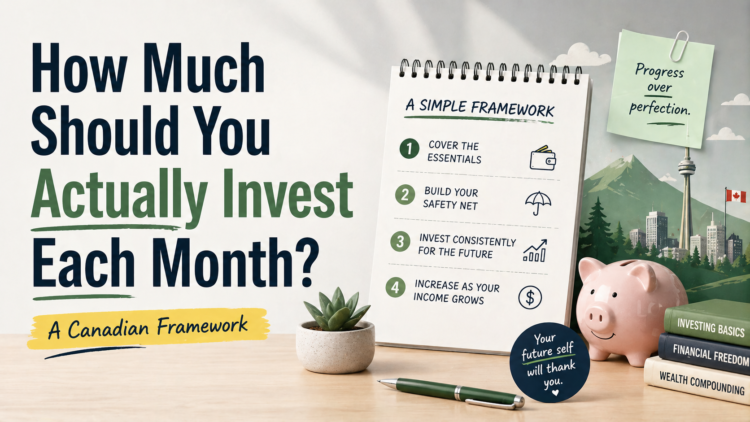
At some point, almost every Canadian who starts taking money seriously asks the same question: how much should I actually be investing each month? Not what the textbooks say. Not what sounds impressive. What’s the real number, given your income, your accounts, and the life you’re actually living?
The honest answer is that there is no universal number. But there is a framework. And once you understand it, the answer for your situation becomes surprisingly clear. This article will walk you through that framework, with Canadian accounts and real contribution limits at the centre of it.
Start With What You Can Afford to Lock Away
Before you think about how much to invest, you need to separate investing money from spending money and emergency money. These are three distinct buckets, and confusing them is one of the most common financial mistakes Canadians make.
Investing money is money you will not touch for at least five years, ideally much longer. If you might need it in two years for a car, a wedding, or a slow patch at work, it is not investing money yet. It belongs in a high-interest savings account or a short-term GIC, not in XEQT.
This is not a pessimistic view. It is a realistic one. The market can drop 30% in a bad year. If you need the money during that drop, you are forced to sell at the worst possible time, and the entire point of long-term investing is lost. Before you invest a single dollar monthly, make sure you have three to six months of expenses sitting somewhere liquid and boring.
The investor who can stay invested through a 30% drop beats the one who panic-sells every time. The only way to stay invested is to not need the money you’ve put in the market.
The Pay Yourself First Principle, Applied to Canada
Once your emergency fund is in place, the most reliable way to build wealth is to automate your investment contributions before you have a chance to spend the money. This is called paying yourself first, and the research behind it is consistent: people who automate savings accumulate significantly more wealth than those who invest whatever is left at the end of the month, because most months, nothing is left.
In Canada, this means setting up an automatic contribution to your TFSA, RRSP, or FHSA on payday. Wealthsimple makes this extremely simple with their recurring buys feature. Questrade requires a bit more manual setup but supports pre-authorized contributions as well. Either way, the mechanics take about ten minutes once your account is open.
The specific amount matters less than the consistency. A Canadian who invests $300 a month starting at 25 and never increases that amount will build a more substantial portfolio than one who invests $800 a month starting at 38. Time in the market is the compounding engine. The monthly contribution is just the fuel.
2026 Registered Account Limits: TFSA contribution room is $7,000 per year for 2026, plus any unused room from prior years. RRSP is 18% of your prior year’s earned income (up to the annual maximum). FHSA allows $8,000 per year up to a $40,000 lifetime limit for first-time home buyers. These are the three accounts to prioritize before touching a taxable account.
A Simple Framework: The Three-Layer Approach
Here is the framework that works for most Canadians in accumulation mode. Think of it as three layers, each building on the last.
Layer one is your TFSA floor. The TFSA is the most flexible registered account Canada offers. Growth is tax-free, withdrawals are tax-free, and the room comes back the following year when you withdraw. If you are not maxing your TFSA first, start there. Divide your annual contribution room by 12 to get your monthly target. For 2026, that is roughly $583 per month to max the year’s new room. If you have unused room from previous years, you can contribute more in a lump sum or increase the monthly amount.
Layer two is your RRSP, sized to your tax bracket. The RRSP makes the most sense when your current income tax rate is higher than your expected retirement tax rate. If you are earning a solid income now and expect a more modest retirement income, RRSP contributions generate a tax refund that effectively boosts your return. The contribution limit is 18% of your prior year’s earned income, and if you have unused room, you can carry it forward indefinitely. A reasonable monthly RRSP target for someone in the 33% to 43% marginal tax bracket is whatever gets you close to the annual limit without creating cash-flow strain.
Layer three is the FHSA if you qualify. If you are a first-time home buyer in Canada, the FHSA is an extraordinary account. Contributions are tax-deductible like an RRSP, growth is tax-free like a TFSA, and qualifying withdrawals for a first home are also tax-free. The annual limit is $8,000 and the lifetime limit is $40,000. That works out to $667 per month to max it in a year. If you are saving for a home in the next several years, this account should be ahead of or alongside your TFSA.
The FHSA is genuinely one of the best accounts the Canadian government has ever created. If you’re a first-time buyer and you’re not using it, you’re leaving a significant tax advantage on the table every single year.
What Percentage of Income Should You Target?
Rules like “save 20% of your income” are useful starting points but not gospel. The right percentage depends on when you started, what you want retirement to look like, and what other income sources you will have, including CPP and OAS.
CPP is worth thinking about more carefully than most Canadians do. If you have been working and contributing for most of your career, CPP at 65 can replace a meaningful portion of pre-retirement income. OAS adds another layer at 65, with the option to defer both to increase payments. These government benefits reduce how much your portfolio needs to generate in retirement, which in turn affects how aggressively you need to save now.
For most Canadians who started investing in their 20s or early 30s, research suggests that saving between 15% and 20% of gross income is sufficient to retire comfortably in their mid-60s, assuming a reasonable rate of return and continued CPP contributions. If you are starting in your 40s, that number needs to climb toward 25% to 30%, and you may need to adjust retirement timing or spending expectations accordingly.
The key point is this: pick a percentage, automate it, and increase it by 1% every year or every time you get a raise. That incremental increase is nearly invisible to your lifestyle but dramatic over a 20-year accumulation period.
Quick Sanity Check: If you earn $80,000 per year and invest 15%, that is $12,000 annually or $1,000 per month. A maxed TFSA takes $583. The remaining $417 can go to RRSP or FHSA depending on your situation. This is a realistic, achievable target for a median Canadian income, and it requires no financial heroics.
Where XEQT Fits Into All of This
Once you know how much to invest and where the money is going, the next question is what to buy. The answer, for most Canadians, is XEQT inside your registered accounts and leave it alone.
XEQT is iShares Core Equity ETF Portfolio, a single ETF holding over 9,000 stocks across Canada, the US, international developed markets, and emerging markets. The MER is 0.20%, which is a fraction of what most Canadian mutual funds charge. You buy one thing, once a month, and you own the global market. There is no rebalancing required. There is no fund manager to monitor. There are no quarterly calls with an advisor who earns a trailer fee for keeping you in mediocre funds.
The argument against XEQT is usually that it holds no bonds, making it purely equity and therefore volatile. That is accurate. In a bad year, XEQT can drop 30% or more. But if your investment horizon is 15-plus years and you have your emergency fund properly funded, short-term volatility is the price of admission for long-term equity returns. For investors closer to retirement who need to reduce risk, shifting to XGRO or XBAL makes sense, but for most working Canadians in accumulation mode, 100% equities in a globally diversified ETF is a defensible and well-supported position.
Commission-based financial planners will not recommend XEQT because they earn nothing from it. That is not a conspiracy theory. It is simply how trailer fees work. The fact that advisors avoid it is, if anything, a mark in its favour.
The simplest investment strategy that a Canadian can execute consistently is more powerful than a complicated one executed inconsistently. Boring beats brilliant over 30 years.
Common Mistakes That Derail Monthly Investors
There are a few patterns that consistently undermine otherwise solid investment plans, and they are worth naming directly.
Waiting for the right time. Every month you delay investing because markets feel uncertain or overvalued is a month of compounding you cannot recover. Research consistently shows that time in the market outperforms attempts to time the market. Invest on a fixed schedule regardless of what the news cycle says.
Under-insuring against life events. If a disability or illness forces you to raid your investments early, all the careful planning evaporates. Canadians with dependents or significant debt should ensure they have adequate disability and life insurance before aggressively investing. Many employer group plans provide a baseline, but it is often insufficient.
Treating the TFSA as a savings account. Millions of Canadians hold cash or GICs inside their TFSA instead of growth assets, which defeats a large part of the account’s purpose. The TFSA contribution room is precious. For money you will not need for five or more years, holding equities inside the TFSA is almost always the right call.
Increasing lifestyle before increasing savings. When income rises, the natural instinct is to upgrade lifestyle first and invest the difference. The more reliable path is to automate a portion of every raise directly into your investment accounts before it touches your chequing account. You cannot spend what you never see.
Adjusting the Number as Life Changes
Your monthly investment amount is not static. It should increase when your income increases, decrease temporarily if you face a genuine financial hardship, and shift in priority between accounts as your situation evolves.
A couple in their early 30s with a first home in their sights should prioritize FHSA and TFSA over RRSP. That same couple at 40 with a mortgage well underway and peak earning years ahead should be directing more aggressively into the RRSP to capture the deduction at their highest marginal rate. At 55 with retirement in sight, the focus shifts toward not over-contributing to the RRSP if their income will drop sharply, and ensuring enough accessible money sits in the TFSA for retirement flexibility without triggering OAS clawbacks.
The framework is the same throughout. What changes is the weighting between accounts. A fee-only financial planner, one who charges you directly rather than earning commissions on products, can be worth consulting at major life transitions precisely to get that weighting right. The rest of the time, you do not need ongoing advice. You need a good system running on autopilot.
Account Priority Order for Most Canadians: 1. Emergency fund first, before any investing. 2. FHSA if you are a first-time buyer. 3. TFSA for flexibility and tax-free growth. 4. RRSP if your marginal rate is high enough to benefit from the deduction. 5. Non-registered account once registered room is exhausted or inaccessible.
Frequently Asked Questions
What if I can only afford to invest $100 or $200 a month? Invest it. A small consistent amount started early beats a larger amount started late almost every time. Both Wealthsimple and Questrade have no account minimums, so there is no barrier. Buy whatever whole units of XEQT $100 or $200 will get you, and increase the amount as your income grows. Wealthsimple’s fractional share feature means you can invest the exact dollar amount without worrying about share prices.
Should I pay down debt or invest? It depends on the interest rate. High-interest debt, anything above 6% or 7%, should almost always be paid down before investing because the guaranteed return of eliminating that interest is hard to beat. Low-interest debt like a mortgage at 3% to 5% can reasonably be carried alongside investing, since long-run equity returns have historically exceeded that threshold. Student loans fall somewhere in between depending on the rate.
Do I need to worry about what month I invest, or should I invest all at once? Monthly contributions are generally the right approach for most Canadians because they match cash flow, and the discipline of automating them is more important than trying to optimize the timing. If you receive a lump sum such as a tax refund or bonus, investing it promptly beats holding it in cash waiting for a better entry point. Lump sum investing outperforms dollar-cost averaging on average, but the psychological benefit of spreading it out is real and not nothing.
How do I know if my monthly investment amount is actually enough for retirement? A rough check is to multiply your current annual expenses by 25. That is the portfolio size you need to support your spending indefinitely at a 4% withdrawal rate, a figure supported by decades of research. Work backward from that number using a compound interest calculator with a 6% to 7% nominal return assumption and your current age. The monthly contribution that gets you to that target by your intended retirement age is your number. If it is more than you can manage right now, adjust your retirement age or reduce your target spending, and revisit annually.