XEQT Pays Dividends? What the Quarterly Distribution Actually Means for You
September 14, 2026

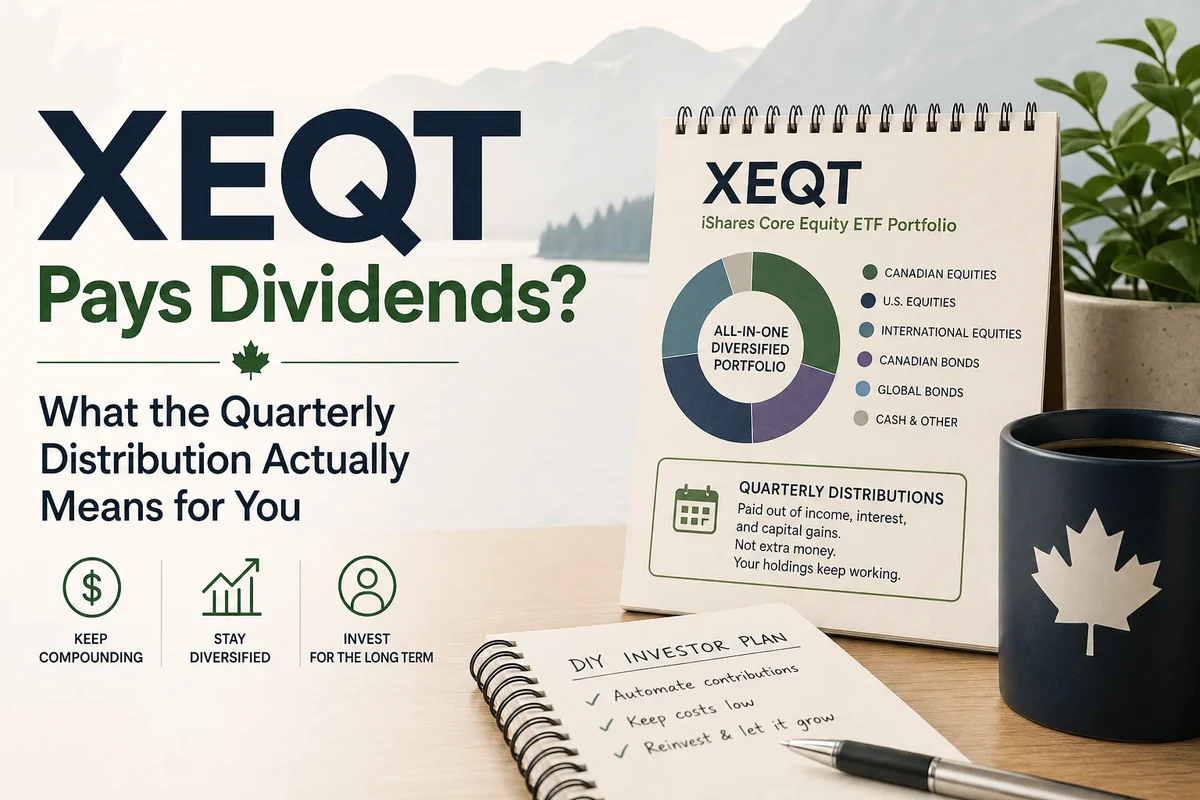
Every few weeks, someone on r/PersonalFinanceCanada asks a version of the same question: does XEQT pay dividends? The answer is yes, but the more useful answer is: it doesn’t matter nearly as much as you think, and if you’re in your 30s or 40s, you should probably stop looking at that number entirely. XEQT pays quarterly distributions, not dividends in the traditional sense. The distinction is mechanical, it has real tax consequences, and confusing the two leads accumulation-phase investors to make decisions that quietly reduce their long-run returns.
Why XEQT “Dividends” Confuse Everyone
XEQT is a fund-of-funds. It holds four underlying iShares ETFs: XUU (US equities), XIC (Canadian equities), XEF (international developed markets), and XEC (emerging markets). Each of those underlying funds collects dividends and distributions from the thousands of companies it holds. That income pools inside the underlying ETF, then gets passed upward to XEQT itself, which bundles it and distributes it to you four times per year.
That’s the key word: pass-through. XEQT isn’t generating income independently. It isn’t a company with retained earnings choosing to reward shareholders. It’s a holding structure that receives income from its underlying funds and hands it down to unitholders. Calling that a “dividend” isn’t technically wrong, but it creates the impression that XEQT has chosen to share profits with you, the way Royal Bank pays its dividend. What’s actually happening is more like: a global pool of 9,000 companies paid dividends and interest to their funds, those funds paid it up to XEQT, and XEQT passed it to your brokerage account. The payout reflects what the underlying world equity markets paid out that quarter, nothing more.
XEQT distributions are not a feature of the ETF’s strategy. They’re a byproduct of holding global equities that pay dividends. The ETF itself has no yield target, no payout policy, and no management decision about income.
This matters because investors who see “distributions” start treating XEQT like a dividend stock, comparing its yield to GICs or income ETFs, and sometimes even choosing between ETFs based on yield. That is the wrong frame entirely for a 100% equity accumulation vehicle.
The Quarterly Schedule: What Actually Hits Your Account
XEQT distributes on a quarterly basis, with ex-dividend dates typically falling in late March, late June, late September, and late December. Based on verified live data, the most recent eight distributions were: $0.094 in September 2024, $0.275 in December 2024, $0.090 in March 2025, $0.267 in June 2025, $0.100 in September 2025, $0.205 in December 2025, $0.091 in March 2026, and $0.322 in June 2026.
Notice the variation. The December quarter consistently runs higher because year-end income from the underlying funds accumulates and gets distributed together. March tends to be the lightest quarter. With XEQT trading around $45.29 and a trailing four-quarter yield of approximately 1.59%, you’re looking at roughly $0.72 per unit per year at current distribution levels. On a $50,000 position, that’s about $360 per year in distributions before any tax considerations. That number probably isn’t changing your life, and it shouldn’t be part of your reason for holding this ETF.
Trailing 4-quarter yield: XEQT’s distribution yield is approximately 1.59% at current prices (~$45.29 CAD). The December payout is typically the largest, as year-end income from underlying funds is bundled and distributed. Quarter-to-quarter variation is normal and expected.
One more thing worth knowing: when you receive a distribution, the unit price of XEQT drops by roughly the distribution amount on the ex-dividend date. A $0.32 distribution means the price falls by approximately $0.32. Your total wealth hasn’t changed in that moment. The distribution is not free money added to your account, it’s your own money being returned to you in a different form. This is true for all ETF distributions and it’s the clearest illustration of why chasing yield in an accumulation portfolio is a mathematical non-starter.
How DRIP Works Across Canadian Brokerages
A Dividend Reinvestment Plan (DRIP) automatically uses your cash distributions to purchase additional units of XEQT instead of leaving the money sitting as cash. XEQT is DRIP-eligible at Wealthsimple, Questrade, and Interactive Brokers.
At Wealthsimple, DRIP enrollment is available directly in the app. Navigate to the position, look for the reinvestment toggle, and enable it. Wealthsimple supports fractional DRIPs, meaning your full distribution amount is reinvested regardless of whether it covers a whole unit. If a distribution of $0.32 per unit lands in your account and a unit costs $45, Wealthsimple buys fractional units to deploy the full amount. No cash sits idle.
At Questrade, the DRIP setup requires contacting their support team or submitting a form, as it isn’t always toggleable in the interface. Questrade’s DRIP purchases only whole units, meaning if your distribution doesn’t cover one full share, the remainder lands as cash. For smaller portfolios, this can mean distributions pool as cash for a quarter or two before a full unit can be purchased. It’s not a serious drag, but it’s worth knowing. At the major bank brokerages, DRIP availability for XEQT varies. Some, including RBC Direct Investing, have reportedly not supported DRIP for XEQT in the past, even while supporting it for other ETFs like VEQT. If you hold XEQT at a big bank and DRIP isn’t available, manually reinvesting each quarter by placing a new purchase is a perfectly functional alternative.
The Canadian Portfolio Manager blog ran the numbers on DRIP versus manual annual reinvestment using XIC data and found the return difference was small enough that the approach matters far less than simply staying invested and reinvesting consistently. That’s the practical takeaway. What does matter: don’t leave distributions sitting as uninvested cash in a taxable account longer than necessary. That’s where the real cost compounds.
Registered vs. Non-Registered: Where the Tax Picture Actually Diverges
The account where you hold XEQT changes the tax math on distributions significantly. In a TFSA, distributions land in your account and are reinvested completely tax-free. There is no CRA reporting, no income inclusion, no adjustment to anything. This is the cleanest possible scenario for distribution handling. The one friction worth acknowledging: XEQT holds US equities through XUU, and US dividend income paid to a TFSA is subject to a 15% withholding tax under the Canada-US tax treaty. This withholding happens inside the fund before distributions reach you, so you never see it directly, but it represents a small drag of approximately 0.22% annually. You can’t recover it in a TFSA. For most investors, this is an acceptable cost for the simplicity and total tax freedom a TFSA provides.
In an RRSP, the same 15% US withholding tax is eliminated entirely. The Canada-US tax treaty grants full exemption for US-source income held in registered retirement accounts. This makes an RRSP technically the most tax-efficient account for holding XEQT from a withholding tax perspective. Distributions inside an RRSP compound tax-deferred and only become taxable when withdrawn, at which point they’re taxed as ordinary income.
Account efficiency for XEQT distributions: RRSP eliminates US withholding tax entirely (0%). TFSA and FHSA carry ~15% US withholding on the US-equity portion, roughly 0.22% annual drag. Non-registered accounts also face 15% withholding on US dividends, but you can claim a foreign tax credit at filing to recover part of it. Distributions appear on a T3 slip, not a T5, since XEQT is structured as a trust, not a corporation.
In a non-registered account, distributions trigger immediate taxable income in the year you receive them. The income type matters: Canadian eligible dividends from XIC qualify for the dividend tax credit, which reduces the effective tax rate. But foreign income from US and international holdings is taxed as regular income, and the 15% US withholding is creditable against your Canadian tax bill via the foreign tax credit on your return. For investors in higher tax brackets, this can mean a meaningful portion of every distribution dollar goes to tax before any reinvestment. Crucially, enabling DRIP in a non-registered account does not eliminate this tax. The distribution is still reported as income in the year it’s paid, even if it’s immediately reinvested. You’ll owe the tax come April regardless of what your brokerage did with the cash.
Distributions from XEQT also show up on a T3 slip, not a T5. This is a point of genuine confusion at tax time. XEQT is structured as a trust, not a corporation, so its income passes to unitholders via T3 (Statement of Trust Income Allocations and Designations). If you’re searching for your XEQT income in the T5 section of your tax software, you won’t find it. Look for your T3.
The Total Return Reality: Distributions Are a Rounding Error
BlackRock’s published annual returns show that XEQT was down 10.93% in 2022, up 17.05% in 2023, up 24.67% in 2024, and up 20.45% in 2025. The trailing four-quarter distribution yield sits at approximately 1.59%. The math is straightforward: in a year when the fund gained over 24%, your 1.59% distribution represented a small fraction of your total gain. The other gains came from the underlying equity markets increasing in value. Capital appreciation is where XEQT does its work. Distributions are residue from that process.
Optimizing around XEQT’s 1.59% yield while ignoring the 20%+ annual equity return swings is like obsessing over the garnish while your steak is cooking. The yield isn’t the meal.
This is the core issue with yield-chasing as a strategy. A higher yield number on an ETF doesn’t mean a better investment. It often means the opposite. Dividend-focused ETFs concentrate in a smaller set of income-producing companies, frequently at higher fees, while delivering comparable or lower total returns than a broad market index. The evidence from independent Canadian investment research consistently supports this conclusion: high-yield stock tilts haven’t reliably outperformed total market indexes over long periods on a total return basis. They just pay more cash and grow more slowly.
For a deeper look at the full XEQT structure and what you’re actually buying, this complete XEQT guide covers the fund’s construction, underlying ETFs, and what the all-equity allocation means for your portfolio long-term.
When Should You Actually Care About Distributions?
If you’re in the accumulation phase, meaning you’re working, contributing regularly, and not drawing income from your portfolio, the honest answer is: almost never. Reinvest whatever lands, via DRIP or manual purchase, and move on. The quarterly payout is not a signal about XEQT’s health or a reason to change your approach. It’s a mechanical byproduct of global equities paying dividends to their shareholders.
Distributions begin to matter meaningfully when you shift into decumulation. If you’re in or near retirement and your plan involves living off your portfolio, the quarterly distribution provides a layer of cash flow that can supplement CPP and OAS without requiring you to sell units. A $500,000 XEQT position generating approximately 1.59% annually delivers roughly $7,950 per year in distributions. That won’t replace employment income on its own, but combined with CPP and OAS, it contributes to a real withdrawal strategy without the mechanical selling of units every time you need cash.
For most investors under 55, though, this framing is premature and occasionally harmful. When you start thinking of your XEQT distributions as “income,” you start making decisions that optimize for income at the expense of total return. That is the first step toward a portfolio full of dividend ETFs, preferred shares, and covered call strategies that feel productive while delivering less compound growth over 20 to 30 years.
If you’re thinking about how to draw down your XEQT portfolio in retirement, including how distributions interact with a sustainable withdrawal rate, the XEQT withdrawal strategy guide covers that in detail.
Setting Up DRIP: The Practical Version
At Wealthsimple, find the XEQT position in your portfolio, tap the three-dot menu or the position detail screen, and look for the “Dividend Reinvestment” or “DRIP” option. Toggle it on for each account separately, your TFSA and RRSP DRIPs are configured independently. Wealthsimple’s fractional DRIP means 100% of your distribution is reinvested automatically without any cash pooling.
At Questrade, DRIP enrollment is handled through the platform’s settings under “Dividend Reinvestment Plan,” or by contacting their customer support team. Because Questrade only purchases whole units, any fractional distribution remainder accumulates as cash. The practical workaround: once accumulated cash approaches a full unit price ($45 or so), place a manual buy order. For most XEQT holders at Questrade who are also making regular contributions, this cash gets swept into the next purchase naturally. It’s a minor inconvenience, not a structural problem.
For investors at major bank brokerages, call and ask specifically whether XEQT is eligible for DRIP in your specific account type. If the answer is no, take note of when each quarterly distribution lands and set a calendar reminder to manually reinvest within a week or two. In a TFSA or RRSP this is a convenience issue only. In a non-registered account, the cash will generate taxable income either way, so the reinvestment timing doesn’t change your tax bill, but getting it back into the market promptly avoids idle cash drag.
XEQT vs. Dividend-Focused ETFs: The Yield Comparison That Misleads
A common comparison surfaces when investors first discover XEQT’s ~1.59% yield: why not buy a dedicated dividend ETF that pays 3%, 4%, or higher? The BMO Covered Call Canadian Banks ETF (ZWB) and the iShares S&P/TSX Canadian Dividend Aristocrats ETF (CDZ) are two popular examples. ZWB currently trades around $30.36 and uses a covered-call strategy on Canadian bank stocks to generate elevated income. CDZ, trading around $45.23, focuses on Canadian dividend growth stocks.
A higher yield number isn’t a better investment, it’s often a trade. You’re trading capital appreciation potential for cash flow today. In an accumulation portfolio with a 20-year runway, that trade is rarely in your favour.
Both of these ETFs do what they’re designed to do. The issue is that what they’re designed to do doesn’t serve most accumulation-phase investors well. Covered call strategies like ZWB cap upside participation in exchange for premium income. In bull markets, you collect the premium but miss the gains above the strike price. Over a full market cycle, covered call strategies tend to underperform simple buy-and-hold on total return, because the premium income doesn’t compensate for the surrendered upside. CDZ concentrates in Canadian dividend payers, which means heavy financials and energy exposure, far less diversification than XEQT’s roughly 9,000 global holdings, and a structural Canadian home-country bias layered on top of what XEQT already provides at a measured 25%.
For investors who want to compare XEQT against other all-in-one ETFs on structure, fees, and diversification rather than yield, the best all-in-one ETF comparison covers the Canadian landscape in full.
The practical summary: if you need cash flow from your portfolio today, dividend ETFs serve a real purpose. If you’re 35 years from retirement and want maximum total wealth at the end of your working life, XEQT’s global diversification and 0.20% MER are doing more work for you than a higher yield from a concentrated Canadian income fund.
Frequently Asked Questions
Does XEQT pay dividends? XEQT pays quarterly distributions, not dividends in the traditional sense. The payouts are pass-throughs of income collected by the four underlying iShares ETFs from approximately 9,000 global companies. The trailing yield is approximately 1.59% at current prices. These distributions appear on a T3 slip, not a T5.
Do I have to pay tax on XEQT distributions? It depends on the account. In a TFSA or RRSP, distributions reinvest tax-free or tax-deferred with no annual reporting required. In a non-registered account, distributions are taxable income in the year you receive them, regardless of whether you reinvest via DRIP. Canadian eligible dividends receive the dividend tax credit, foreign income is taxed at your marginal rate, with a partial foreign tax credit available for US withholding taxes paid.
Should I enable DRIP for XEQT in my TFSA? Yes, generally. If your brokerage supports it, DRIP keeps your full distribution working in the market rather than sitting as idle cash. Wealthsimple’s fractional DRIP is the most efficient setup available in Canada. Questrade’s whole-unit DRIP leaves small cash remainders, but these get swept into your next manual contribution. In a TFSA there’s no tax complication to consider, it’s a pure efficiency question.
Why does XEQT’s distribution vary so much by quarter? The December distribution is consistently the largest because year-end income from the underlying ETFs accumulates and is distributed in bulk. March tends to be the smallest quarter. This variation reflects the payout timing of global companies inside the underlying funds, not any change in XEQT’s strategy or health. The variation is normal, expected, and no cause for concern.