XEQT vs XGRO: Which One Actually Fits Your Portfolio
May 6, 2026

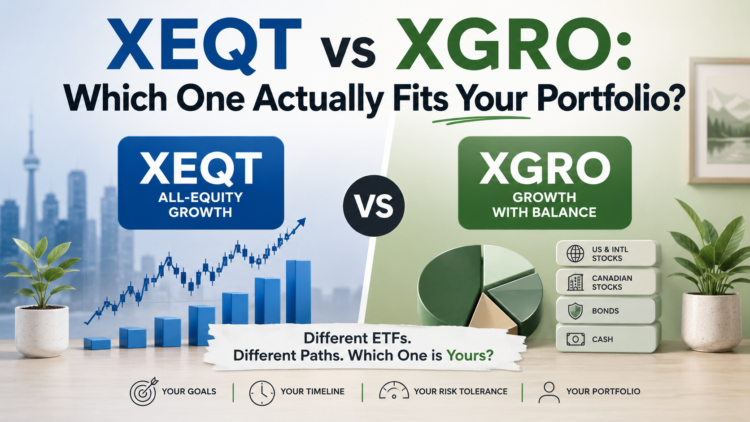
At first glance, XEQT and XGRO look like twins. Both are BlackRock iShares all-in-one ETFs. Both carry a 0.20% MER. Both trade commission-free on Wealthsimple and Questrade. Both hold thousands of global equities under the hood. And yet the choice between them is one of the most consequential decisions a Canadian DIY investor will make, because it shapes your portfolio’s volatility profile, tax efficiency, and long-run return trajectory for potentially decades.
The difference comes down to one number: 20. XGRO holds roughly 80% equities and 20% fixed income. XEQT holds 100% equities and zero bonds. That sounds simple. But the downstream effects of that 20% bond allocation, across different account types, different investor temperaments, and different time horizons, are anything but simple. This article is going to walk through those effects honestly, without the hedge-everything language you’ll get from most financial media.
The Core Trade-Off: Equity Concentration Versus Bond Ballast
XEQT is a pure equity bet on global markets. It holds Canadian, US, international developed, and emerging market equities with no cushion. When markets fall 30%, XEQT falls close to 30%. When markets rip higher for a decade, XEQT captures all of it. There is no dampening mechanism built in. You own the full ride.
XGRO introduces a 20% fixed income allocation as a structural brake. In theory, when equity markets sell off, bonds hold their value or even appreciate, which softens the portfolio drawdown. The cushion is real, not imaginary. During the COVID crash in early 2020, XGRO held 80% equities and 20% bonds and did not fall as far as the all-equity ETFs on March 23, 2020, the market low. It also did not rise as high on February 20, 2020, the pre-crash peak. The bonds functioned exactly as designed.
What this means practically is that XGRO will lag XEQT in bull markets and protect somewhat more in sharp bear markets. Over very long periods, 20 years or more, that lagging return compounds into a real gap. Over shorter periods, the protection matters more. The honest question to ask yourself is not “which fund is better” but “which fund will I actually stay invested in when things get ugly.”
The best investment strategy is the one you can execute without panicking. A 100% equity fund that you sell at the bottom is strictly worse than an 80% equity fund you hold through the downturn.
Where XGRO Actually Earns Its Keep: The Behavioral Case
Financial planning research consistently shows that investor returns trail fund returns because people buy high and sell low. The gap between what a fund returns and what the average investor in that fund actually earns is sometimes called the “behavior gap,” and it is particularly wide for high-volatility portfolios.
XGRO’s 20% bond allocation does not just reduce volatility mathematically. It reduces the psychological pressure to act when markets drop. If your portfolio falls 25% instead of 32% during a correction, you are less likely to open your brokerage app at midnight and sell everything. That behavioral protection has real dollar value, even though it never shows up in a fund’s published performance numbers.
For investors who are newer to market cycles, who watched their portfolio in 2020 or 2022 and felt genuinely anxious, XGRO is not a lesser choice. It is a more realistic choice. There is no trophy for holding the highest-volatility portfolio. There is only the compounded return you actually received over your investing lifetime.
COVID-19 crash data point: During the February to March 2020 market correction, XGRO’s 20% bond allocation meant it fell less severely than all-equity ETFs at the March 23 low. XGRO also rose less at the February 20 peak. The bonds worked as intended, providing a modest but real cushion at the worst moment.
The Hidden Cost: How the Same MER Plays Differently by Account Type
Both XEQT and XGRO have a 0.20% MER. On a $100,000 portfolio, that is $200 per year in management fees for either fund. The fee argument alone gives you no reason to choose one over the other. But account type changes the calculus in a way most comparisons skip over.
Inside a TFSA or RRSP, the tax treatment of income is identical regardless of whether it comes from bond interest or equity dividends. Everything compounds tax-sheltered. In this environment, the only thing that matters is after-fee return, and since XEQT holds more equities, it will likely deliver higher long-run returns inside tax-sheltered accounts, assuming you can tolerate the volatility.
In a taxable account, the 20% bond allocation in XGRO creates a structural disadvantage. Bond interest is taxed at your full marginal rate, the same rate as employment income. Equity dividends from Canadian companies get the dividend tax credit. Capital gains get a 50% inclusion rate (for most Canadians, under the $250,000 annual threshold). So the income generated by XGRO’s bond sleeve is taxed more harshly than the income generated by XEQT’s equity holdings, all else equal. If you are investing in a taxable account, XEQT’s all-equity structure is more tax-efficient by construction.
XGRO’s distribution yield is also higher than XEQT’s, largely because bonds pay regular interest that flows through as distributions. In a taxable account, those distributions trigger a tax event every year whether you want them to or not. XEQT’s distributions are lower and more equity-heavy, which means less annual tax drag for taxable investors who would prefer to defer gains.
Account priority framework: XEQT is generally preferable in TFSA, RRSP, and FHSA accounts (2026 TFSA limit: $7,000; FHSA limit: $8,000/year up to $40,000 lifetime). For taxable accounts, XEQT’s all-equity structure also tends to be more tax-efficient than XGRO’s bond-inclusive distributions. Max your registered accounts first before worrying about taxable account optimization.
Exposure Gaps: The US Tilt and Canada Underweight in XGRO
Here is something the surface-level comparison misses entirely. XGRO and XEQT do not just differ in bond allocation. They have meaningfully different equity exposures, and those differences have implications for currency risk and sector concentration.
XGRO holds approximately 36.5% in US equities and only 19.63% in Canadian equities, the lowest Canadian equity weighting among the major growth all-in-one ETFs in Canada. For comparison, VGRO holds roughly 23.2% in Canadian equities and 31% in US equities. XGRO’s higher US tilt and lower Canada weighting means you are taking on more currency risk (your returns will be more sensitive to CAD/USD movements) and less exposure to Canadian-specific sectors like energy, financials, and materials.
Whether that is a feature or a bug depends entirely on your view. If you believe the US market will continue to dominate over the next 20 years, XGRO’s tilt is an advantage. If you believe Canadian equities are undervalued or that currency concentration is a meaningful risk for a Canadian investor who earns, spends, and retires in Canadian dollars, it is a liability.
Historical data since 2019 shows XGRO has slightly outperformed VGRO: 17.96% versus 17.66% in 2019, and a smaller loss in 2022 (negative 11.0% versus negative 11.21% for VGRO). That outperformance is partly explained by XGRO’s lower MER and partly by its higher US equity exposure during a period when the US market ran well ahead of global peers. It is not evidence of superior fund management. It is evidence of a tilted exposure that happened to be rewarded in that specific period.
XGRO’s slight historical outperformance over VGRO tells you more about the US market’s decade-long dominance than it tells you about BlackRock’s fund construction. Do not mistake a regional tailwind for a structural edge.
Distribution Yield and Tax Efficiency: Match the Fund to the Account
XGRO’s distribution yield sits higher than XEQT’s, driven by the bond interest flowing through its fixed income sleeve. For investors holding XGRO inside a TFSA or RRSP, this is irrelevant: distributions compound tax-free or tax-deferred, and the yield itself is not a performance advantage or disadvantage. You simply reinvest and move on.
For taxable account holders, however, the yield matters a great deal. Bond interest income is taxed at your full marginal rate in Canada. A higher-yielding fund held in a taxable account generates more annual tax liability, which reduces your compounding rate relative to a lower-distributing fund. XEQT’s lower yield and more equity-weighted distributions mean less friction in a taxable account over time.
This is not a reason to categorically avoid XGRO in a taxable account if its volatility profile genuinely suits you better. It is a reason to be clear-eyed about the cost. If you are maxing your TFSA ($7,000 per year in 2026), RRSP (18% of prior year income, up to the annual limit), and FHSA ($8,000 per year if eligible) before investing in a taxable account, the taxable account question is secondary. Most Canadians have years of registered room to fill before the taxable account optimization problem becomes urgent.
The Rebalancing Reality: Drift and Discipline Over Time
One underappreciated difference between these two funds is what happens to their asset allocation over time if you do nothing.
XEQT rebalances internally to maintain its target equity weights across Canada, US, international, and emerging markets. Because it holds only equities, there is no asset class drift. The fund stays 100% equities by construction. You never have to rebalance your holdings of XEQT to maintain your intended allocation. Buy it and leave it alone.
XGRO also rebalances internally, but its 80/20 split between equities and bonds is maintained by the fund’s internal mechanism. In extended equity bull markets, if XGRO did not rebalance, your effective equity exposure would creep upward as stocks outperform bonds. The fund’s internal rebalancing prevents this drift, which actually means XGRO is trimming equities and buying bonds during strong markets, a form of automatic discipline most investors could never enforce on themselves.
For a pure set-and-forget investor, both funds deliver. But XEQT’s simplicity is cleaner because there is no bond allocation to second-guess. You will never wonder whether XEQT’s internal rebalancing bought bonds at the wrong time. It simply does not own bonds.
Internal rebalancing in XGRO is a genuine benefit, not a marketing line. It forces the fund to systematically buy bonds when equities are up and to hold a larger equity weight when bonds have run. Most investors cannot do this manually without flinching.
Time Horizon as the Real Decider
This is the question that actually settles the XEQT versus XGRO debate for most people: how many years until you need the money?
For investment timelines of 15 years or more, the mathematical case for 100% equities is strong. The historical evidence shows that over long horizons, the added return from eliminating bonds more than compensates for the higher volatility experienced along the way. For RESPs with a 12-plus year horizon, for example, research supports holding all-equity ETFs like XEQT rather than a growth fund like XGRO precisely because bond drag becomes measurable over that timeline.
For timelines under 10 years, the calculus shifts. If you are five years from retirement, or five years from a down payment, bonds reduce the probability of a catastrophic sequence-of-returns scenario at the worst possible moment. Sequence-of-returns risk, the danger of experiencing large losses right before or right after you start drawing down, is the central risk in near-retirement portfolios. XGRO’s bond cushion provides genuine protection here, not just behavioral comfort.
For investors in the accumulation phase of FIRE planning, with 15 or 20 years of runway ahead, XEQT is almost certainly the better instrument. The volatility is real but manageable, and the compounding advantage of 100% equity exposure is significant over that horizon. For investors approaching the decumulation phase, or already in it, XGRO’s structure deserves serious consideration, and a transition toward even more conservative allocations (XBAL or a custom mix) may be appropriate regardless of which fund you currently hold.
The simple timeline rule: 15-plus years to drawdown, XEQT. Under 10 years to drawdown, XGRO or more conservative. Between 10 and 15 years, your own emotional response to a 30% drop is the deciding variable, not the math.
The Bottom Line: Who Should Own Which Fund
XEQT is the right fund for most Canadians who are in the early to mid stages of their investing life, who have stable employment income, who understand that equity markets drop sharply and recover, and who will not check their portfolio balance every week during a correction. It is cleaner, simpler, more tax-efficient in taxable accounts, and will almost certainly deliver higher long-run returns for the same cost.
XGRO is not a lesser fund. It is a different fund, appropriate for investors who have genuinely experienced their reaction to portfolio volatility and found it difficult. It suits investors within a decade of retirement, investors with lower risk capacity due to income instability, or investors holding significant assets in taxable accounts who want a slightly more moderate distribution profile while still maintaining substantial equity exposure.
Both funds come from the same issuer, carry the same MER, and are available commission-free on Questrade and Wealthsimple. The fund you actually hold through a bear market is the fund that builds your wealth. Choose accordingly.
Frequently Asked Questions
Is XGRO safer than XEQT? In terms of short-term volatility, yes. XGRO’s 20% bond allocation reduces peak-to-trough drawdowns during equity corrections. In terms of long-run purchasing power and wealth building over 20-plus years, XEQT is likely to deliver higher returns precisely because it holds no bonds. “Safer” depends entirely on which risk you are managing: short-term volatility or long-term underperformance.
Can I hold XGRO in my TFSA and switch to XEQT later? Yes, and many investors do this. Selling XGRO and buying XEQT inside a TFSA has no tax consequences. The switch is straightforward through any discount broker. The main consideration is timing: if you are selling XGRO during a downturn, you lock in a loss, which inside a TFSA means you also permanently lose that contribution room on the capital lost. There is no universally correct time to switch, but a strong equity market environment minimizes the room-loss issue.
Does XGRO’s higher US equity exposure make it riskier than XEQT in some ways? Yes. XGRO holds approximately 36.5% in US equities compared to XEQT’s lower US weighting and holds only about 19.63% in Canadian equities. This means XGRO investors have greater currency risk and more concentration in US market sectors. For Canadian investors who earn and spend in CAD, a heavier USD-denominated portfolio introduces exchange rate sensitivity that XEQT moderates somewhat with its more balanced regional allocation.
Which fund is better for a TFSA if I’m in my 30s? For most Canadians in their 30s with a 20-plus year investment horizon and stable employment, XEQT is the stronger choice inside a TFSA. The tax-sheltered environment eliminates the distribution-tax argument, the long timeline absorbs volatility, and 100% equity exposure will likely compound to a meaningfully larger balance by the time withdrawals begin. XGRO remains a legitimate choice if you know from experience that equity drawdowns cause you to lose sleep and consider selling.