
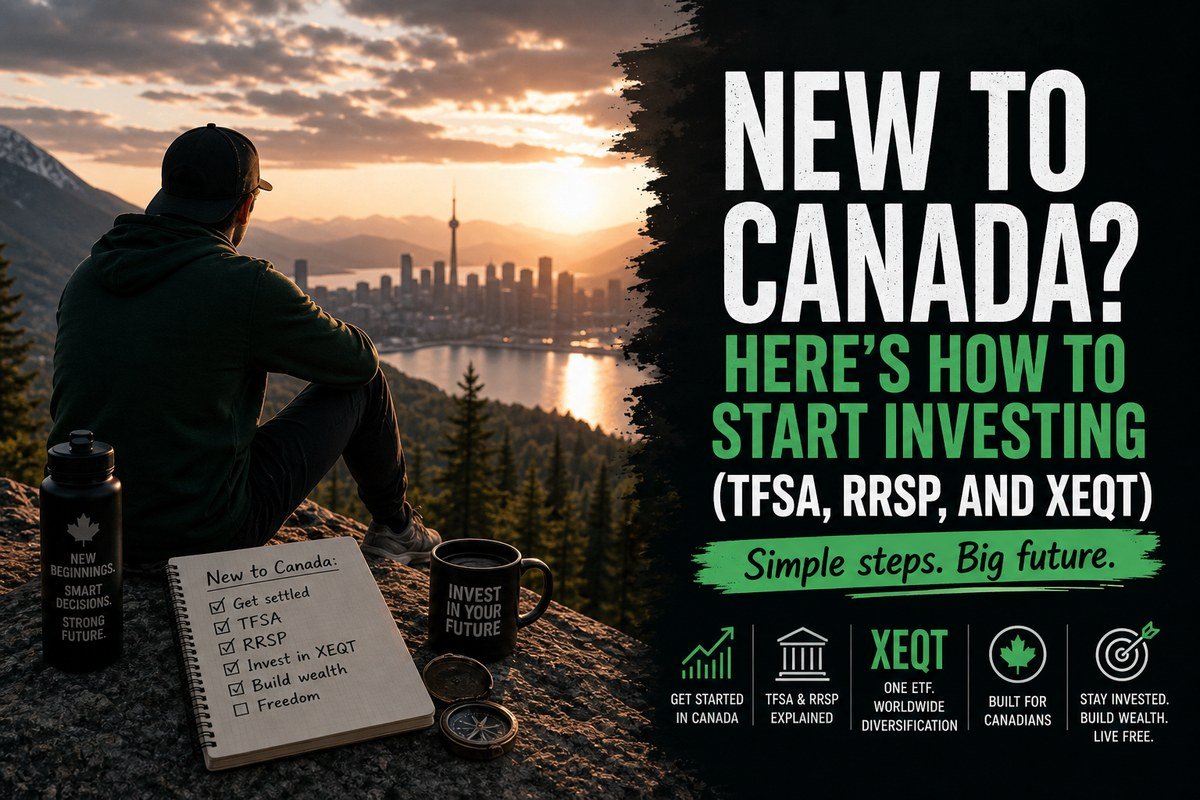
New to Canada? Here’s How to Start Investing (TFSA, RRSP, and XEQT)
May 11, 2026

Canada has one of the best systems in the world for building long-term wealth as an individual investor. The accounts are generous, the tax shelters are real, and the investment options are excellent. The problem is that almost nobody explains this system to people who didn’t grow up here. If you arrived in Canada as a permanent resident, skilled worker, or new citizen in the last few years, there is a reasonable chance you have a bank account, maybe a GIC, and a vague sense that you should be doing something called “investing”, but no clear picture of where to start. This article gives you that picture, plainly and directly.
The Canadian System Is Built Around Three Registered Accounts
Before you think about what to invest in, you need to understand where to invest, and what to invest in. Canada has three registered accounts that shelter your money from tax in different ways. Most Canadians use all three at different points in their lives. As a newcomer, understanding these accounts early is one of the highest-return financial decisions you can make, because the benefits compound for every year you have them open.
The Tax-Free Savings Account (TFSA) is the starting point for most people. Despite the name, it is not just for savings. You can hold stocks, ETFs, bonds, and GICs inside it. Any growth inside the TFSA is completely tax-free, and withdrawals are completely tax-free. There is no tax form to file, no income to declare. You contribute after-tax dollars, and everything that grows from there belongs entirely to you. The annual contribution limit for 2026 is $7,000.
The Registered Retirement Savings Plan (RRSP) is a tax-deferral account. Contributions reduce your taxable income in the year you make them, which means you pay less tax now. The money grows tax-sheltered inside the account, and you pay tax on withdrawals in retirement, ideally when your income is lower than during your working years. Your RRSP contribution room is 18% of your prior year’s earned income, up to a maximum of $32,490 for 2026.
The First Home Savings Account (FHSA) is a newer account, launched in 2023, and it is genuinely remarkable. It combines the best feature of the RRSP (contributions are tax-deductible) with the best feature of the TFSA (qualifying withdrawals for a home purchase are completely tax-free). If you have not owned a home in the current or prior four calendar years, you are likely eligible. The annual limit is $8,000 per year, with a $40,000 lifetime cap.
2026 Account Limits: TFSA: $7,000/year. RRSP: 18% of prior year earned income, up to $32,490. FHSA: $8,000/year, $40,000 lifetime maximum. All three accounts can hold XEQT and other ETFs.
When Can a Newcomer Actually Open These Accounts?
This is the question most guides skip, and it matters practically. Here is how eligibility works for each account.
For the TFSA, you are eligible as soon as you are a Canadian resident for tax purposes, at least 18 years old, and have a valid Social Insurance Number (SIN). You do not need to be a citizen. A permanent resident or a temporary resident on a valid work permit both qualify. The critical rule for newcomers is that your TFSA contribution room starts accumulating from the year you become a Canadian resident for tax purposes, not from 2009 like a Canadian who was born here. So if you arrived in 2023, you have accumulated room from 2023 onward only. Do not assume you have the full cumulative lifetime room that long-term residents have. Check your exact room in your CRA My Account portal before contributing.
For the RRSP, you can contribute as soon as you have filed a Canadian tax return showing earned income, because that is what generates contribution room. If you worked in Canada last year and filed a return, you have RRSP room equal to 18% of that earned income. Your Notice of Assessment from CRA confirms the exact number. The RRSP also does not require citizenship, just Canadian residency and earned income history.
For the FHSA, the rules are the same: Canadian resident, at least 18 years old, and no home ownership in the current or prior four years. Many newcomers qualify immediately upon arrival, which makes this one of the first accounts worth opening if you have any intention of buying a home in Canada.
Your TFSA contribution room begins the year you become a Canadian resident for tax purposes. If you arrived in 2022, your 2026 room is based on four years of accumulation, not the full lifetime total. Getting this wrong is the most common TFSA mistake newcomers make, and CRA charges 1% per month on excess contributions until they are withdrawn.
Which Account Should You Fill First?
For most newcomers, the answer is the TFSA first. Here is the reasoning.
When you first arrive in Canada, your income is often lower than it will be in five or ten years once you have established yourself professionally. The RRSP is most valuable when your marginal tax rate is high, because the deduction is worth more. If you are earning $50,000 to $70,000 in your early years here, contributing to the RRSP saves you some tax now, but you may well be in a similar or higher bracket in retirement. The TFSA is simpler and more flexible: the money grows tax-free, you can withdraw at any time without penalty, and withdrawals restore your contribution room the following January.
If you are planning to buy your first home in Canada within the next 15 years, open an FHSA as early as possible, even if you can only contribute a small amount. The carry-forward rules for the FHSA are strict: you can only carry forward a maximum of $8,000 in unused room per year. Opening the account and contributing even a modest amount starts the clock. The account has to exist before unused room begins accumulating.
Once your income grows and you are earning above roughly $80,000 to $90,000, the RRSP becomes increasingly worthwhile. At that income level, the marginal tax rate in most Canadian provinces puts you in a bracket where deferring income makes real financial sense. The FHSA guide on this site covers the interaction between all three accounts in more detail if you are weighing the home-buying decision specifically.
What Should I Actually Invest In?
Once your accounts are open and funded, you need to decide what to buy inside them. This is where a lot of newcomers get stuck, partly because Canadian financial institutions are very good at selling you their own products, and those products are often expensive and mediocre.
Bank advisors will frequently steer you toward mutual funds. These funds often carry management expense ratios (MERs) of 1.5% to 2.5% per year. That sounds small until you understand how fees compound against you over decades. Over a 30-year period, a high annual fee creates a meaningful and permanent drag on your ending balance compared to a low-cost alternative. Evidence on long-run fund performance consistently shows that the majority of actively managed funds underperform their benchmark index over time, especially after fees are accounted for.
The better path for most newcomers is a single all-in-one equity ETF. The one that most Canadian DIY investors land on is XEQT, the iShares Core Equity ETF Portfolio, listed on the Toronto Stock Exchange. It currently trades around $43 CAD, has an MER of just 0.20%, and gives you exposure to approximately 9,400 companies across four markets in one purchase.
XEQT holds roughly 45% US equities, 25% Canadian equities, 25% international developed markets, and 5% emerging markets. It rebalances automatically. You do not need to do anything to maintain that allocation over time. You buy it, keep contributing, and let it run. For a complete breakdown of what XEQT actually holds and how it is structured, the full XEQT guide on this site is the best place to start.
For a newcomer trying to build wealth in Canada, XEQT inside a TFSA is about as clean a starting point as exists. One account, one fund, automatic global diversification, a 0.20% annual cost, and zero action required beyond regular contributions.
Why XEQT Works Well for Newcomers Specifically
There is a behavioural case for XEQT that applies especially well to newcomers. When you are new to a country, you are already managing an enormous amount of complexity: building credit history, understanding a new tax system, navigating a new job market, possibly working through professional licensing processes, and making decisions about where to live long-term. Adding active portfolio management to that list is a recipe for either paralysis or expensive mistakes.
XEQT removes the investment complexity entirely. There is no decision about how much to allocate to Canada versus the US, no rebalancing task that needs scheduling, and no need to research individual companies or sectors. You contribute what you can afford, buy XEQT, and the fund handles the rest. The 0.20% MER means on a $10,000 portfolio you pay $20 per year in fees. A typical bank mutual fund in the same situation would charge many times that amount annually.
Because XEQT holds global equities without currency hedging, it also gives you natural diversification across currencies. Roughly 75% of XEQT’s exposure is outside Canada, mostly in US dollars and other major currencies. For a newcomer who may have financial ties in another country, or who is uncertain about long-term plans, that global footprint can be a genuine feature rather than a drawback. The CAD currently buys approximately $0.73 USD, and XEQT’s unhedged structure means a stronger US dollar tends to benefit Canadian holders in CAD terms.
XEQT at a glance: Price ~$43 CAD. MER: 0.20%. Holdings: ~9,400 global companies. Geographic mix: ~45% US, ~25% Canada, ~25% international developed, ~5% emerging markets. Automatic rebalancing. Eligible for TFSA, RRSP, FHSA, and non-registered accounts.
Where to Open Your Accounts
You have two main options as a Canadian DIY investor, and both are well-suited to newcomers because they have no account minimums and charge no commissions on ETF trades.
Wealthsimple is the simplest starting point. The app is clean, the account-opening process takes about 15 minutes on your phone, and you can buy fractional shares of XEQT, meaning you can invest $50 or $500 without worrying about whether it covers a full share price. Wealthsimple supports TFSA, RRSP, FHSA, and non-registered accounts, and recurring automatic contributions are easy to set up. For someone new to DIY investing, Wealthsimple’s interface removes almost all friction.
Questrade is the other major option. It has slightly more functionality for investors who want to hold US dollar accounts or deal with more complex investment structures later on. To actually place a trade at Questrade, you need a minimum of $1,000 in the account, which is worth knowing if you are starting with smaller amounts. ETF purchases are commission-free at Questrade. Both platforms are regulated by CIRO (the Canadian Investment Regulatory Organization) and insured by CIPF up to $1 million per account category.
One practical note: to open any of these accounts, you will need your Social Insurance Number, a Canadian bank account, and government-issued identification. If you arrived recently and are still waiting for your SIN, opening a brokerage account is something you do after that process completes.
The Order of Operations for a New Canadian Investor
If you are starting from zero and want a practical sequence, here it is.
First, get your SIN and file a tax return for any year you worked in Canada. Your RRSP room and various government benefits depend on this filing. Second, open a TFSA and start contributing. Even $100 a month matters more than you might expect over a long time horizon. Third, if you are considering buying a home in Canada within the next decade and have not owned one recently, open an FHSA immediately and contribute what you can. Fourth, as your income grows and you find yourself in a higher tax bracket, start directing more dollars to your RRSP, particularly in years when reducing your taxable income is worthwhile. Fifth, inside each of those accounts, buy XEQT and set up automatic contributions on payday. Automate the investing so it happens before you have a chance to spend the money.
The compounding effect of starting early is not a cliché. It is arithmetic. A newcomer who opens a TFSA and invests consistently starting at age 30 will accumulate substantially more by age 60 than someone who waits until 38 to start, even if the later investor contributes more per month. Time in the market is the variable that matters most, and it is the one you can only control by starting now.
The Canadian financial industry will not proactively guide you toward low-cost index investing. They will offer you mutual funds with fees ten times higher than XEQT’s and call it a balanced portfolio. The knowledge gap is real, and it costs newcomers real money every year they spend in the wrong products.
Frequently Asked Questions
Can I open a TFSA as a newcomer to Canada without citizenship? Yes. You need to be a Canadian resident for tax purposes, at least 18 years old, and have a valid Social Insurance Number. Permanent residents and eligible temporary residents on work permits can all open TFSAs. Your contribution room begins accumulating from the year you establish Canadian residency, not from 2009.
How much TFSA room do I have if I arrived in Canada in 2022? Your room accumulates at the annual limit for each year you were a Canadian resident aged 18 or older. The annual limits were $6,000 in 2022 and 2023, $7,000 in 2024, $7,000 in 2025, and $7,000 in 2026, giving someone who arrived in 2022 a total of approximately $33,000 in cumulative room by 2026. Confirm the exact number in your CRA My Account portal before contributing, since the CRA tracks this officially and your number may differ based on timing of arrival within the calendar year.
Should I invest in Canada-focused funds to build local ties, or go global with something like XEQT? A globally diversified fund like XEQT is the stronger choice for most investors. XEQT already holds about 25% Canadian equities, giving you meaningful exposure to the Canadian economy where you live and work. Concentrating further in Canadian stocks adds geographic risk without adding diversification. Financial research broadly supports holding a globally diversified portfolio rather than heavily overweighting your home country.
What if I leave Canada someday? Does that affect my TFSA or RRSP? It does. Once you become a non-resident, you stop accumulating new TFSA contribution room and cannot make new contributions without incurring a 1% monthly tax on any amount contributed while non-resident. Your existing TFSA balance can remain and continue to grow inside the account, but you cannot add to it. RRSP funds can generally remain in the account if you leave Canada, and you can continue to defer withdrawals until you need the income. Tax treaties between Canada and your destination country may affect the withholding rates applied to RRSP withdrawals. This is a complex area worth discussing with a cross-border tax professional if departure becomes a real possibility.