
You’re 20 and Just Opened a TFSA. Here’s Exactly What to Do.
May 10, 2026

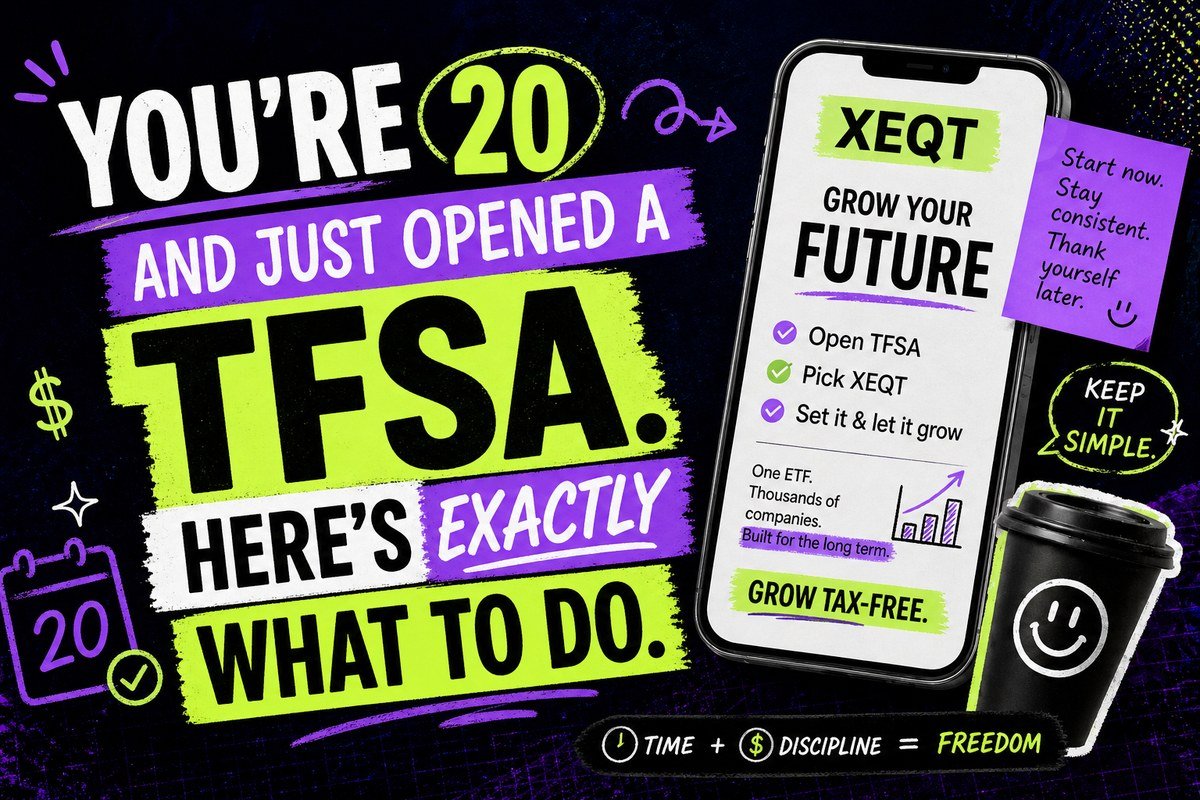
You just opened a TFSA. Maybe a friend mentioned it. Maybe you fell down a Reddit rabbit hole at midnight. Maybe someone at your bank handed you a form and you signed it without knowing quite what you were agreeing to. None of that matters. What matters is that you did it, and you did it young. That single decision, made in your late teens or early twenties, is worth more to your future financial life than almost anything else you will do in the next decade.
This article is not going to bury you in theory. It is going to tell you exactly what to do, in order, with no unnecessary detours. If you are 18, 19, 20, or even 22 and starting from scratch, this is the guide.
First, Understand What You Actually Have
The Tax-Free Savings Account is the most powerful investment account in Canada, and it is tragically misnamed. The word “savings”, makes it sound like something you park cash in while earning 1.5% interest. That is not what it is. A TFSA is a full investment account that can hold stocks, ETFs, bonds, GICs, and more. Every dollar of growth inside it, whether from dividends, capital gains, or interest, is completely tax-free when you take it out. The government taxes you on the way in, when you earn the money, and never again after that.
If you opened your TFSA at a bank and they put your money into a savings account or a GIC, you have not made a mistake yet. But you are leaving serious money on the table. The goal is to understand what the account can hold, then fill it with the right thing.
Your 2026 TFSA numbers: The annual contribution limit is $7,000 for 2026. Contribution room accumulates starting the year you turn 18, as long as you are a Canadian resident with a valid SIN. The annual limit has not always been $7,000, so your exact accumulated room depends on which years you have been eligible, a common source of costly errors. Log into CRA My Account to see your precise figure. Withdrawals restore your contribution room the following calendar year.
One more thing worth understanding before you invest a single dollar: the TFSA is not just a retirement account. You can take money out at any time, for any reason, without paying tax. That flexibility is part of what makes it ideal for a 20-year-old who might need to access funds for education, a car, or a future home down payment. The room comes back the next year when you withdraw, so there is no permanent cost to pulling money out in a real emergency.
Build a Small Emergency Fund Before You Invest
This is the step most finance content skips because it is boring, and yet it is the one that determines whether your investment plan actually survives contact with real life. Before you put money into your TFSA and invest it in equities, you need a cushion. Research on investor behaviour consistently shows that people who lack emergency savings are far more likely to panic-sell or raid their investments the moment something goes wrong: a car repair, a missed shift, a surprise dentist bill.
The target is three months of essential expenses in something liquid and low-risk, such as a high-interest savings account at a digital bank that earns a reasonable rate. This does not need to live inside your TFSA. It just needs to exist and be easy to access. Once that buffer is in place, you are free to invest your TFSA contributions in equities and actually stay invested when the market drops 20%, which it will at some point during your investing life.
The investor who stays in through a crash builds wealth. The investor who sells at the bottom to cover an emergency loses twice: once on the drop, and once by missing the recovery. The emergency fund is what makes staying invested possible.
Ignore the Noise: Crypto, Meme Stocks, and the Hot Tip You Just Heard
You are 20. Your social media feed is full of people claiming to have made thousands of dollars on a single stock or a cryptocurrency trade. Some of them are lying. The rest got lucky in a short window and will give most of it back before the year is out. Research consistently shows that fewer than 10% of active institutional investors beat their benchmark index over a full decade. Individual stock pickers with no institutional resources or edge tend to do considerably worse.
Behavioural finance research also shows that young investors are among the most likely to hold under-diversified portfolios, driven by overconfidence, social pressure, and a bias toward familiar or exciting names. The exciting trade is usually the expensive one. The boring index fund is usually the right one. You do not have to believe this right now. You just have to act as if you do for the next few decades, and then the math will confirm it.
The best investing decision you can make at 20 is not finding the right stock. It is choosing a strategy simple enough that you will never abandon it during a crash, a bull run, or a period when everything on social media seems to be outperforming you.
What to Actually Buy: One Fund, Full Stop
Open a Wealthsimple or Questrade account, link it to your bank, and buy XEQT. That is the answer. XEQT is the iShares Core Equity ETF Portfolio, listed on the Toronto Stock Exchange. One purchase gives you ownership in roughly 9,000 companies across four markets: approximately 45% US equities, 25% international developed markets, 25% Canadian equities, and 5% emerging markets. The whole world, in one ticker, for a management expense ratio of 0.20% per year.
At a current price of around $43 per share, you can buy a piece of that global portfolio with very little capital. You do not need to save up $5,000 before you start. Buy one share if that is what you have. The habit of investing matters more at this stage than the amount. And because XEQT is automatically rebalanced by BlackRock, there is nothing to do after you buy it. No annual rebalancing. No decisions about which country to overweight. No maintenance. You own it, contribute more when you can, and let it run.
XEQT at a glance: MER 0.20% | 100% equities | ~9,000 companies globally | Holds XUU (US), XIC (Canada), XEF (international), XEC (emerging markets) | Automatically rebalanced | DRIP eligible at Wealthsimple, Questrade, and IBKR. Current price: approximately $43.38 CAD.
Why XEQT and not something else? Because it is 100% equities, which is well-suited to a 20-year-old with a 40-plus year horizon. At your age, short-term volatility is not the primary risk. Volatility is the price you pay for higher long-run returns. The real risk is not having enough money in retirement, and the surest path to underperformance is holding bonds or GICs during the decades when equity compounding does its most important work. Academic research on investment time horizons is consistent: for holding periods greater than ten years, equity-heavy portfolios have historically dominated on end-of-period wealth, and the probability of a shortfall decreases as the horizon lengthens.
Automate Everything So Willpower Is Never Required
The single biggest determinant of how much you accumulate over the next 20 years is not which fund you pick. It is whether you keep contributing, consistently, through every market condition imaginable. The investors who build wealth slowly and reliably are not the ones who made the right call in 2020 or 2022. They are the ones who set up automatic contributions years earlier and never turned them off.
On Wealthsimple, you can set up a recurring buy on XEQT in about two minutes. Choose payday as the trigger date, pick an amount, and it runs automatically. On Questrade, you set up a pre-authorized contribution to your account and then manually invest it, or enable automatic dividend reinvestment. Either platform works. The key is removing the decision entirely. When contributing happens automatically, you never have to think about whether now is a good time to invest. It is almost always a sensible time to buy a globally diversified fund inside a tax-free account when you are 20 years old.
Even a modest amount invested consistently starting at 20 produces a materially different outcome than a larger amount starting at 30. That is not intuition. That is arithmetic. The compounding gains in the final decade of a 40-year run are larger in absolute dollar terms than the gains in the entire first two decades combined. Starting early is not a minor advantage. It is the whole game.
A Canadian who starts investing a modest amount each month at 20 and sticks with it will likely accumulate more than someone who invests a much larger amount starting at 35. Time does not just help. Time is the mechanism.
Should You Open an FHSA Too?
If you think you might buy a home at some point in the next 15 years, yes. Open an FHSA immediately, even if you can only contribute a small amount. The First Home Savings Account lets you contribute $8,000 per year up to a $40,000 lifetime limit, and every dollar you put in is tax-deductible, similar to an RRSP. When you withdraw the money for a qualifying home purchase, you pay zero tax. If you never buy a home, you transfer the balance to your RRSP without using any of your existing RRSP room. There is no real downside scenario.
The reason to open it now rather than later is the carry-forward rule. Unlike the TFSA, which carries forward all unused room indefinitely, the FHSA only carries forward a maximum of $8,000 per year. So if you do not open it this year, you cannot retroactively claim that room later. The account has to be open to accumulate. Think of it as a free option on a future tax break: it costs nothing to open and starts the clock running.
Inside the FHSA, if your home purchase is more than five years away, XEQT makes sense as the investment. Under five years, a high-interest savings ETF or GIC is more appropriate, since you cannot afford a major equity drawdown right before you need the funds. For a full breakdown of how the FHSA works alongside your TFSA, the site’s article on the FHSA and first-time buyers covers it in detail.
What About the RRSP?
At 20, the RRSP is almost certainly not your first priority. The RRSP gives you a tax deduction now and defers taxation until withdrawal, ideally in retirement when your marginal rate is lower. That math works well when your income is high. When you are earning a typical early-career income, your marginal tax rate is low enough that the RRSP deduction is not particularly powerful. The TFSA and FHSA are better uses of limited dollars at this stage for most young Canadians.
There is also something worth noting: RRSP room accumulates and never expires. Statistics Canada found that Canadians collectively had hundreds of billions in unused RRSP contribution room as of 2012, and the number has grown substantially since then. You will have plenty of room to use the RRSP strategically in your 30s and 40s when your income is higher and the deduction delivers more value per dollar. For most 20-year-olds, the right sequence is to fill the TFSA first and open the FHSA if homeownership is on the horizon.
Priority order at 20: 1. Emergency fund, roughly three months of expenses in a high-interest savings account. 2. TFSA, contributed to first for most Canadians, invested in XEQT. 3. FHSA, if a home purchase is a possibility within 15 years, invested in XEQT or a savings ETF depending on your timeline. 4. RRSP, once income rises and the deduction becomes more valuable.
The Mindset That Determines Everything
The practical steps above take about an afternoon to execute: open accounts, link a bank, buy XEQT, automate contributions. What takes years to develop is the mindset that keeps you from wrecking it. There will be a market correction during your investing life that feels like the world is ending. There will be a new investment trend that sounds compelling. There will be a moment when your TFSA balance drops by several thousand dollars in a week and every instinct says to do something. The right response in all three cases is to do nothing, keep contributing, and let the structure you built work.
Most investing mistakes are not analytical failures. They are behavioural ones: panic selling, chasing performance, jumping in and out based on headlines. A one-fund portfolio like XEQT is partly a defensive structure against your own worst impulses. There is nothing to tinker with. No allocation to second-guess. No sector to rotate out of. You own the world. You keep buying. You wait.
Most investing mistakes come from activity, not inactivity. The investor who opens a TFSA at 20, buys XEQT, sets up automated contributions, and checks in once a year will almost certainly beat the one who spends ten years trying to optimize.
If you want to go deeper on how XEQT’s fees compare to what most Canadians are actually paying inside bank-sold mutual funds, the article on XEQT’s real cost breaks down the compounding impact of a 0.20% MER versus the industry average. And if you want to think about what consistent investing from your age could look like over time, the monthly investing framework covers that math in detail. Neither article will change the core recommendation. Buy XEQT. Stay invested. Start now.
Frequently Asked Questions
How much TFSA contribution room do I have at 20? Your room depends on the year you turned 18 and the annual limit that applied each year since then. The limit has been $7,000 for 2024, 2025, and 2026, but it was different in prior years. The most accurate way to find your exact figure is to log into CRA My Account, where your available contribution room is updated regularly. Do not guess, because over-contributing results in a penalty tax.
Can I lose money in a TFSA? Yes. The TFSA shelters you from taxes, not from market losses. If you invest in equities like XEQT, your balance will go up and down with global markets. Over long periods, diversified equity funds have historically produced strong positive returns, but short-term losses are normal and expected. The key is not needing the money during a downturn.
Is XEQT right for me if I might need the money in three years? No. If you have a specific goal within five years, such as a car, tuition, or a down payment, that money should be in something stable: a high-interest savings account or a GIC. XEQT is well-suited for money you can leave untouched for at least five to ten years, ideally much longer. Money you might need soon does not belong in equities regardless of how strong the long-term case is.
Should I use Wealthsimple or Questrade? Both are solid choices for a 20-year-old Canadian investor. Wealthsimple charges no commissions on Canadian ETF trades and offers the easiest automation through recurring buys. Questrade charges no commissions on ETF purchases (only on sales) and has more research tools. For a simple XEQT strategy, either platform works well. The platform matters far less than the habit of buying consistently and leaving it alone.