
OAS Clawback Threshold 2026: How Much You Lose and How XEQT Holders Can Protect Their Pension
May 16, 2026

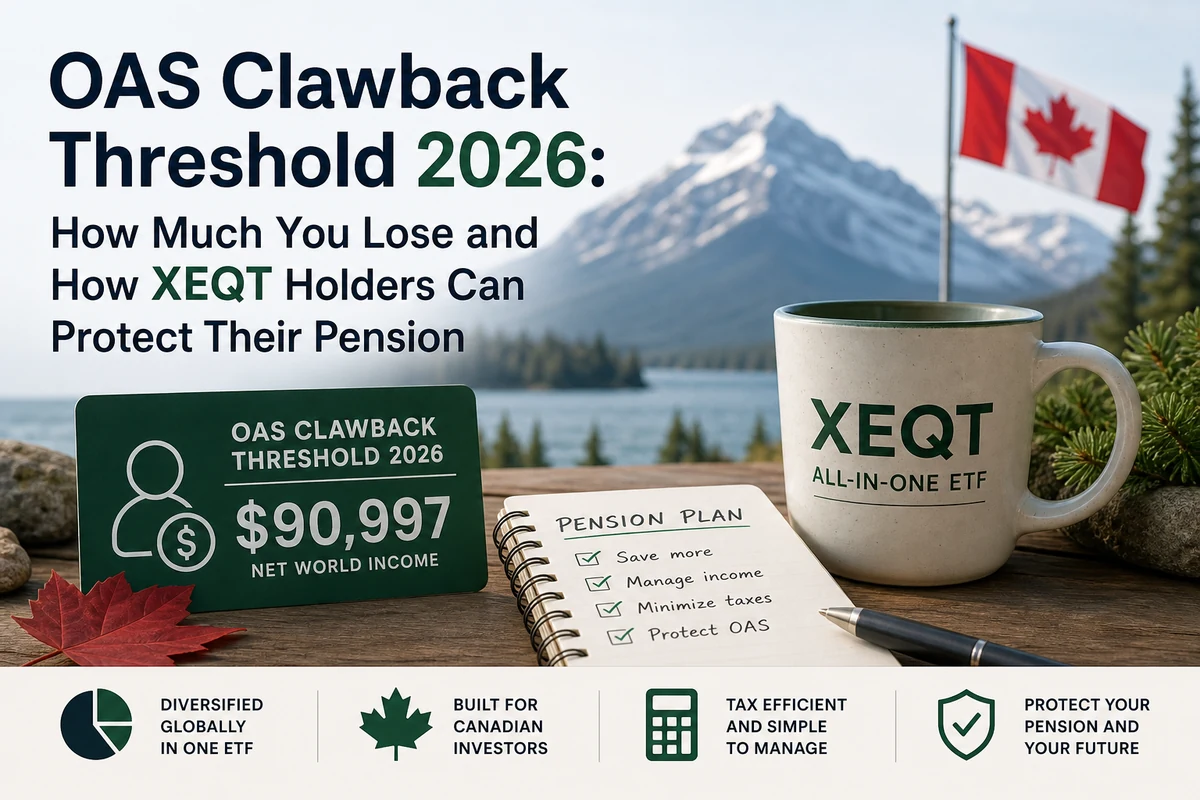
The Old Age Security clawback is one of the most misunderstood taxes in Canada. It doesn’t appear as a line item on your paycheque. It doesn’t trigger a warning when you file your return. It just quietly reduces your pension, dollar by dollar, once your net income crosses a threshold most Canadians have no idea exists. For 2026, the threshold is $93,454 in net world income for the July, December period (based on 2025 income), and $90,997 for January, June (based on 2024 income). The CRA adjusts it annually for inflation. Every dollar above it costs you 15 cents of OAS. If you’re building a retirement portfolio around XEQT, understanding how this works now, long before you collect a cent of OAS, is one of the highest-value planning decisions you can make.
What the OAS Clawback Actually Is
The government calls it the “OAS recovery tax,” which is a polite name for a benefit clawback. Once your net income for the year exceeds the CRA’s annual threshold, you repay 15% of every dollar above that line directly to the government. This repayment is then withheld from future OAS payments, usually starting the following July.
So if your net income for 2026 comes in at $103,000 and the threshold is $93,454, you have gone $9,546 over. Fifteen cents on each of those dollars equals $1,500 in OAS clawback. If your full annual OAS benefit is in the range of $8,000 to $9,000, you’ve just lost close to 20% of it. Go $30,000 over the threshold and the clawback climbs to $4,500 per year. That’s a meaningful number, and it compounds across every year of retirement.
The clawback is not a tax on being wealthy. It’s a tax on having the wrong mix of income at the wrong time. Many Canadians who trigger it didn’t plan to, and with better account structuring, many of them didn’t have to.
What makes this particularly tricky is that the threshold applies to net world income, not just Canadian income. RRSP or RRIF withdrawals count. Pension income counts. Investment income from non-registered accounts counts. Capital gains count at the applicable inclusion rate. Even foreign income counts. What does not count, and this is the key planning lever, is money withdrawn from a TFSA.
2026 OAS Clawback at a Glance: The recovery tax begins at $93,454 in net income for July, December 2026, and $90,997 for January, June 2026. The rate is 15 cents per dollar above the threshold. OAS is eliminated entirely at approximately $152,000 for ages 65, 74. TFSA withdrawals are not counted as income and do not affect this calculation at all. For a full breakdown and interactive calculator, see our OAS Clawback Threshold 2026 guide.
Why RRIF Withdrawals Are the Hidden Trigger
Most Canadians who get caught by the OAS clawback aren’t high earners living lavishly in retirement. They’re people who saved diligently in their RRSPs, converted to a RRIF at 71 as required by CRA rules, and are now forced to withdraw a growing percentage of their RRIF balance each year regardless of whether they actually need the money.
The mandatory RRIF minimum withdrawal starts as a modest percentage of the balance in the first year and increases annually. If you’ve saved $800,000 in your RRSP and converted it to a RRIF, the required withdrawals in early years can easily exceed $40,000 annually, all counted as ordinary taxable income. Add CPP, OAS itself, and perhaps income from a small defined benefit pension or non-registered investments, and many retirees find themselves crossing the clawback threshold within a few years of the RRIF conversion, without ever making a single discretionary decision to spend more.
Research into early RRSP withdrawal strategies, sometimes called the RRSP meltdown approach, is consistent on this point: the collision of CPP, OAS, mandatory RRIF minimums, and investment income in the same year is where retirement income planning goes wrong. The problem isn’t having a large RRSP. The problem is waiting too long to draw it down at lower rates during the window between retirement and age 71.
How XEQT’s Account Structure Gives You a Natural Advantage
If you’ve been building your XEQT portfolio across a TFSA, an RRSP, and potentially a non-registered account, you have more planning flexibility than most Canadians realize. The key insight is this: the account you draw from determines how much income the CRA sees, not the amount you actually spend.
TFSA withdrawals don’t add a cent to your net income. If you’ve accumulated $400,000 in your TFSA by retirement, drawing $25,000 per year from it is invisible to the OAS threshold calculation. You’re spending real money, funding your life, and the clawback clock isn’t moving. That’s the core structural advantage of the TFSA, and it’s why every serious discussion of Canadian retirement income planning eventually comes back to it.
Your RRSP or RRIF is the taxable account. Every dollar you pull out is ordinary income. The strategy that evidence consistently supports is to draw down your RRSP in the window between the year you retire and the year you turn 71. During those years, employment income has stopped. CPP and OAS may not have started yet. Your marginal rate is at its lowest point across your entire adult life. Modest, strategic withdrawals from the RRSP during this period reduce the future RRIF balance, lower mandatory minimums, and dramatically reduce the probability of hitting the OAS clawback threshold a decade later.
Think of the years between retirement and 71 as your tax-planning window. You’re not just living off savings. You’re repositioning assets from a high-future-tax account to a no-future-tax account at the lowest rates you’ll ever see.
The mechanics work like this: withdraw from your RRSP at a rate that keeps your taxable income in a comfortable bracket, pay tax at today’s lower rate, and recontribute the after-tax proceeds to your TFSA where contribution room is available. Under the Carney government’s 2026 tax changes, the lowest federal bracket rate dropped from 15% to 14%, and it applies up to approximately $58,000 in taxable income. That’s a lower rate than most working Canadians face during their peak earning years, and it represents a real opportunity to rebalance your income mix before OAS and mandatory RRIF withdrawals arrive simultaneously.
The Dividend Gross-Up Trap That Catches XEQT Investors Off Guard
Here’s something that surprises many people holding XEQT or other broad ETFs in a non-registered account. When you receive Canadian eligible dividends, you don’t report the actual amount received. You report a grossed-up version, 38% higher. So if XEQT distributes $10,000 in Canadian eligible dividends to your non-registered account this year, you declare $13,800 as income for OAS threshold purposes, even though only $10,000 actually landed in your brokerage account.
You do receive a dividend tax credit that partially offsets this, so your actual tax bill is lower than the inflated figure suggests. But the grossed-up income figure still counts fully toward the OAS threshold calculation. A retiree sitting just below the clawback line could tip over it with a distribution they didn’t even notice, particularly in a year when the fund’s capital gains distributions are higher than usual.
The practical implication: if you’re holding XEQT in a non-registered account and are near the OAS threshold, be aware that distributions including capital gains distributions, dividends, and interest all count toward your net income in the year they occur. This isn’t a reason to avoid non-registered XEQT entirely. It’s a reason to plan carefully and model your projected income before December 31, while you still have options to act.
The Dividend Gross-Up: Canadian eligible dividends are reported at 138% of the amount actually received. A $10,000 XEQT distribution in a non-registered account becomes $13,800 for net income purposes. If you are near the OAS clawback threshold, this difference can matter more than most people expect.
Income Splitting: The Other Lever Worth Pulling
The OAS clawback applies per person, not per household. This matters enormously for couples. If one partner has a taxable income of $113,000 and the other has $63,000, the first partner faces a significant clawback while the second is well below the threshold. If they could instead have income of roughly $88,000 each, neither crosses it. The household outcome is dramatically better with the same total dollars.
Income splitting mechanisms available to Canadian retirees include pension income splitting, where up to 50% of eligible pension income can be allocated to a lower-income spouse, spousal RRSP contributions made during working years, and RRIF income splitting after age 65. None of these apply to TFSA withdrawals, because TFSA income doesn’t need splitting in the first place.
For XEQT investors, the implication is straightforward: if you and your partner have both been building separate TFSA and RRSP accounts, your household has far more flexibility than one where savings are concentrated in one person’s name. Two separate OAS thresholds are far better than one. Consider this when deciding whose RRSP to draw down first during the pre-71 window, whose name non-registered accounts are held in, and how spousal RRSP contributions were structured during your accumulation years.
After age 65, RRIF income becomes eligible for pension income splitting. A couple with one large RRIF and one smaller one can allocate up to half of the RRIF income to the lower-income spouse, which can keep both partners well below the OAS threshold even with meaningful total withdrawals.
What a Practical XEQT Drawdown Might Look Like
Consider a hypothetical couple in their mid-60s. Each holds XEQT across their accounts: $300,000 in the TFSA each, $400,000 in the RRSP each, and some holdings in a shared non-registered account. They retire at 63, before CPP and OAS begin. For several years, they live on a combination of modest RRSP withdrawals, targeting roughly $40,000 to $50,000 per person per year in taxable income and well within the lowest federal bracket, plus TFSA withdrawals to top up their lifestyle spending. Where TFSA room is available, they recontribute after-tax RRSP proceeds.
By the time they reach 71 and are required to convert their RRSPs to RRIFs, the balance has been meaningfully reduced through those strategic withdrawals. The mandatory minimums are lower than they would otherwise have been. CPP has started, and they delayed it to 70 for the enhanced payment. OAS begins at 65. Their combined taxable income from CPP, OAS, and RRIF minimums sits comfortably below the clawback threshold for each person. The TFSA remains large and untouched, available for travel, healthcare costs, or estate planning.
This is not a theoretical outcome. It reflects the kind of plan that fee-only financial planners in Canada have been guiding retirees through for years. The account structure matters, and the decade before retirement is where the choices that determine it are made. If you’re 50 today, the decisions you make now about your RRSP, your TFSA contributions, and how you allocate XEQT across account types are the same decisions that will determine whether the OAS clawback takes nothing from you or several thousand dollars a year through your 70s and 80s.
The best time to plan around the OAS clawback is 10 to 15 years before you collect OAS, when you still have the tools to reshape your income structure. By the time you’re 72 and receiving mandatory RRIF withdrawals, most of those tools are gone.
For a deeper look at how XEQT fits into the full lifecycle of a Canadian investor, the guide at what XEQT is and how it works covers the building blocks clearly. For thinking about how to sequence withdrawals once you’re actually in retirement, see the detailed breakdown of XEQT as a retirement withdrawal engine.
Practical Sequencing for XEQT Holders: In the years between retirement and age 71, draw from your RRSP first at low bracket rates and supplement with TFSA withdrawals as needed. After 71, minimize RRIF mandatory amounts by keeping the balance lower going in, and use TFSA withdrawals to cover any spending gap without adding to taxable income or triggering the OAS threshold.
This Is a Good Problem to Have, But Still Worth Solving
It’s worth saying plainly: if you’re worried about the OAS clawback, it likely means you’ve saved enough that the government wants some of your pension back. That’s not a tragedy. It’s a sign your financial plan worked. The clawback threshold sits at $93,454 in annual income (July, December 2026), which represents a solid retirement by most Canadian standards.
But “good problem to have” doesn’t mean you should let it slide. For most retirees, the clawback is manageable or avoidable with thoughtful planning. The strategies above aren’t loopholes. They’re the way the system is designed to work. The TFSA exists precisely to give Canadians a place to hold savings that the government won’t count against them for benefit purposes. Using it is not aggressive tax avoidance. It’s basic literacy about how Canadian accounts function.
The contrast with the alternatives is worth stating. A retiree holding an actively managed mutual fund portfolio, drawing down without a plan, paying close to 2% in annual fees, and relying on an advisor focused on product sales rather than income planning, is far more likely to stumble into the OAS clawback unintentionally. A retiree who has spent decades putting $7,000 per year into a TFSA holding XEQT, building a meaningful tax-free balance, and who starts thinking about account sequencing well before 65, has real structural advantages. Not because they’re cleverer, but because they built the account structure that gives them choices when it counts.
For the complete breakdown of both 2026 thresholds, a step-by-step calculator, and all six reduction strategies in detail, see the dedicated OAS Clawback Threshold 2026 guide on this site.
Frequently Asked Questions
At what income level does the OAS clawback start in 2026? The OAS recovery tax begins at $93,454 in net world income for the July, December 2026 benefit period (based on your 2025 tax return), and $90,997 for the January, June 2026 period (based on your 2024 return). Once your income crosses the threshold, you repay 15 cents for every dollar above it. The clawback is calculated on the prior year’s income, so the amount withheld from your OAS payments in mid-2026 reflects your 2025 net income. For the full numbers including max OAS amounts and an interactive calculator, visit our complete OAS clawback guide.
Do TFSA withdrawals count toward the OAS clawback threshold? No. TFSA withdrawals are entirely excluded from net income calculations. They are not counted as taxable income and have no effect on the OAS threshold calculation. This is the single most important reason to maximize your TFSA during your working years and to draw from it preferentially in retirement when you are near the clawback threshold.
What happens if I go over the OAS clawback threshold in one unusual year? The CRA adjusts your OAS payments based on the income you reported in the prior year. If your income was unusually high due to a one-time event such as a large RRSP withdrawal, a capital gain on a property sale, or a lump-sum payment, you can write to Service Canada and request reassessment based on your current estimated income. This process is sometimes called a “current year income” application and can restore a portion of your OAS payments partway through the year.
Can income splitting with a spouse help avoid the OAS clawback? Yes, meaningfully. Pension income splitting lets you allocate up to 50% of eligible pension income, including RRIF withdrawals after age 65, to your lower-income spouse. Since the clawback threshold applies individually and not at the household level, redistributing income between two partners can keep both below the threshold even when combined household income is well above it. This is one of the most underused tools in Canadian retirement tax planning.