TFSA, RRSP, or FHSA: Where Should Your XEQT Actually Live?
June 10, 2026

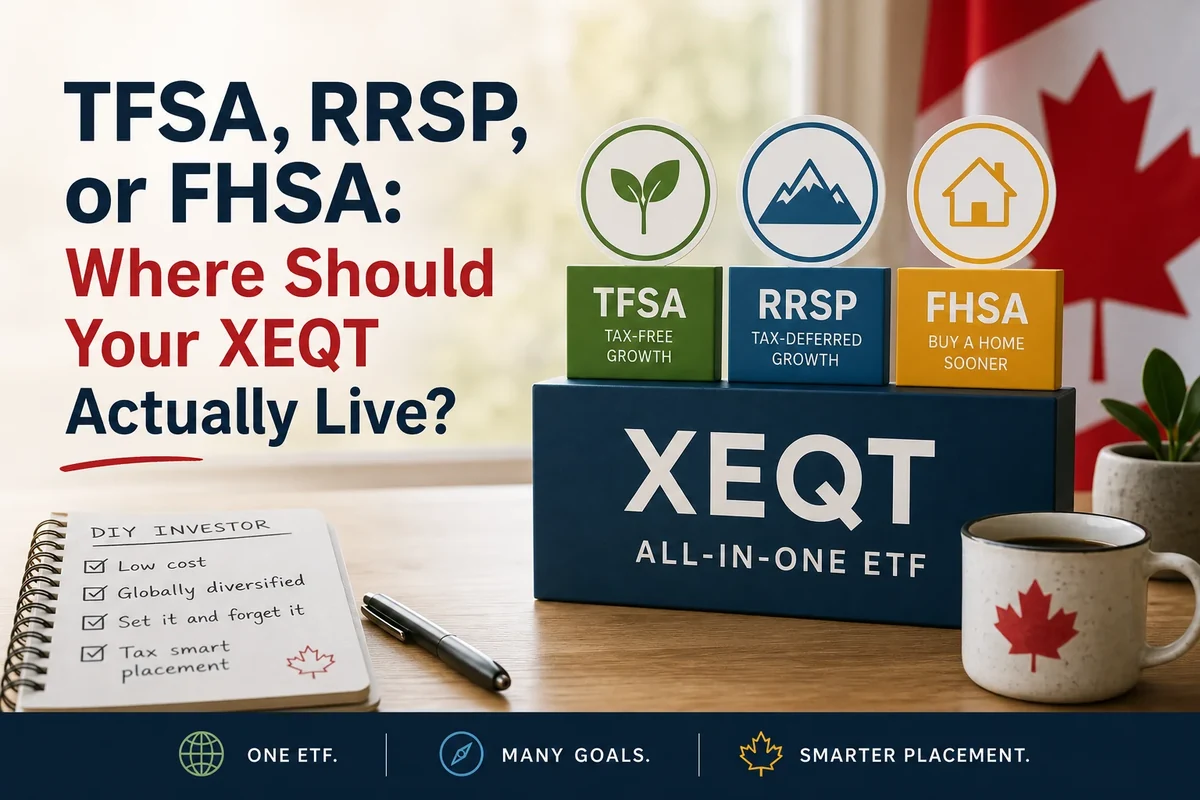
Most Canadians spend weeks researching which ETF to buy and about ten minutes deciding where to put it. That is exactly backwards. XEQT is a fine fund, its 0.20% MER, automatic rebalancing, and exposure to roughly 9,000 companies across four geographies make it one of the simplest wealth-building tools available to Canadians. But the account that holds it determines whether the government taxes your growth every year, defers that tax to retirement, or never collects it at all. Over a 30-year horizon, that is not a minor detail. It is one of the highest-leverage decisions in your financial life. If you are new to what XEQT actually is, start there first, then come back to this.
The Account Structure Is the Strategy
When an advisor or a Reddit thread tells you to “just max your TFSA,” they are giving you a reasonable starting point wrapped in a false sense of completeness. The real question is not which account is best in the abstract. It is which account is best for you, given your current income, your marginal tax rate, whether you plan to buy a home, and how much room you have in each account. Get those inputs right and the answer is usually clear. Get them wrong and you can leave thousands of dollars of tax savings on the table over a decade.
XEQT is eligible for every major registered account in Canada: TFSA, RRSP, FHSA, RESP, RRIF, and non-registered. That flexibility is a genuine feature. It also means the burden of choosing correctly falls entirely on you. This article walks through each account type, explains how XEQT’s specific structure interacts with the tax rules inside each one, and gives you a sequencing framework you can apply to your own situation tonight.
TFSA: The Default for Most Canadians
If you have TFSA room and your marginal tax rate is below roughly 40%, the TFSA is a strong first choice for most people. The logic is simple: every dollar of growth, every quarterly distribution XEQT pays out, every gain you eventually realize when you sell, is permanently sheltered from tax. You pay no tax on the way in, no tax on the way out, and no tax on anything that happens in between. Withdrawals do not count as income, which means they do not trigger OAS clawback, do not reduce your Canada Child Benefit, and do not affect income-tested benefits in retirement.
TFSA Room in 2026: The annual limit is $7,000. If you were 18 or older and a Canadian resident in 2009 when the TFSA launched, your cumulative room as of January 1, 2026 is $109,000. Unused room carries forward indefinitely, and withdrawn amounts are re-added to your room the following January 1.
The TFSA’s other underrated advantage is flexibility. RRSP withdrawals are taxed as income in the year you take them. TFSA withdrawals are not. If you need $20,000 for a car repair, a sabbatical, or an emergency in retirement, pulling it from a TFSA does not push you into a higher bracket or claw back your OAS. That optionality has real value, and it is one reason the TFSA is often the right answer even when the RRSP math is close.
XEQT currently trades near $43.98 and pays quarterly distributions, with a trailing yield of approximately 1.52% based on the last four distributions totalling $0.67 per unit. Inside a TFSA, those distributions compound without any income tax friction. The one caveat worth noting: US dividends flowing through XEQT still face a 15% withholding tax inside a TFSA because the Canada-US tax treaty exemption does not extend to TFSAs. More on this below.
RRSP: Only If You’re Deferring Into a Lower Tax Bracket
The RRSP is a tax-deferral machine, not a tax elimination machine. The distinction matters enormously. When you contribute $10,000 to your RRSP at a 43% marginal rate, you receive a $4,300 refund, real and immediate. When you withdraw that $10,000 in retirement, it is fully taxable as ordinary income, regardless of whether the growth inside came from capital appreciation, dividends, or your original contributions. The RRSP does not know or care about the source. It treats every dollar leaving the account as employment income.
The RRSP works when you contribute at a higher marginal rate than the rate you will face at withdrawal. If those two rates are equal, you get deferral but no tax advantage. If your retirement income is higher than your working income, the RRSP may cost you more in tax than you saved.
That second scenario is less rare than people assume. Canadians with defined benefit pensions, large RRSP balances that convert to RRIF mandatory withdrawals, OAS, and CPP stacking in the same year can find themselves in surprisingly high brackets in their seventies. The RRSP’s reputation as universally beneficial largely comes from an era when most people retired with little savings and drew down at near-zero rates. That is not the profile of someone actively maxing their RRSP today.
The case for RRSP is clearest when your current marginal rate is high and your projected retirement income is genuinely lower. For a professional earning well above $110,000 who plans to retire on moderate investment withdrawals, the bracket compression is real and the RRSP makes sense. For someone earning $65,000 with a government pension, it is a much harder argument to make. The 2026 RRSP dollar cap is $32,490 (18% of prior-year earned income, up to the CRA maximum).
RRSP Rule of Thumb: Prioritize RRSP contributions when your current marginal tax rate exceeds 40% and you have credible reason to believe your retirement income will fall into a bracket at least 10 percentage points lower. Below that threshold, the TFSA’s flexibility generally makes it the stronger default for most people.
FHSA: The Best Tax Structure in Canada for First-Time Buyers
The First Home Savings Account does something no other registered account in Canada does: it gives you a tax deduction on contributions (like an RRSP) and tax-free withdrawals for a qualifying home purchase (like a TFSA). That is not a minor feature. It is the only account where both sides of the transaction are sheltered from tax at the same time.
The limits are $8,000 per year with a $40,000 lifetime maximum. You can carry forward up to $8,000 of unused room to the following year, but unlike the TFSA, unused room does not accumulate indefinitely. Open the account as early as possible, even if you contribute minimally, because the 15-year clock starts on opening date. If you never buy a home, the balance transfers to your RRSP or RRIF without consuming any of your existing contribution room, which means the worst-case scenario is a painless RRSP top-up.
For someone buying a home within five to fifteen years, the FHSA should sit at the top of the contribution priority list, above the RRSP and often above the TFSA. Putting XEQT inside an FHSA with a horizon of seven or more years gives you fully sheltered equity growth on both the contribution deduction and the withdrawal. You get a government subsidy going in and nothing withheld coming out. No other structure comes close. You can read more about the FHSA mechanics in our full FHSA guide, which covers investment selection and timing in more detail.
How XEQT’s Structure Changes the Tax Calculus
XEQT is a Canadian-domiciled fund of funds. It holds XUU (US equities), XIC (Canadian equities), XEF (international developed), and XEC (emerging markets). Because the fund itself is structured as a Canadian trust, the tax treatment inside each account differs in important ways from what you would get holding a US-listed ETF directly.
The Canada-US tax treaty eliminates US dividend withholding inside an RRSP when you hold US-listed securities directly. That full exemption does not flow through to XEQT in the same way, because XEQT is a Canadian fund that holds a Canadian ETF (XUU) which in turn holds US stocks. The withholding is embedded at the underlying fund level before it reaches you, regardless of which account you use. According to the Canadian Portfolio Manager’s foreign withholding tax analysis, the effective foreign withholding tax drag on XEQT is approximately 0.22% across TFSA, RRSP, and non-registered accounts alike. This is a critical nuance: the “put US equities in your RRSP” advice applies with full force to direct US-listed ETFs, but has much less practical impact with an all-in-one like XEQT.
The practical implication: if your only equity holding is XEQT, the withholding tax difference between your TFSA and RRSP is minimal. The account decision should be driven by your marginal rate and flexibility needs, not by trying to optimise withholding on a fund that does not fully expose that lever.
Where account type does matter for XEQT is on the distribution side. XEQT pays quarterly distributions, and those are reported on a T3 slip, not a T5, because XEQT is structured as a trust, not a corporation. This is a common source of confusion at tax time. Inside a TFSA or RRSP, you never see the T3. In a non-registered account, those distributions are fully taxable in the year received, which is the main reason non-registered should be your last account for XEQT, not your first. Inside a TFSA or RRSP, the quarterly compounding runs uninterrupted. For a deeper look at XEQT’s full structure and how it behaves across market conditions, the 2026 XEQT review covers it thoroughly.
The Decision Framework: Income, Timeline, and Room
Run through these questions in order and the right account sequence will usually emerge on its own.
Does your employer offer a pension match or group RRSP match? If yes, capture the full match before doing anything else. Free employer contributions outperform any account-type optimization by a wide margin.
Are you a first-time buyer who might purchase a home within the next fifteen years? Open an FHSA immediately, even if you can only contribute a small amount. The $8,000 annual room is lost if you do not use it, and the clock starts on the date you open the account, not the date you contribute.
What is your current marginal tax rate? Below roughly 40%, the TFSA is a strong default for most people. Your contributions went in after tax, your growth is permanently sheltered, and your withdrawals are flexible. Above 43%, the RRSP deduction becomes powerful enough that deferral is likely worth it, assuming your retirement income will genuinely be lower.
Have you maxed your TFSA? With $109,000 in cumulative room available to anyone eligible since 2009, many Canadians in their thirties and forties have significant unused TFSA capacity. Filling that before pivoting to heavy RRSP contributions is a reasonable call at middle-income brackets, because the TFSA’s flexibility and permanent shelter often outweigh the RRSP’s upfront deduction when the bracket gap is small.
After registered accounts are maximized, XEQT can sit in a non-registered account. The growth is still compounding, the MER is still 0.20%, and the diversification is still working. You will pay tax on distributions annually via T3 and on capital gains when you sell, but those are manageable friction costs, not reasons to avoid investing entirely.
The Mistake That Costs People the Most: Wrong Account, Right Fund
The single most common error is maxing an RRSP before filling TFSA room, at an income level where the bracket gap does not justify it. Consider someone earning $85,000 in Ontario, facing a marginal rate of roughly 31.5%. They put $15,000 into their RRSP, get a meaningful refund, and feel good about the decision. But if they retire with a pension and CPP producing $60,000 per year, they will withdraw those same dollars at a rate close to what they paid. The bracket arbitrage that makes the RRSP powerful essentially disappears.
Had they put $15,000 into their TFSA instead, that same money would compound without any withdrawal tax, can be accessed freely in emergencies without income impact, and does not interfere with income-tested benefits in retirement. For most Canadians in the $60,000 to $110,000 income range, the TFSA is not the consolation prize. It is the main event.
A second common error is using the TFSA or RRSP Home Buyers’ Plan to fund a down payment when the FHSA exists. Pulling from your TFSA permanently removes years of compound growth from your most flexible tax shelter. Using the RRSP HBP requires repayment over 15 years or you face inclusion in income. The FHSA was specifically designed to make both of those options unnecessary. If you have not opened one yet, today is the right time regardless of how uncertain your home-buying plans feel.
The RRSP Home Buyers’ Plan is a useful tool. The FHSA is a structurally superior one. Using the HBP when you have not yet exhausted your FHSA room means leaving a tax deduction and a tax-free withdrawal on the table simultaneously.
Your Account Sequencing for XEQT
Treat the following as a general framework, not personal financial advice. Your specific situation, particularly your provincial tax rate, pension income, and home-buying timeline, may shift the order.
Capture any employer match first, that is always the highest-return move available to you. From there, if you are a first-time buyer or might become one within 15 years, open and begin contributing to an FHSA. The deduction and tax-free growth combination is too valuable to pass up, and the $40,000 lifetime room fills slowly enough that starting early matters.
Once your FHSA contributions are in motion, turn to your TFSA. With $109,000 in cumulative room available for anyone eligible since 2009, there is likely significant capacity here. At income levels below roughly $110,000, filling this before aggressively contributing to an RRSP is a reasonable approach for most people. Above $110,000, particularly above the top federal bracket, the RRSP deduction becomes compelling and the sequencing can reasonably shift to maximize RRSP contributions up to the 2026 cap of $32,490.
When all registered room is in use, a non-registered account with XEQT remains a rational choice. The 0.20% MER still applies, global diversification still works, and XEQT’s structure means distributions are relatively modest at a trailing yield of approximately 1.52%, limiting the annual tax drag compared to a high-yield income fund. The priority order of tax shelter still holds: most growth should live in the highest-value shelter first.
Account Sequencing Summary: Start with any employer match, then FHSA if you may buy a home within 15 years, then TFSA for income below roughly $110,000, then RRSP for income above roughly $110,000 or if your marginal rate exceeds 40%, then non-registered as overflow. Hold XEQT in every account, the fund does not change, only the tax wrapper around it does.
Frequently Asked Questions
Should I hold XEQT in my TFSA or RRSP? For most Canadians earning under $110,000, the TFSA is the stronger default. Tax-free growth is permanent, withdrawals are flexible, and there is no income impact in retirement. The RRSP is more powerful when your current marginal rate is above 40% and you expect meaningfully lower retirement income. XEQT’s all-in-one structure means the withholding tax difference between TFSA and RRSP is minimal for this specific fund.
Can I put XEQT in my FHSA? Yes, and for most first-time buyers with a horizon of five or more years, you should. XEQT inside an FHSA gives you tax-deductible contributions, tax-sheltered growth, and a tax-free withdrawal for a qualifying home purchase. If you end up not buying, the balance transfers to your RRSP without consuming existing contribution room. It is one of the most efficient uses of XEQT available.
Does it matter which account XEQT is in for withholding tax purposes? Less than you might expect with this specific fund. Because XEQT is a Canadian-domiciled fund of funds, the withholding tax on international dividends is embedded at the underlying ETF level and not fully recoverable in any account. The Canadian Portfolio Manager’s analysis puts the effective foreign withholding drag at approximately 0.22% across TFSA, RRSP, and non-registered. The RRSP’s US withholding exemption under the Canada-US tax treaty applies most powerfully to direct US-listed securities, not to Canadian-wrapped funds like XEQT.
What if I have contribution room in all three accounts: TFSA, RRSP, and FHSA? If you are a first-time buyer or might become one: FHSA first up to $8,000, then TFSA if your income is below roughly $110,000, then RRSP. If you are not a potential first-time buyer: TFSA first below $110,000, RRSP above it. In all cases, XEQT works in every account. The decision is purely about which tax wrapper creates the most lifetime value given your income profile and flexibility needs.