TFSA vs RRSP in 2026: The Decision Framework Most Canadians Get Wrong
May 4, 2026

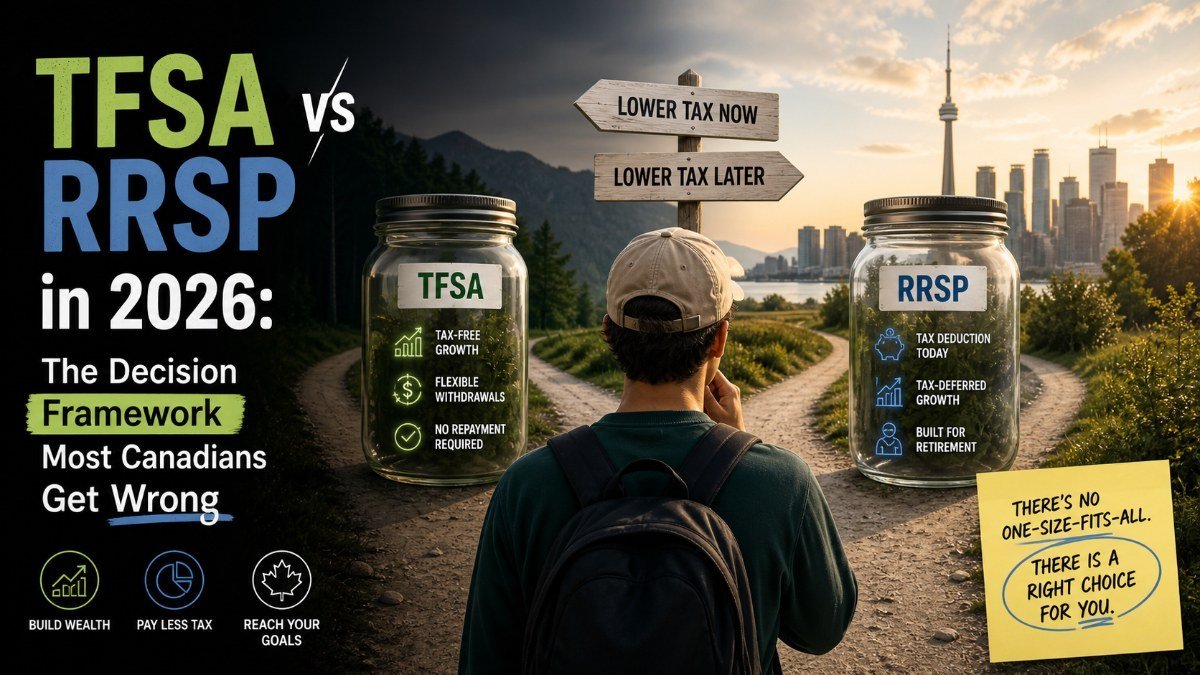
Every February, Canadians rush to make RRSP contributions before the deadline. Every tax season, someone discovers they’ve been filling the wrong account for three years. The TFSA versus RRSP debate is one of the most reliably misunderstood corners of Canadian personal finance, not because it’s genuinely complicated, but because most of the advice out there hedges so hard it becomes useless.
So let’s be direct. The choice between a TFSA and an RRSP is not a mystery. It is a math problem with one key variable: your marginal tax rate now compared to your expected marginal tax rate in retirement. Once you understand that, the framework almost runs itself.
The Core Logic in Plain Language
An RRSP gives you a deduction today and taxes you on withdrawal. A TFSA gives you no deduction today but lets you withdraw tax-free forever. Both accounts shelter your investment growth from tax while the money sits inside. The real question is: when do you want to pay the tax?
If you are in a high tax bracket now and expect to be in a lower bracket in retirement, you want the RRSP. You get the deduction at a high rate today and pay tax at a lower rate later. That spread is free money, essentially a government subsidy on your savings.
If you are in a low or moderate tax bracket now and expect to be in a similar or higher bracket later, the TFSA wins. You pay tax on the income now at a low rate, invest it inside the TFSA, and never pay tax on it again, including on decades of compound growth.
The RRSP is a tax-deferral tool. The TFSA is a tax-elimination tool. Which one you need depends entirely on the direction your tax rate is travelling over your lifetime.
The 2026 Numbers You Need to Know
Before applying any framework, get the actual limits straight. Decisions made on outdated numbers cost real money.
2026 Contribution Limits: TFSA: $7,000 for the 2026 calendar year, with a cumulative lifetime limit of $109,000 for anyone who has been eligible since 2009. RRSP: the lesser of 18% of your 2025 earned income or $33,810 (up from $32,490 in 2025). FHSA: $8,000 per year, $40,000 lifetime, for eligible first-time home buyers. Unused TFSA and RRSP room carries forward indefinitely.
The RRSP number matters here: you need roughly $188,000 in earned income before the $33,810 ceiling actually applies to you. Most Canadians never hit that ceiling, which means your RRSP room is simply 18% of whatever you made last year. Check your CRA My Account or your most recent Notice of Assessment for your exact available room. Do not guess.
The Income-Bracket Framework
Here is the framework, stated plainly. It is not perfect for every edge case, but it is correct for the vast majority of working Canadians.
Under roughly $55,000 in taxable income: Prioritize the TFSA. At this income level, your marginal federal rate is 20.5% or lower, and your combined federal-provincial rate in most provinces sits below 35%. Contributing to an RRSP at that rate only to withdraw later at a potentially similar rate produces minimal benefit. Worse, RRSP withdrawals in retirement can claw back GIS (Guaranteed Income Supplement) if your income in retirement is low, turning your RRSP into a trap rather than a tool.
Between roughly $55,000 and $110,000: This is where the decision gets more nuanced and where getting it right actually pays off. Contributions to the RRSP that push your taxable income below a major bracket threshold, particularly the jump into the second federal bracket at around $57,375 or the third at around $114,750 for 2026, generate outsized deductions. Use RRSP contributions strategically to reduce income to the bracket below. Then direct remaining savings to the TFSA.
Above $110,000: The RRSP becomes strongly favoured. You are paying marginal rates of 43% to 53% depending on your province. If you retire with modest income, say $60,000 to $80,000 in annual withdrawals, you will pay tax at rates 15 to 25 percentage points lower than the rate you got the deduction at. That spread compounds over decades. Max your RRSP first at this income level, then the TFSA, then a taxable account.
The single most expensive TFSA versus RRSP mistake a high earner makes is treating both accounts as interchangeable. They are not. At a 50% marginal rate, an RRSP deduction is worth twice what it is worth at 25%.
Where the FHSA Fits In
If you have not yet bought a home and you are a first-time buyer, the First Home Savings Account should sit ahead of both the TFSA and RRSP on your priority list. The FHSA gives you a deduction on contributions (like an RRSP) and completely tax-free withdrawals for a qualifying home purchase (like a TFSA). It is the only account that does both. You can contribute $8,000 per year up to a $40,000 lifetime limit, and unused room from the prior year carries forward by one year.
Once you have used your FHSA room and bought a home, or if you are not eligible, you return to the TFSA versus RRSP framework above. The FHSA does not change that framework. It simply comes first for people it applies to.
The Mistakes That Actually Cost People Money
The most common error is treating the TFSA as a savings account and the RRSP as the investing account. Both are just containers. The tax treatment lives in the container, not in what you put inside it. You can hold XEQT in either account. You can hold a GIC in either account. The account type does not dictate the investment. Put your highest-growth assets in whichever registered account you plan to touch last, so the compounding happens in the most tax-advantaged space.
The second common error is making RRSP contributions without using the refund strategically. A $15,000 RRSP contribution at a 43% marginal rate produces roughly a $6,450 refund. If you spend that refund on a vacation, you have cut the efficiency of your RRSP contribution nearly in half. The correct move is to reinvest the refund, ideally into the TFSA. That loop, RRSP contribution generates refund, refund goes into TFSA, is one of the most powerful legal tax manoeuvres available to middle-income Canadians.
The third mistake is ignoring the OAS clawback at higher retirement incomes. For 2026, Old Age Security begins to be clawed back when net income exceeds approximately $90,997. Retirees with large RRIF withdrawals, OAS, and CPP can find themselves in an effective marginal rate above 50% if they are not careful. If your RRSP is projected to become very large, TFSA contributions while working can give you tax-free income in retirement that does not trigger the clawback. This is not a beginner concern, but it is worth flagging for anyone with a defined benefit pension plus significant RRSP savings.
The Refund Loop: RRSP contribution at a high marginal rate generates a tax refund. That refund, invested into your TFSA, grows completely tax-free. Over 20 years, this loop consistently outperforms either account used alone. The math only works if you actually reinvest the refund.
What to Do When You Cannot Max Both
Most Canadians cannot fully max both a TFSA and an RRSP in the same year. The combined annual room is over $40,000. That is a lot of after-tax money to move.
The answer is to prioritize based on the framework above, and then do one more thing: automate whatever amount you can commit to, even if it is modest. A $400 monthly contribution to the right account, automated from your chequing account on payday, will outperform a $4,800 lump sum in February made under panic almost every time. This is not because of market timing. It is because the automated version actually happens, and the lump sum sometimes does not.
Wealthsimple and Questrade both make this automation straightforward. Set it up once, direct your contributions to the appropriate account type, and buy XEQT with whatever lands. The account decision and the investment decision are separate. Make the account decision once using the framework in this article, then forget about it and focus on consistency.
The investor who gets the TFSA versus RRSP decision slightly wrong but contributes consistently for 30 years will retire in far better shape than the one who optimizes the account choice but never gets around to actually contributing.
A Note on Spousal RRSPs
If you and your partner have meaningfully different incomes, the spousal RRSP is one of the most underused tools in Canada. The higher earner contributes to an RRSP in the lower earner’s name, taking the deduction at their higher rate. In retirement, the lower earner withdraws at their lower rate. Income is split at the source, before the CRA gets involved. The contribution counts against the contributor’s RRSP room, not the spouse’s, so it does not affect their own RRSP room. If you are the higher earner in a couple and your partner expects to have less retirement income than you, the spousal RRSP deserves serious attention before you simply max your own.
Frequently Asked Questions
Should I contribute to my TFSA or RRSP if I am in school or have low income? Almost certainly the TFSA. At low income levels, the RRSP deduction is worth very little because your marginal rate is low. Your RRSP contribution room does not expire, so you can save it for the years when you are earning more and the deduction is worth significantly more. TFSA room also carries forward, so there is no urgency to use it immediately either, but the tax-free growth starts the moment you invest.
Can I hold XEQT in both a TFSA and an RRSP? Yes. XEQT is eligible for RRSP, TFSA, RRIF, RESP, FHSA, and taxable accounts. The investment is the same regardless of the account. The only meaningful difference is the tax treatment of the account wrapper around it. Hold it in whichever registered account makes sense for your situation, and once those are full, hold it in a taxable account.
Does it matter which account I use for withdrawals in retirement? It matters a great deal. RRSP withdrawals (via RRIF) count as taxable income and can affect GIS eligibility, OAS clawback thresholds, and provincial benefits. TFSA withdrawals count as nothing. A retirement income strategy that draws from the right accounts in the right sequence can save tens of thousands of dollars in tax over a 20-year retirement. This is where working with a fee-only financial planner, not a commission-based advisor, can genuinely add value.
What if I have unused TFSA room from previous years? You can contribute all of your unused room at any time, in any year. If you have been eligible since the TFSA launched in 2009 and have never contributed, your total room in 2026 is $109,000. There is no deadline and no penalty for leaving room unused, though unused room earns nothing. The best time to use it was yesterday. The second best time is today.