
XEQT vs Your Bank’s Mutual Funds: The Fee Math Is Embarrassing
May 20, 2026

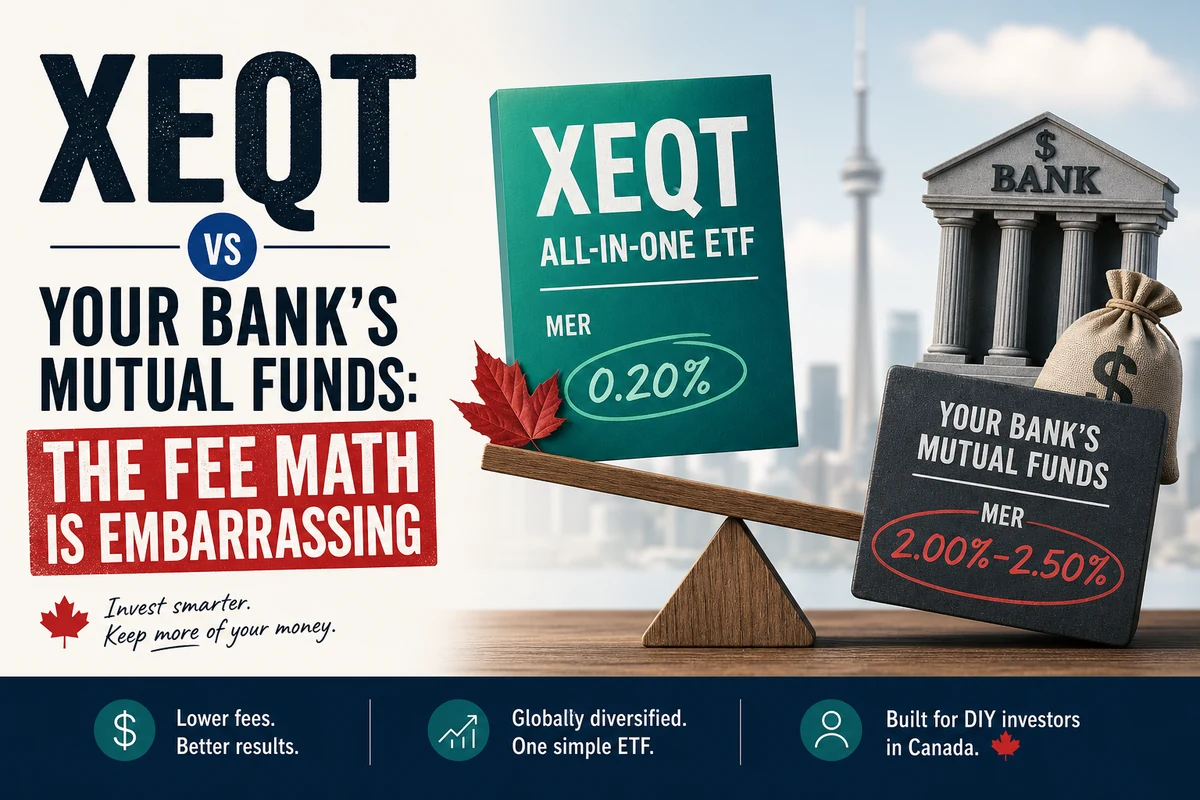
Your bank’s mutual fund probably has a name that sounds reassuring. Something like “Balanced Growth Portfolio” or “Diversified Income Plus.” What it almost certainly also has is a Management Expense Ratio somewhere between 1.8% and 2.5% per year. That number does not sound alarming. Spread over twelve months, on a percentage basis, it barely registers. In dollar terms, over a working lifetime of investing, it is one of the most expensive financial decisions most Canadians ever make without realizing they made it.
XEQT, the iShares Core Equity ETF Portfolio, charges 0.20% per year. That is the whole number. No advisor fee layered on top, no trailing commission buried in the fine print, no “Series A” versus “Series F” confusion. Just 0.20%, all in, for a globally diversified portfolio of thousands of companies across dozens of countries. The gap between 0.20% and 2.0% sounds like a rounding error. Over thirty years, it is not a rounding error. It is a house.
Why Canadian Mutual Fund Fees Are This High
Canada has historically had some of the highest mutual fund fees in the world. While the average MER for equity mutual funds in the United States sits around 0.50% and the UK average is closer to 0.75%, many mainstream Canadian mutual funds have charged MERs in the 2.0% to 2.5% range for decades. The numbers have edged down somewhat in recent years, but the big-bank flagship funds that most Canadians actually hold have not moved dramatically.
The reason is structural. Canadian mutual funds sold through bank branches and traditional advisors embed what are called trailing commissions directly into the MER. These are ongoing annual payments, typically 0.5% to 1.0% of your assets, paid by the fund company to the advisor or bank branch every single year you remain invested. You never see this payment leave your account. It is deducted from the fund’s net asset value before the return is calculated and reported to you. The person sitting across the desk at your bank branch is not required to disclose this arrangement in a way that makes its dollar magnitude obvious. The incentive this creates is straightforward: as long as you stay invested in the fund, the advisor gets paid. Recommending you switch to a low-cost ETF that pays them nothing is not in their financial interest.
Canadian mutual funds are not sold because they are the best product for investors. They are sold because they are the best product for the people selling them. That is not cynicism, it is how the compensation model works.
This is not a conspiracy. It is a feature, not a bug, from the industry’s perspective. The Canadian mutual fund industry is dominated by a small number of large institutions with enormous distribution networks, and those networks run on trailing commissions. Your “advisor” at the bank is, legally speaking, a licensed salesperson required to recommend products that are “suitable” for you, not necessarily optimal for you. Those two standards are not the same thing.
What Does 2% Actually Cost You? Run the Numbers
Percentages are psychologically inert. Actual dollar figures are not. So let’s work through a realistic Canadian scenario.
Assume you are 35 years old, contributing $700 per month to your TFSA and RRSP combined, and you plan to retire at 65. Over thirty years, you contribute $252,000 in total. Assume the market delivers a gross annualized return of 7% before fees, which is consistent with long-run global equity return assumptions used widely in financial planning.
At XEQT’s 0.20% MER, your net annual return is approximately 6.80%. After thirty years, this modeled scenario produces a portfolio of approximately $693,000.
At a typical bank mutual fund MER of 2.0%, your net annual return is approximately 5.00%. The same modeled scenario produces a portfolio of approximately $484,000.
The fee gap in real dollars: On identical contributions and identical gross market returns, the difference between a 0.20% MER and a 2.0% MER over 30 years is approximately $209,000 in this scenario. That is not a hypothetical edge case. It is the compounding math applied to a completely ordinary Canadian savings rate.
Two hundred thousand dollars is not a marginal portfolio optimization. It is the difference between retiring with full confidence and retiring with an uncomfortable spreadsheet. And the cruel geometry of compounding means that the damage accelerates. In year one, the fee gap costs you maybe $600 on a $30,000 portfolio. In year twenty-nine, when your portfolio is approaching $500,000, the 2% MER is quietly removing roughly $10,000 from your account in a single year. You will never see a bill for that. It will simply not be there.
The Performance Promise That Doesn’t Deliver
The implicit promise of a high-MER mutual fund is that active management earns back the fee. Professional managers, with their research teams and market access, will pick better investments and outperform a passive index. This would make the premium worthwhile. The problem is that this claim fails repeatedly and consistently in the data.
S&P’s SPIVA (Indices Versus Active) Scorecard tracks active fund performance against benchmarks across every major market. Over long time horizons of ten to twenty years, the research consistently shows that roughly 90% of actively managed funds underperform their benchmark index. In Canada specifically, one SPIVA report found that just 2.5% of actively managed Canadian equity funds outperformed the S&P/TSX Composite Index during a five-year measurement period. The percentage that sustains outperformance over longer periods shrinks further still.
This is not because Canadian portfolio managers are incompetent. It is because beating a market index is genuinely difficult, especially after fees. A fund manager charging 2% has to outperform the index by more than 2% every single year just to break even with a passive fund. Over a full career of thirty years, sustaining that outperformance is extraordinarily rare. Warren Buffett wrote in his 1996 letter to Berkshire Hathaway shareholders that most investors would be better served by low-cost index funds than by professional money managers. He has made the same argument consistently for decades, and the evidence has only strengthened in that time.
A fund manager has to outperform the index by more than their fee every single year just to keep pace with a passive ETF. Over thirty years, that is an almost impossible ask. Most never come close.
What XEQT Actually Gives You for 0.20%
At its current price of around $42.97, XEQT holds a globally diversified portfolio across four underlying iShares ETFs: XUU covering US equities at roughly 45% of the portfolio, XIC covering Canada at roughly 25%, XEF covering international developed markets at roughly 25%, and XEC covering emerging markets at roughly 5%. The portfolio rebalances automatically. You do not need to buy multiple ETFs, track allocation drift, or place rebalancing trades. You buy one thing, and it maintains global diversification permanently.
The 0.20% MER is a single, all-in number. There is no advisor fee on top, no trailing commission embedded inside, no double-counting at the underlying fund level. The costs of the four underlying ETFs inside XEQT are already absorbed into the 0.20% figure. There is no hidden second layer. What iShares publishes is what you pay.
You can hold XEQT in every major registered account in Canada. The TFSA allows $7,000 in new contributions in 2026. The RRSP allows 18% of prior year earned income, up to approximately $32,490 in 2026. The FHSA, which remains dramatically underused, allows $8,000 per year up to a $40,000 lifetime limit and is one of the best first-step vehicles for new investors. XEQT is eligible in all of them. If you want a fuller breakdown of how XEQT functions as a complete long-term portfolio, the complete XEQT guide covers the structure in detail.
2026 Registered Account Limits: TFSA: $7,000/year. RRSP: 18% of prior year income, max ~$32,490. FHSA: $8,000/year, $40,000 lifetime. XEQT is eligible in all three, and costs 0.20% MER in every single one of them.
The Switching Conversation Your Bank Does Not Want You to Have
If you currently hold mutual funds at a big bank and want to move to XEQT, the practical path is simpler than most people assume. You open an account at Wealthsimple or Questrade, both of which offer commission-free ETF purchases. You initiate a transfer of your registered account directly to the new brokerage, a process called a direct transfer of registered funds. Your bank is legally required to process this request. They will not be enthusiastic about it. They may call you, remind you of your long relationship with them, and suggest that switching is complicated or risky. None of that is accurate.
The one cost worth knowing about: some brokerages charge a transfer-out fee when you move a registered account. Questrade reimburses transfer fees up to $150 for qualifying accounts. Wealthsimple also periodically offers transfer fee rebates. In most cases, a single year’s fee savings from moving out of a 2% mutual fund will cover that transfer cost many times over.
If you are not sure which account structure fits your situation, the all-in-one ETF comparison guide runs through the full landscape and helps you think through the right approach for your specific accounts and goals.
The Psychological Trap Keeping Canadians Stuck
If the math is this clear, why do millions of Canadians still hold expensive bank mutual funds? Several reasons, and they are all worth naming directly.
First, inertia. The mutual fund was probably set up by someone at the bank when you opened your RRSP ten years ago. You have never been given a compelling reason to revisit it. The statements show a number that goes up over time, and that number going up feels like success, even if it would have gone up significantly more in a cheaper vehicle.
Second, the fee is invisible. You never receive a bill for 2% of your assets. It does not show up as a line item on your statement. It is extracted from the fund’s return before the return reaches you. Research in behavioural finance consistently shows that costs people never explicitly see feel less real than costs they pay directly. A $5,000 annual fee paid via cheque would feel outrageous. A $5,000 fee quietly deducted from a fund’s net asset value feels like nothing, because you never watch it leave.
Third, the advisor relationship. Many Canadians have worked with the same bank advisor for years. Leaving feels disloyal. It is worth being clear: in most cases, that “advisor” is a salaried bank employee whose compensation is tied, directly or indirectly, to the products they sell. The relationship may be genuine, and they may be a perfectly decent person, but the financial incentive is not aligned with yours. A genuinely independent, fee-only financial planner who charges a flat fee or hourly rate for advice rather than earning commissions is a meaningfully different arrangement. But a commission-based bank advisor recommending you stay in a 2% mutual fund is not functioning as a fiduciary.
The fee is invisible by design. If every Canadian received a single annual statement showing the exact dollar amount extracted from their portfolio in fees that year, the mutual fund industry would look very different within a decade.
What About Index Mutual Funds From the Bank?
Some banks offer index mutual funds, and these are a meaningful improvement over actively managed ones. TD’s e-Series funds, for example, carry MERs well below 1% and provide straightforward index exposure at a fraction of the cost of actively managed alternatives. These are a legitimate stepping stone, particularly for investors who are not yet comfortable navigating a brokerage account or who are contributing in small, frequent amounts.
But even lower-cost bank index mutual funds typically carry higher MERs than XEQT’s 0.20% all-in figure, particularly once you account for all components of a diversified portfolio. For a $200,000 portfolio, even a modest MER difference of 0.25% amounts to $500 per year. Over twenty years, with compounding, that difference adds up. More practically, index mutual funds through bank platforms can restrict which accounts you use them in, may require minimum contributions, and generally offer less flexibility than a no-commission ETF platform. For most investors past their first year or two, a brokerage account holding XEQT offers better economics and fewer constraints.
Frequently Asked Questions
What is the average MER for a Canadian bank mutual fund? Most actively managed Canadian equity and balanced mutual funds carry MERs between 1.8% and 2.5% per year. According to Morningstar data, Canada has historically had some of the highest mutual fund fees in the world, significantly above averages in the US (around 0.50%) and UK (around 0.75%). Some banks have introduced lower-cost index mutual funds, but flagship balanced funds at most major banks remain well above 1.5%.
Does the higher fee mean a better return? No. SPIVA research shows that over long time horizons of ten to twenty years, roughly 90% of actively managed funds underperform their benchmark index after fees. The fund manager must outperform the index by more than the full MER every year just to match a passive fund’s return. Sustained outperformance at that level is extremely rare and cannot be reliably identified in advance.
How do I switch from a mutual fund to XEQT? Open a TFSA or RRSP at Wealthsimple or Questrade, both of which offer commission-free ETF purchases. Request a direct registered transfer from your current bank, they are legally required to process it. Once the funds arrive, you buy XEQT. Questrade reimburses transfer fees up to $150 for qualifying accounts, and a single year’s fee savings from leaving a 2% fund will typically cover the transfer cost many times over.
Is XEQT appropriate for most long-term investors? XEQT is 100% equities, which means it will decline significantly in a market downturn. For investors with a time horizon of ten or more years who can stay the course through volatility, the all-equity allocation is well-suited to long-term wealth building, and the 0.20% MER advantage compounds most powerfully when given time. Investors closer to retirement or with lower risk tolerance may want to consider a balanced option instead.