
My Parents Kept Pushing Their Advisor on Me, So I Ran the 20-Year Math
October 16, 2026

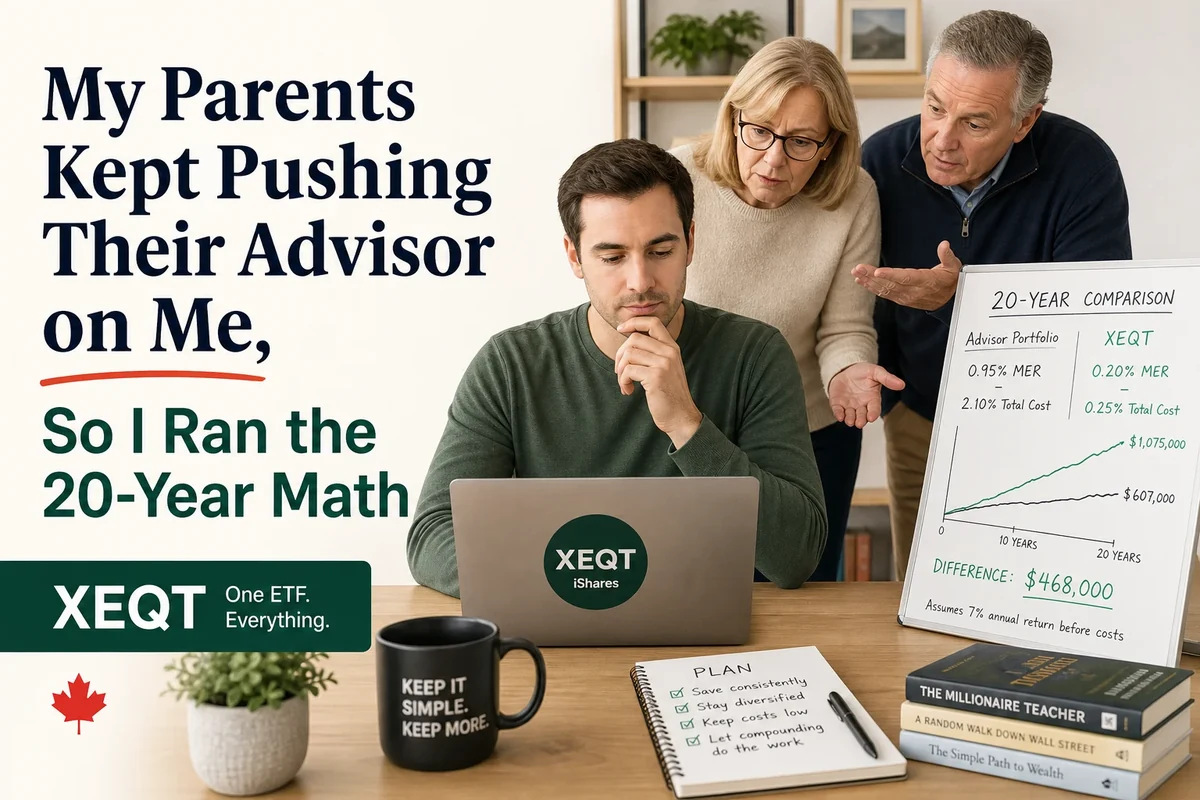
A 2% mutual fund MER on a $250,000 portfolio costs about $5,000 a year. Assume a 6% return before fees. After 20 years, that portfolio ends up roughly $224,000 behind the same money in XEQT, which charges a 0.20% MER. That is the number I took to my parents. The conversation that followed taught me more than the spreadsheet did, because the math was the easy part.
Below you will find the calculation, the tax issues that matter for retirees, the cases where an advisor earns their fee, and a way to raise the subject without suggesting anyone’s advisor is a crook. I ran every figure myself using annual compounding and the verified 0.20% XEQT MER. The return assumptions are illustrations, not forecasts.
Why Parents Trust Their Advisor, and Why It Is Emotional, Not Financial
My parents’ advisor has been in their lives for decades. He remembers the family milestones. He phones every RRSP season. When markets get scary, he is the one who talks them out of selling. That is real value, and I did not want to wave it away.
The trouble is that the relationship is doing the work that the portfolio’s performance should be doing. Nobody in my family could tell me what the funds cost. The fee never leaves a chequing account. It is baked into the fund’s MER and paid to the fund company and the advisor before your statement shows a return. One 2026 Canadian advisor guide makes the point well: there is no psychological hit when the fee is invisible, which is exactly why commission-based pricing survives.
Canada also has a history here. A 2026 Canadian mutual fund guide notes that our MERs are among the highest in the world, with global equity mutual funds still commonly sitting between 2.1% and 2.5%. It puts the average mutual fund MER in the United States at about 0.50% and in the United Kingdom at about 0.75%. When my parents started investing, a bank or advisor selling mutual funds was close to the only game in town. Nobody was foolish for trusting that system. The system just never got cheaper for them.
How Much Does a 2% MER Cost Over 20 Years?
A 2% MER on $250,000 costs about $5,000 in the first year, versus $500 for XEQT. Compounded over 20 years at a 6% pre-fee return, the 2% fund ends near $547,800 and XEQT ends near $772,100. The gap is about $224,000, and it grows with every point of market return you add.
A 2% fee does not sound like much. But at a 6% pre-fee return, 2% is a third of what the market gave you. XEQT’s 0.20% takes about a thirtieth. You can check the fee side in our breakdown of XEQT’s 0.20% MER.
Twenty-year gap on $250,000: At a 6% return before fees, a 2% MER fund grows to about $547,800, a fee-based advisor charging 1% on top of 0.20% ETFs grows it to about $638,500, and XEQT at 0.20% grows it to about $772,100. These results assume no withdrawals and no new contributions, and they are illustrations rather than forecasts.
I tested the sensitivity too. If markets deliver 5% before fees, the gap is about $187,000. If they deliver 7%, it is about $269,000. The direct fee difference alone adds up to a bit over $50,000 within the first ten years, before the lost compounding on that money even shows up. The fee never has a bad year. It collects the same percentage whether markets rise or fall.
A 2% fee does not take 2% of your money. At a 6% market return, it takes a third of your return, every year, for as long as you hold the fund.
Could the advisor’s funds beat the index by enough to cover the gap? The evidence says rarely. The SPIVA Scorecard for June 30, 2019 found that only 12% of actively managed Canadian equity mutual funds beat their benchmark. That is one report from a particular period, so treat it as a data point rather than a law. Even so, the fee is a certain loss and the outperformance is a hope.
Where the Hidden Tax Layer Shows Up, and Where It Does Not
The tax story is real but narrower than most fee-bashing articles admit. It only applies to money held outside registered accounts. Inside a TFSA, RRSP or RRIF, mutual fund distributions trigger no tax. For many retirees, most of the money sits in those accounts, so the fee drag is the main problem and the tax drag is a footnote.
In a non-registered account, the picture changes. A mutual fund manager who trades actively can realize capital gains inside the fund, and those gains are passed to you as a distribution you owe tax on, even if you never sold a unit. A low-turnover index ETF such as XEQT generally throws off less of this. To be clear, XEQT is not tax-free. It still pays out dividends and foreign income, reported on a T3, and about 15% US withholding tax applies in a TFSA, FHSA or non-registered account. In an RRSP, that withholding is 0%. XEQT is simply cheaper and quieter than most managed funds.
The clearest retiree tax problem I found was not a mutual fund issue at all. In the four-part series “Before You Fire Your Parents’ Financial Advisor, Do This First,” a Canadian planner describes a client with a large portfolio of dividend-paying stocks. Canadian dividends are grossed up on the tax return, so the reported income was higher than the cash she received. Stacked on top of RRIF withdrawals, pensions and government benefits, that pushed her over the OAS recovery threshold, the net income level where the government starts clawing back Old Age Security. She was effectively paying a marginal rate above 40% even though her income did not look high. The fix was a total return approach with less reliance on dividends, and the clawback disappeared.
I want to be careful here. That case shows that a portfolio’s structure affects retirees’ taxes in ways the headline MER hides. It does not show that XEQT magically avoids clawbacks. A broad global fund can make it easier to lean on growth rather than dividends, but your parents’ real exposure depends on their pensions, RRIF minimums and where each account sits. The same planner described a couple who under-withdrew from their RRIFs in their 60s, then faced large forced minimums in their late 70s that pushed them into higher brackets. Fee math cannot see that. A good planner can.
When Is an Advisor Actually Worth Paying For?
An advisor is worth paying for when they do work that changes your outcome by more than their fee. That means coordinating RRIF and TFSA withdrawals to smooth taxes, planning around OAS and CPP timing, updating wills and beneficiaries, and talking a nervous retiree out of selling at the bottom. If your parents’ advisor does those things and charges for them transparently, the fee may well be justified.
The Canadian Couch Potato blog has made a version of this argument for years. A good advisor can pay for themselves by preventing behavioural mistakes that would cost more than 1% to 1.5% a year. The same writer also says the real problem is an advice industry dominated by commissioned salespeople. If your parents are paying 2% for someone who rebalances a dividend growth strategy and calls twice a year, nothing in that fee is buying planning.
Commission-based advice is still described as the most common model in Canada, with fee-only planners a small minority. I could not verify an exact percentage, so I will not quote one. The incentive point stands regardless. When an advisor is paid through embedded trailing commissions, a cheap index fund is the one product they cannot recommend, because it pays them nothing.
Advisor fee transparency test: Ask for the dollar amount your parents paid last year in all fees, including the fund MERs and any advisor charge. If the advisor cannot give you one number in dollars within a week, you have learned something important about the arrangement.
How to Raise It Without Dismissing 30 Years of Decisions
Do not open with the fee. If you start with “your guy is ripping you off,” you are asking your parents to agree that they were fooled, and nobody signs up for that. I started instead with a question about me: “I am trying to learn how retirement withdrawals work, would you let me sit in on your next review?”
That framing works because it asks for help instead of delivering a verdict. Once I was in the room, I asked what the all-in cost of their accounts was, what each fund’s MER was, and how the advisor was paid. The answers were guesses. Nobody had misled anyone. Nobody had ever been asked.
From there I suggested an audit together rather than a switch. We listed every account, what it held, and what it cost in dollars. I put the $250,000 example next to it and let them draw their own conclusion. That was my opening to say that the advisor’s relationship and the fund’s fee are two separate things. Parents can keep the person and change the product, or keep the product and ask for a lower-cost series. They do not have to choose between loyalty and arithmetic.
If they decide to move, check for redemption fees and any unrealized gains in non-registered accounts before selling anything. A sale inside an RRSP, RRIF or TFSA is tax-neutral, but outside those accounts it can trigger capital gains. Moving money in registered accounts to a new institution should be done as a direct transfer so it never passes through your parents’ hands.
The Middle Path: Robo Advisors and Fee-Only Planners
If your parents want a human voice without a 2% bill, there are middle options. A robo advisor such as Wealthsimple charges a management fee that, per a 2026 Canadian robo advisor roundup, runs 0.20% to 0.50% as of 2026, plus the low costs of the ETFs inside. ModernAdvisor charges 0.35% to 0.50%, and that roundup reported a 5.00% average five-year after-fee return on its balanced portfolio. That balanced return includes bonds, so it is not directly comparable to an all-equity fund like XEQT. Justwealth, which a recent review described as giving every client access to a real portfolio advisor, sits at the higher-service end of the robo spectrum.
A fee-based planner who uses ETFs is another route. PWL Capital, for example, states on its advisor page that clients pay up to 0.75% of assets, falling as the account grows, in return for an investment policy statement, portfolio management, and ongoing planning. That is still a real fee, so run it through the same 20-year math before agreeing.
The cheapest route for a retiree who just needs a plan is a fee-only planner who charges a flat fee. A Canadian guide to Certified Financial Planners puts that at roughly $1,000 to $5,000 or more depending on complexity. A one-time planning bill is a rounding error next to $5,000 a year in hidden fund fees. Your parents could buy the plan, then implement it themselves at Questrade or Wealthsimple.
If the holding is XEQT, our guide to an XEQT withdrawal strategy in retirement covers how drawdown works with an all-equity fund as the core. A retiree who cannot stomach 100% equities should look at a more conservative all-in-one instead. XEQT is all stocks, and that is not right for every 72-year-old.
Three Scenarios: Early Career, Mid-Accumulation, Pre-Retirement
Take an early-career saver who invests $6,000 a year ($500 a month) for 30 years at a 6% return before fees. In XEQT, that grows to about $458,000. In a 2% MER fund, it grows to about $336,500, a gap near $121,500. This person has no complexity that justifies an advisor. A TFSA with a $7,000 annual limit, or an FHSA with an $8,000 annual limit and a $40,000 lifetime cap, can hold the whole plan. DIY wins decisively.
Now take someone in mid-accumulation with $150,000 invested and no new contributions over 15 years. At the same 6% assumption, XEQT reaches about $349,400 and a 2% fund reaches about $270,100. That is a gap of roughly $79,300 for owning the same market. The planning needs at this stage are modest. The RRSP limit is 18% of prior-year earned income up to a cap of about $32,490 for 2026, and a one-time fee-only plan can answer the questions that come up about how to use that room.
Pre-retirement is where an advisor’s case is strongest, and also where the fee hurts most in dollars. On a $600,000 portfolio, a 2% MER costs $12,000 a year, while XEQT costs $1,200. A fee-only plan at $1,000 to $5,000 plus a 0.20% ETF is still far cheaper than a bundled 2% product. The planning work that matters here, including RRIF sequencing, OAS timing, and estate documents, is exactly what is worth paying for. What is not worth paying for is the fund fee on top.
If you want to run your own numbers, our XEQT growth calculator lets you compare fee levels directly, and our full guide to XEQT explains what the fund holds. The aim is not to talk your parents out of their advisor. It is to get them asking for the dollar cost, because once they see it, the rest of the conversation tends to take care of itself.
Frequently Asked Questions
How much does a 2% MER really cost over 20 years? On $250,000 growing at 6% before fees, a 2% MER leaves you with about $547,800 after 20 years, versus about $772,100 at XEQT’s 0.20% MER. The difference is about $224,000.
Is a financial advisor ever worth the fee? Yes, when the advisor provides tax-aware withdrawal sequencing, OAS and CPP planning, estate coordination, and behavioural coaching, and charges transparently for it. A commission-based advisor who only selects and rebalances high-MER funds is hard to justify.
What does XEQT cost compared with an advisor-managed mutual fund? As of 2026, XEQT’s MER is 0.20%, which is $500 a year on $250,000. A mutual fund with a 2% MER costs $5,000 a year on the same balance.
Can I switch my parents’ accounts to XEQT without a tax bill? Selling funds inside an RRSP, RRIF or TFSA triggers no tax, but selling in a non-registered account can realize capital gains. Check unrealized gains and any redemption fees first, and use a direct transfer for registered accounts.