How Canadian Taxes Actually Work With Your Investments (And Why XEQT Makes It Simpler)
May 5, 2026

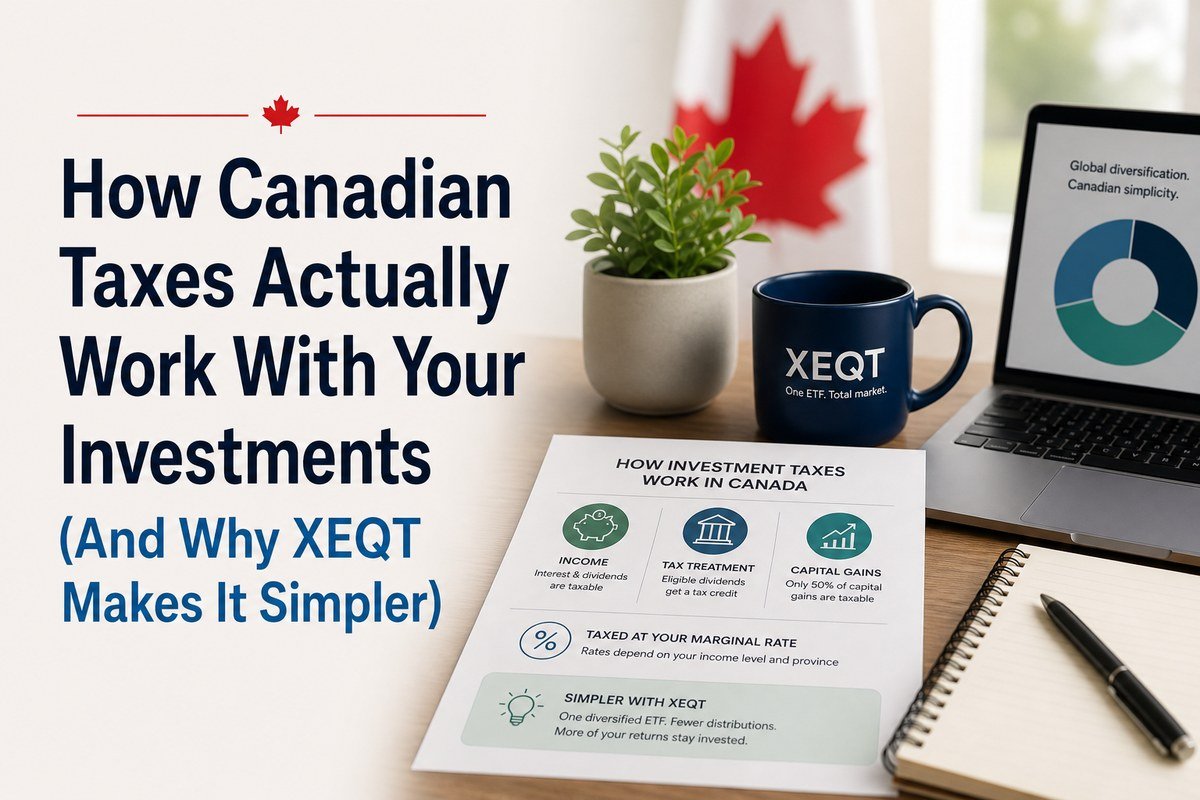
Most Canadians Are Losing Money to Taxes They Don’t Have to Pay
Not through fraud. Not through bad luck. Through something far more mundane: holding investments in the wrong accounts, misunderstanding how capital gains are taxed, and never sitting down to think about the order in which they should be using their registered accounts. The tax system in Canada is genuinely favourable to long-term investors. But you have to understand the basic rules to take advantage of them.
This article is not about exotic tax shelters or loopholes. It’s about the foundational stuff: how investment income gets taxed in Canada, which accounts protect you from that taxation, and how a single-ETF approach like XEQT fits cleanly into a tax-efficient strategy without requiring a spreadsheet and a law degree.
The single most impactful tax decision most Canadians will ever make is not which investments to hold. It’s which accounts to hold them in.
The Three Types of Investment Income and How CRA Treats Them
Before you can make smart decisions about account placement, you need to understand that not all investment income is taxed the same way. CRA treats three types differently, and the differences are significant.
Interest income is taxed at your full marginal rate, the same as employment income. If you hold a GIC or bond fund in a non-registered account and you’re in a 40% marginal tax bracket, you keep 60 cents of every dollar earned. There is no preferential treatment here.
Canadian eligible dividends come with a dividend tax credit that reduces the effective tax rate considerably. Depending on your province and income, the effective rate on eligible dividends can be dramatically lower than your marginal rate, and in some cases, at lower income levels, the effective rate is near zero or even negative.
Capital gains are taxed on only a portion of the gain. As of 2024, the federal inclusion rate for capital gains was increased to two-thirds for gains over $250,000 annually for individuals (and for most corporations), but for most Canadian investors with modest annual capital gains, the effective rate remains meaningfully lower than ordinary income. The long and short of it: capital gains are still the most tax-friendly form of investment income for most people.
Foreign income, including dividends from US or international companies, is taxed as ordinary income in a non-registered account, with no preferential treatment. This matters when you’re thinking about where to hold global equity ETFs like XEQT.
Your Registered Accounts Are the Most Powerful Tool You Have
Canada gives investors three core registered account types that shelter investment growth from tax, each in a slightly different way. Most Canadians are not using all three optimally.
The TFSA is the most flexible. You contribute after-tax dollars, your investments grow completely tax-free, and withdrawals are also tax-free. There is no tax on dividends, capital gains, or interest earned inside a TFSA. Withdrawals add back to your contribution room the following calendar year. For 2026, the annual contribution limit is $7,000. If you’ve never contributed and have been eligible since age 18, your accumulated room could be substantially higher. No investment income earned inside a TFSA affects your eligibility for income-tested benefits like OAS or GIS in retirement.
The RRSP works differently. Contributions are tax-deductible, meaning you reduce your taxable income today. The investments grow tax-sheltered, but withdrawals are taxed as ordinary income. The annual contribution limit is 18% of your prior year’s earned income, subject to a dollar maximum set by CRA each year. The RRSP is most powerful when you contribute in high-income years and withdraw in lower-income years, typically in retirement.
The FHSA is the newest account and genuinely excellent for eligible first-time buyers. You can contribute $8,000 per year up to a lifetime maximum of $40,000. Contributions are tax-deductible like an RRSP, and qualifying withdrawals for a first home purchase are completely tax-free like a TFSA. If you’re eligible and not already using an FHSA, it should be near the top of your priority list.
2026 Account Limits: TFSA contribution limit is $7,000 per year. RRSP limit is 18% of prior year earned income (check your Notice of Assessment for your exact room). FHSA allows $8,000 per year with a $40,000 lifetime maximum for eligible first-time home buyers.
The Account Priority Order Most People Get Wrong
The standard advice you’ll see everywhere is some version of: max your RRSP, then max your TFSA. That framing is too simple and in many cases leads people to make the wrong call.
Here’s a cleaner way to think about it. If your employer matches RRSP contributions, that match is an immediate 50% or 100% return on your money, which nothing else can beat. Contribute enough to get the full match first, always. After that, the TFSA vs. RRSP question depends on your current marginal tax rate versus your expected marginal rate in retirement.
If you’re in a high marginal bracket now and expect to have lower income in retirement, the RRSP is likely the better vehicle. The deduction saves you more tax today than the future withdrawal will cost you. If you’re in a lower income year, starting your career, or expecting a high retirement income from pensions, a TFSA may serve you better because you avoid future taxation entirely.
For first-time buyers, prioritizing the FHSA before or alongside the RRSP makes strong sense. You get the deduction benefit of the RRSP and the tax-free withdrawal benefit of the TFSA, combined in one account specifically for a home purchase.
Once you’re past those structured choices, a non-registered account is still valuable. You’re not stuck paying high fees or avoiding investing just because your registered accounts are full. Capital gains treatment and dividend tax credits make non-registered investing reasonable, particularly when you’re holding equity ETFs with relatively low turnover.
Where XEQT Fits in a Tax-Efficient Account Structure
XEQT is a globally diversified all-equity ETF holding Canadian, US, international developed, and emerging market equities. It pays distributions that include a mix of Canadian dividends, foreign income, and return of capital. In a non-registered account, some of that foreign income is taxed as ordinary income rather than receiving preferential dividend treatment.
This is why the general guidance from Canadian portfolio management experts is to prioritize equities with foreign income exposure, including broad global ETFs, inside registered accounts first. Holding XEQT in your TFSA or RRSP means all of those distributions, whether they’re dividends, foreign income, or capital gains, grow completely sheltered from tax. You never have to think about it.
In a non-registered account, XEQT is still a reasonable choice. The MER is 0.20%, turnover is low, and the capital gains you accumulate grow unrealized until you sell. You control the timing of that tax event. Compare that to an actively managed mutual fund that may distribute capital gains to unitholders every year regardless of whether you sold anything. The tax drag from high-turnover active funds in non-registered accounts is a real and chronic cost that most investors never see directly on their statements.
Holding a low-turnover, broadly diversified ETF in a non-registered account is one of the more tax-efficient strategies available, not because it avoids tax entirely, but because it defers and controls when tax is owed.
One nuance worth knowing: if you hold XEQT or similar ETFs in an RRSP, US-listed ETFs held directly would allow you to avoid the 15% US withholding tax on US dividends under the Canada-US tax treaty. XEQT is a Canadian-listed ETF, so there is some foreign withholding tax that cannot be recovered inside either a TFSA or RRSP. For most people with relatively modest portfolios, this is a small cost compared to the complexity of holding multiple ETFs to optimize around it. If your portfolio is well into six figures and you want to pursue that optimization, the Canadian Portfolio Manager blog has detailed guidance on the so-called “Plaid” portfolio approach. For everyone else, XEQT in registered accounts is a very good outcome.
Simple Account Prioritization: (1) Employer RRSP match if available. (2) FHSA if you’re a first-time buyer. (3) TFSA for flexibility and tax-free growth. (4) RRSP if you’re in a high marginal rate year. (5) Non-registered account once registered room is filled. Hold XEQT in all of them and adjust account order as your situation changes.
What Happens When You Switch Brokers or Rebalance
One of the most common tax questions in the Canadian investing community comes up when someone wants to move accounts or simplify their portfolio. Inside a TFSA or RRSP, switching from one ETF to another, or moving from mutual funds to XEQT, has no immediate tax consequence. You can sell your TD e-Series funds or your bank mutual funds, buy XEQT, and the only thing that happens is you pay whatever trading commission applies. No tax bill.
In a non-registered account, selling a position that has appreciated triggers a capital gains event. If you bought something years ago and it has grown significantly, selling it to simplify into XEQT could create a meaningful tax obligation in that year. This doesn’t mean you shouldn’t do it. It means you should be aware of the cost, possibly spread the switch over multiple years to manage the annual gain, and consider consulting a tax professional if the numbers are large.
Transferring accounts between brokers, for example moving from Questrade to Wealthsimple or vice versa, does not trigger tax if done as an in-kind transfer. Your positions move as-is to the new broker. The cost basis stays the same. No taxable event occurs. The only practical consideration is transfer fees, which most receiving brokers will reimburse up to a limit.
Tax Loss Harvesting: Real but Overrated for Most Canadians
Tax loss harvesting is the practice of selling a position at a loss to realize the capital loss, which can offset capital gains elsewhere in your portfolio. It’s a legitimate strategy and one that sophisticated investors use intentionally. However, for most Canadians investing in a single ETF like XEQT in registered accounts, it’s largely irrelevant because there is no taxable gain or loss inside a TFSA or RRSP.
In a non-registered account, if XEQT dropped significantly and you wanted to harvest the loss, you could sell, book the loss, and immediately buy a comparable ETF to maintain your market exposure. The CRA superficial loss rule prevents you from repurchasing the identical security within 30 days before or after the sale. Buying VEQT (Vanguard’s comparable all-equity ETF) immediately after selling XEQT would satisfy this rule while keeping you invested. After 30 days, you could switch back if you preferred XEQT. This is a real strategy, but for most people the operational complexity and potential for mistakes in maintaining market exposure outweighs the tax benefit unless the loss amount is substantial.
Tax optimization should make your financial life simpler over time, not more complex. A strategy that requires active management to maintain is working against the core reason most Canadians should own a single all-equity ETF in the first place.
Frequently Asked Questions
Is XEQT tax-efficient in a non-registered account? Yes, relative to most alternatives. XEQT has a low MER of 0.20%, low portfolio turnover, and does not distribute large capital gains to unitholders the way many active mutual funds do. You will owe tax on distributions each year and on capital gains when you eventually sell, but the timing of the larger tax event is largely within your control.
Should I hold XEQT in my TFSA, RRSP, or both? Both are excellent options. Inside a TFSA, all growth and withdrawals are tax-free with no impact on retirement benefits like OAS. Inside an RRSP, you defer tax on growth until withdrawal. If you only have one registered account to fill, most lower-to-middle income Canadians are well served starting with the TFSA for its flexibility. Higher earners in peak income years often benefit more from the RRSP deduction. You can hold XEQT in both simultaneously and in a non-registered account once registered room is exhausted.
Does moving my mutual funds to XEQT inside my RRSP trigger a tax bill? No. Switching investments inside an RRSP or TFSA does not trigger any tax event. You can sell mutual funds and buy XEQT within those accounts freely. The only costs are any trading commissions your broker charges, which at Wealthsimple Trade are zero, and at Questrade are also free for ETF purchases.
What happens to my TFSA contribution room if XEQT drops in value and I withdraw? Your contribution room is restored based on the dollar amount you withdrew, not the original purchase price. If XEQT dropped and you withdrew $5,000 from your TFSA, you get $5,000 of room back on January 1 of the following year. The loss in value is simply gone; you cannot claim a capital loss on a TFSA withdrawal. This is one reason why holding investments with higher short-term volatility, like all-equity ETFs, in a TFSA is generally a long-term strategy rather than a short-term parking spot.