Your Friends Are Buying Individual Stocks. Here’s the Math on Why You Shouldn’t.
September 16, 2026

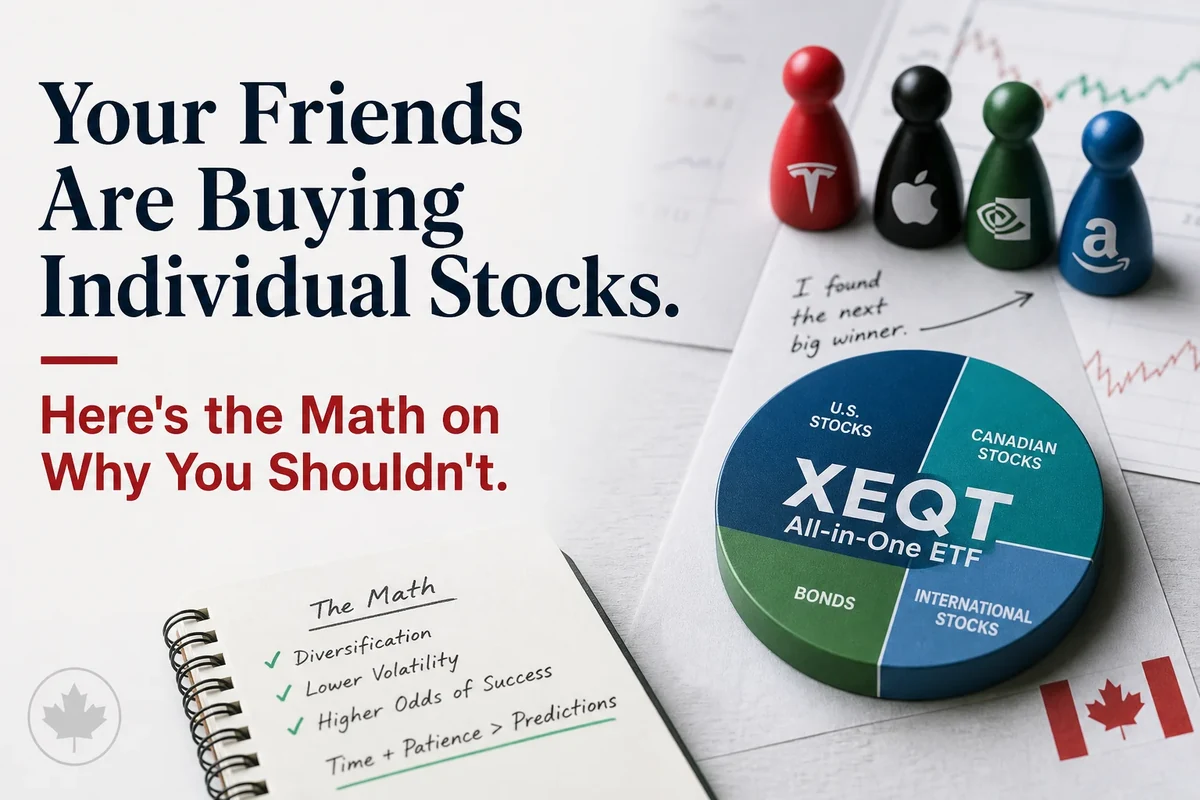
Someone in your life is up 40% on Nvidia. Maybe they told you at a dinner party, or posted a screenshot on Instagram, or just casually mentioned it while you were talking about something else entirely. The implication was clear: they figured something out that you haven’t. And now you’re sitting there wondering if you should be doing what they’re doing.
You probably shouldn’t. Not because picking stocks is impossible, and not because your friend isn’t smart. But because the math on individual stock picking is so consistently, unfavourably skewed for retail investors that it functions less like a skill-based game and more like a lottery with extra steps. The data on this isn’t thin or contested. It’s about as settled as anything gets in personal finance.
Why Your Friend’s Win Is Probably Survivorship Bias
Your brain keeps a tidy ledger of the people who made money on stocks. It does a terrible job recording the people who lost. That’s not a character flaw, it’s how memory works when social stakes are involved. Nobody posts their Shopify loss in the group chat. Nobody brings up the four other bets that went sideways before the one that paid off.
This is survivorship bias in its purest form, and it operates at every level of the investing world. Research by Hendrik Bessembinder, published in 2018 and updated through 2025, found that from 1926 onward, just 208 companies were responsible for creating approximately 75% of all net wealth in the U.S. stock market. The win rate for individual stocks against Treasury bills, a proxy for cash, has hovered around 50% in recent decades. That means roughly half of all public companies, over their entire lifetimes, failed to beat the risk-free rate. You weren’t just fighting to beat an index. You were fighting to beat cash.
When just 4% of stocks account for all the net wealth creation in the market, you’re not picking from a basket of opportunities. You’re playing a game where most of the chips belong to a small number of names you probably don’t own.
The Bessembinder research makes explicit what experienced passive investors have understood for decades: stock market returns are driven by a tiny minority of extraordinary winners. Miss those winners and the math turns against you fast. Broad index funds like XEQT, which hold roughly 9,000 companies across global markets, are structured specifically to capture those winners automatically. Concentrated stock portfolios are structured to guess which ones they’ll be.
The Documented Performance Penalty Active Traders Actually Pay
This isn’t just a story about bad luck. Academic research has tracked the actual returns of individual investors across large datasets, and the results are consistent and sobering.
Odean (1999) found that individual investors’ purchases systematically underperform their sales by a significant margin. That sounds counterintuitive until you think about it: investors tend to hold their losers and sell their winners, which means the stocks they’re buying into tend to be overpriced relative to their expectations, and the stocks they’re selling tend to continue rising after they’re gone. Barber and Odean (2000, 2001) extended this work and documented that, on average, individual investors who hold common stocks pay a substantial performance penalty for trading actively. The more active the trader, the worse the results. The research characterizes this as consistent with overconfidence: people trade as though they know more than they do, and the market extracts a price for that belief.
The S&P Indices Versus Active (SPIVA) Scorecard tracks mutual fund manager performance over long time horizons. These aren’t retail investors trading on tips from friends. These are full-time professionals with research teams and institutional-grade tools. Over 10, 15, and 20-year periods, more than 90% of actively managed funds fail to beat their benchmarks. In Canada specifically, SPIVA data showed that only 12% of actively managed Canadian equity mutual funds delivered higher returns than their benchmarks over five years. If the professionals can’t do it reliably, the weekend investor tracking Shopify earnings calls is fighting even longer odds.
The SPIVA result: Over 10, 15, and 20-year periods, more than 90% of actively managed funds underperform their benchmark index. These are professional money managers with full-time research teams. Retail stock pickers face worse odds, not better.
Why XEQT’s 0.20% MER Destroys the “Edge” Argument
Stock pickers often frame their case around the idea that they have an edge: local knowledge, industry insight, or pattern recognition that the market hasn’t priced in yet. Even granting that edge generously, the math of fees makes it nearly impossible to translate into meaningful net outperformance over time.
XEQT carries an MER of 0.20%. On a $100,000 portfolio, that’s $200 per year. On $500,000, it’s $1,000 per year. That is your total cost of owning a globally diversified portfolio of roughly 9,000 companies, automatically rebalanced, with no trading commissions on Wealthsimple or Questrade.
Now consider what individual stock picking actually costs. There are trading commissions on platforms that charge them, bid-ask spreads, the tax friction from realizing capital gains in a taxable account every time you rebalance or cut a loser, and the opportunity cost of holding cash between positions. Beyond the explicit costs, there’s the performance drag from the documented behavioural patterns above: selling winners too early, holding losers too long, and trading more frequently than the evidence supports. Barber and Odean’s research found that active traders consistently underperform passive benchmarks, not by a trivial margin, but by amounts that compound meaningfully over the years and decades a Canadian investor actually needs their portfolio to grow.
To justify picking individual stocks over holding XEQT, you need to outperform the index by enough to cover your trading friction, your behavioural drag, your research time, and still land ahead net of taxes. The bar is high. Most professionals don’t clear it consistently. The research says most amateurs won’t either.
For a full breakdown of what XEQT’s fee structure actually looks like in dollar terms and how it stacks up against what Canadians typically pay for mutual funds and advisor-managed portfolios, the XEQT fee explainer runs that math in detail.
The Diversification Problem That Feels Like Diversification But Isn’t
Ask someone who holds ten or fifteen individual stocks whether they’re diversified, and most will say yes. They’re not. Not in any meaningful sense of the word.
Holding fifteen Canadian technology stocks isn’t diversification. It’s a concentrated sector bet with extra steps. Even holding fifteen stocks across different industries leaves you with enormous company-specific risk. A single earnings miss, a management scandal, a sector-wide repricing driven by interest rate changes, any of these events can devastate 5%, 10%, or 15% of your portfolio in a single day. When you own 9,000 companies globally, the failure of any single one is a rounding error.
Research on portfolio concentration in academic finance surfaces something important: roughly 70% of individual stocks either beat or trail the broad market index by 10% or more in any given period. That number flips the standard narrative on its head. Your concentrated bets don’t need to be wrong to hurt you. They need to be both right and lucky just to match the average. The distribution of individual stock outcomes is so wide that holding a small number of names dramatically increases your exposure to the unfavourable tail of that distribution.
Even a concentrated portfolio strategy with decent average performance comes with dramatically higher variance, more big wins, but also more devastating losses, and more permanently wasted tax-sheltered room when those losses land inside a TFSA or RRSP.
Research by Bessembinder shows that just 4% of stocks are responsible for all net wealth creation in the market. Broad index funds are designed to capture those 4% automatically. Concentrated stock portfolios are designed to guess which 4% they’ll be.
What Happens When Bad Stock Picks Land in Your TFSA or RRSP
The registered account angle is where individual stock picking gets particularly painful for Canadians, and it’s a dimension that rarely gets discussed honestly.
Your TFSA gives you $7,000 in new contribution room every year, with cumulative room of $109,000 for anyone who has been eligible since 2009. Growth inside a TFSA is completely tax-free. But that also means losses inside a TFSA are permanently destructive. If you put $20,000 into your TFSA and watch it drop to $8,000 on three concentrated stock positions, you haven’t just lost $12,000. You’ve lost $12,000 of tax-free compounding room that you cannot get back by re-contributing. The CRA doesn’t restore contribution room for investment losses. You contributed $20,000, you can withdraw $8,000, and your new room going forward is based on that $8,000 withdrawal, not the $20,000 you started with.
The same logic applies to your RRSP. Bad stock picks inside registered accounts don’t just cost you the dollar loss, they cost you decades of compounding on that room at a tax-sheltered return rate. XEQT inside a TFSA or RRSP, growing at historical global equity rates over 30 years, is a compounding machine. A portfolio of concentrated bets that goes badly is a compounding destroyer, and it’s using your most valuable financial real estate to do it.
TFSA contribution room in 2026: $7,000 annual limit, $109,000 cumulative room since 2009. Investment losses inside a TFSA do not restore contribution room. A bad stock pick in a registered account doesn’t just lose money, it permanently erodes tax-sheltered compounding capacity.
Where Stock Pickers Are Actually Right (And Why It Still Doesn’t Work)
To be fair: the case for individual stock picking isn’t completely invented. There are circumstances where retail investors genuinely have informational advantages.
Local and professional knowledge matters, particularly in smaller markets. Academic research, including work by Ivkovic and Weisbenner, has found evidence that individual investors who concentrate in local stocks they have genuine proximity to, especially smaller companies outside large-cap indices, can earn modest outperformance relative to their other holdings. If you work in a specific industry and understand it deeply, you may occasionally spot dynamics that a generalist fund manager wouldn’t catch as quickly.
The Fama-French framework puts the scope of this honestly: roughly 95% of a portfolio’s performance comes from asset allocation and broad risk factor exposures. Security selection drives perhaps 5% of performance, and on average that impact is negative. So even if you’re among the minority with genuine skill in a niche, you’re competing for scraps at the margin. You’re also competing against the practical realities of Canadian retail investing: transaction costs, bid-ask spreads on less liquid names, the tax implications of frequent turnover in non-registered accounts, and the research load required to sustain any real information edge over time.
For almost every Canadian who isn’t a professional investor with institutional research support, the edge erodes faster than the returns accumulate.
The Hours You’re Spending Have a Cost Too
There’s a version of the stock picking argument that doesn’t rely on beating the market at all: some people find it genuinely engaging and are comfortable with the risk. That’s a legitimate personal choice, and it’s not one this article is trying to argue against.
But for the majority of Canadians who are considering stock picking because they think it will produce better returns, not because they find the process intrinsically rewarding, the time cost deserves real scrutiny. Staying current on five to fifteen individual companies means reading quarterly earnings reports, tracking management commentary, monitoring sector developments, watching for insider trading disclosures, and reassessing your thesis every time a competitor makes news. Doing this properly takes hours every month. Doing it casually, which is how most people actually do it, produces the results Odean and Barber documented: overconfident decisions based on incomplete information.
The research suggests that the performance penalty from active trading is large enough that, when you account for the hours spent, the expected return on your research time is negative for most retail investors. Wealthsimple or Questrade, automatic contributions into XEQT, and genuinely not touching it for a year is not just simpler. For the vast majority of Canadians, it is the higher-expected-value use of both their money and their time.
You Already Own Shopify and Nvidia
The final piece that tends to surprise people: if you hold XEQT, you already own Shopify, Nvidia, Apple, Microsoft, and every other company your friends are excited about. XEQT’s underlying index funds own roughly 9,000 companies globally, weighted by market capitalization. When Nvidia has a great year, XEQT captures it. When Shopify recovers from a correction, XEQT participates. You don’t get the concentrated upside of holding Nvidia alone, but you also don’t get the concentrated downside when it corrects 30%.
XEQT’s geographic composition currently sits at approximately 45% U.S. equities, 25% Canadian equities, 25% international developed markets, and 5% emerging markets. That U.S. allocation means meaningful exposure to the large-cap technology names that dominate market conversation. You’re not missing the AI trade. You’re owning it alongside thousands of other global businesses, which is what makes the outcome more predictable over long time horizons. If you want the full picture of what you’re actually buying when you purchase a single share, the complete XEQT guide breaks down the structure in detail.
The case for broad global diversification over concentrated single-stock bets isn’t that concentration never wins. It’s that it doesn’t win reliably enough, for long enough, to justify the risk, the cost, or the time. And when your TFSA is the vehicle, the cost of being wrong is permanent.
You don’t need to pick the right stocks. You need to own enough of the market that the right stocks find you. That’s the entire thesis behind a globally diversified index fund.
Frequently Asked Questions
Doesn’t Warren Buffett beat the market? Can’t I do what he does?
Buffett’s edge came from structural advantages most retail investors can’t replicate: permanent capital, no redemption pressure, the ability to acquire companies outright, and decades of compounding at scale. Buffett himself has repeatedly and publicly advised individual investors to buy low-cost index funds rather than try to replicate his approach, making him one of the most prominent voices for passive investing despite being history’s most famous stock picker.
What if I just put 10% of my portfolio into individual stocks for fun?
That’s a personal choice, and if the amount is genuinely money you’re comfortable losing, it’s not irrational. The issue is when the “fun” portfolio grows to represent a meaningful share of your net worth, or when you find yourself convinced it’s outperforming and shift more capital into it. The line between a small speculation account and a concentrated portfolio tends to move in one direction over time.
Doesn’t XEQT mean I’m just buying everything, including the losers?
Yes, and that’s the design. Bessembinder’s research shows that the losers in an index are a modest drag, while the winners drive enormous outperformance across the whole market. Owning the entire market means you hold the 4% of stocks that create all the net wealth alongside the 96% that don’t. Picking stocks means you’re trying to identify that 4% in advance. The evidence suggests very few people can do that consistently, and the cost of being wrong outweighs the upside of being right for most retail investors.
What if I already have individual stocks in my TFSA? Should I sell?
That depends on your specific situation, and this isn’t personal tax or investment advice. But if you’re holding concentrated positions in a registered account and the original thesis has changed or was never rigorous to begin with, the question worth asking is: if I had cash today, would I buy this same stock at this price? If the honest answer is no, holding it is a form of the disposition effect that Odean documented, waiting for a return to breakeven rather than acting on current expected value. The tax-free nature of a TFSA makes it a poor place to let sentiment override math.