
Best Broker to Buy XEQT in Canada: Questrade vs Wealthsimple vs the Rest
May 27, 2026

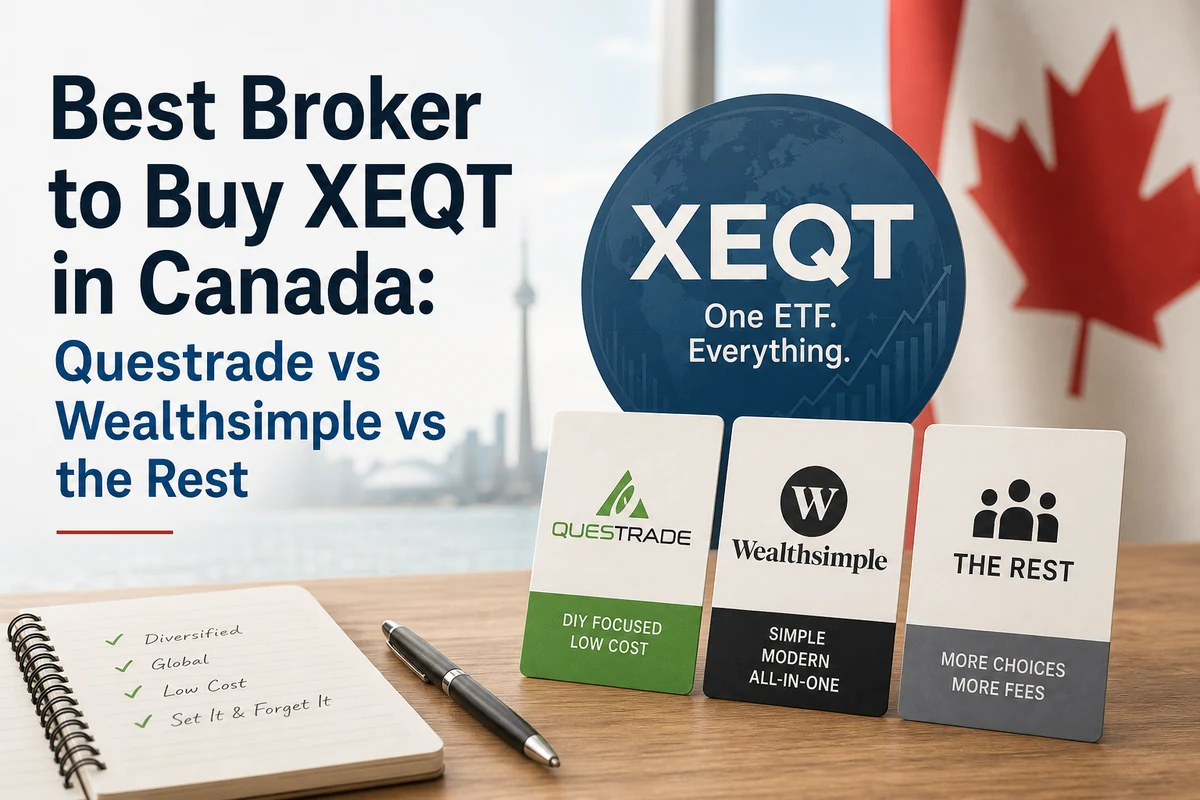
The broker you use to buy XEQT matters more than most people think, but not for the reason most comparison articles lead with. Trading commissions among Canada’s top discount brokerages have essentially collapsed to zero in 2026. That is genuinely great news. The differences that remain, and that can meaningfully affect your investing life, come down to account types, platform reliability, customer service when things go wrong, and a few fee structures that are easy to miss until they sting you. This article cuts through the noise and tells you which broker to use, and why.
The Short Answer for Most Canadians
If you want to open an account today and buy XEQT with the least friction, the most account flexibility, and a platform that won’t let you down when you’re trying to make a trade: Questrade is the right choice for most Canadians. It supports TFSA, RRSP, FHSA, RESP, and non-registered accounts, charges no commission on ETF purchases or sales, and has no annual account fees. The ECN fees it charges on trades are genuinely small, typically just a few cents on a standard XEQT purchase.
If you want zero friction whatsoever, fractional shares, and you’re comfortable with a platform that has had well-documented service issues, Wealthsimple Trade is a reasonable second choice. And if you are 30 or under or you already bank with National Bank, their Direct Brokerage is worth a serious look for reasons explained below.
What you almost certainly should not do is buy XEQT at your bank’s brokerage. TD charges $9.99 per trade. RBC charges $9.95. Those commissions don’t disappear because XEQT has a 0.20% MER. They add to your total cost, particularly in the early years when contributions are smaller and each trade represents a larger percentage of what you’re investing.
2026 Commission Landscape: Questrade, Wealthsimple Trade, Qtrade, and National Bank Direct Brokerage all charge $0 to buy and sell Canadian ETFs including XEQT. TD, RBC, and Scotia iTrade still charge $6.95 to $9.99 per trade. That gap compounds over decades of monthly contributions.
Questrade: The Best All-Round Platform for XEQT Investors
Questrade has been Canada’s leading independent discount brokerage since 1999, and in 2026 it holds that position by a reasonable margin for the kind of investor this site is built for. As of March 2026, Questrade charges no commission to buy or sell ETFs. That’s a meaningful shift from the older model where buying was free but selling triggered a $4.95 to $9.95 commission. The current structure is cleaner: buy XEQT, sell XEQT, pay nothing beyond the small ECN fees that apply to most trades.
What are ECN fees? Electronic Communication Network fees are a pass-through cost from the exchange, not a brokerage revenue line. For Canadian-listed ETFs like XEQT, Questrade charges approximately $0.0035 per share. On a typical XEQT purchase, that works out to a few cents. It is not the kind of number that changes any investment decision, but it is worth knowing it exists so you are not confused when you see it on your trade confirmation.
The bigger Questrade advantage is not the fee structure. It is the account breadth. Questrade supports TFSA, RRSP, FHSA, RESP, non-registered margin accounts, and corporate accounts. For someone who wants to hold XEQT across multiple account types as their wealth grows, that one-platform simplicity has genuine value. You can open all three registered accounts at once during signup, which the step-by-step guide for buying XEQT on Questrade covers in detail if you want the mechanics spelled out.
Questrade is not owned by a bank. That matters because the big banks have every incentive to sell you their own high-fee mutual funds rather than a 0.20% MER ETF. Questrade has no such conflict.
The legitimate knock on Questrade is customer service. It is not their strength, and it has gotten worse as the platform has grown. Wait times can be frustrating, and some users report difficulty resolving account transfer issues. If you never need to call them, which is likely as a buy-and-hold XEQT investor, this matters less. But it is not nothing, and Questrade should be held accountable for it.
Wealthsimple Trade: The Simplest Entry Point, With Caveats
Wealthsimple Trade is the path of least resistance for a first-time investor who wants to be up and running quickly. The app is cleaner than any other Canadian brokerage app. The account opening process is fast. And ETF trading, both buying and selling, is completely free, with no ECN fees either.
For buying XEQT in a TFSA with a modest balance, Wealthsimple Trade works perfectly well. The fund is available, the account type is supported, and you can set up a dividend reinvestment plan directly from the phone app. Fractional shares are available on many Canadian and US securities, which is a feature Questrade does not offer and that benefits investors making smaller, irregular contributions.
There are real limitations worth knowing before you commit. Wealthsimple Trade does not support a self-directed RESP. If you plan to hold XEQT in a Registered Education Savings Plan for a child’s education, you will need Questrade or another broker. Additionally, Wealthsimple charges a 1.5% currency conversion fee when you buy or sell US-listed securities. XEQT trades on the TSX in Canadian dollars, so this fee does not apply directly to XEQT purchases. But if you ever want to buy anything US-listed, that fee is meaningful.
The more serious concern is platform reliability and customer service. As of early 2026, Wealthsimple Trade holds a 1.4-star customer service rating on TrustPilot Canada. Multiple independent editorial teams have noted receiving more complaints about Wealthsimple’s self-directed platform than any other Canadian broker in 2025. The company has pivoted significantly toward higher-margin products including cryptocurrency trading and private equity, moving away from the pure low-fee passive investing philosophy it was founded on. For a straightforward XEQT investor, none of those new products matter, but the platform and service quality drift deserves honest attention.
Wealthsimple FX Fee: Wealthsimple Trade charges 1.5% on currency conversion for US securities. XEQT trades in CAD on the TSX, so this fee does not apply to XEQT itself. It does apply to any US-listed ETF or stock you might want to hold alongside it.
Qtrade: The Sleeper Pick That Deserves Your Attention
In late 2025, Qtrade made a significant move: it dropped all trading commissions and all account fees simultaneously. No per-trade costs, no ECN fees, and no annual maintenance charges. That puts it in genuine competition with both Questrade and Wealthsimple Trade on the cost dimension, and it exceeds both on customer service and platform quality.
Multiple independent rankings, including the annual Globe and Mail digital brokerage ranking, have placed Qtrade at or near the top of Canadian brokerage rankings for years running. The platform is described consistently as the most polished and investor-friendly experience in Canada. Research tools, portfolio analytics, and mobile functionality are considered superior to Questrade by most reviewers. Customer service is a meaningful differentiator: Qtrade does not have Wealthsimple’s TrustPilot problem.
The reason Qtrade is not the default recommendation here is that Questrade has a longer track record at scale, broader name recognition among new investors, and promotional offers that make opening an account straightforward. But if you want a premium platform experience with zero commission costs and solid customer service, Qtrade deserves serious consideration. As of May 2026, Qtrade is running a cash-back promotion for new accounts.
National Bank Direct Brokerage: The Best-Kept Secret for Younger Investors
National Bank Direct Brokerage was the first of Canada’s major bank-owned brokerages to introduce commission-free trading on all stocks and ETFs, and they deserve credit for it. Their fee structure is straightforward: zero commissions, full stop, with no ECN fees. That is actually cleaner than Questrade’s model in one dimension.
The reason NBDB does not crack the top two for most investors is a $100 annual administration fee that applies unless you meet one of these conditions: you are 30 years old or younger, you hold assets of $20,000 or more, or you participate in a qualifying financial program for certain professions including engineers, teachers, healthcare workers, and business students. For younger investors who qualify on age alone, NBDB is genuinely worth considering alongside Questrade and Wealthsimple.
The Canadian Portfolio Manager blog, one of the most research-driven resources in Canadian passive investing, specifically recommends NBDB as the first option for younger investors and students because of the fee-free combination and account options available. If you are 25, opening your first TFSA, and planning to buy XEQT every month, the zero-commission, zero-ECN-fee, zero-account-fee structure at NBDB is an honest contender.
The Big Bank Brokerages: What You’re Paying For
TD Direct Investing is Canada’s largest brokerage by assets and has the best platform in the big bank category. The Globe and Mail has given it an A+ rating for digital experience. If you are an active investor who uses advanced order types, wants deep research integration, and makes complex trades, the platform quality is defensible. But for an XEQT investor, none of those features are relevant. You are buying one TSX-listed ETF repeatedly. TD charges $9.99 per trade for that, with a quarterly maintenance fee waived only if you maintain $15,000 or more in the account.
RBC Direct Investing charges $9.95 per trade or $6.95 for active traders executing 150 or more trades per quarter. That second tier is irrelevant to a passive investor. CIBC Investor’s Edge has a more competitive flat fee of $6.95, which makes it the least costly of the bank options, and it supports TFSA, RRSP, RESP, and FHSA accounts. BMO InvestorLine uniquely offers free trading on a curated list of approximately 80 ETFs. If XEQT is confirmed on that list, the big bank convenience plus free ETF trading becomes a defensible combination for someone who strongly values consolidated banking.
If you are buying XEQT once a month at a big bank brokerage charging $9.99 per trade, you are paying around $120 a year in commissions alone, before the MER. On a $10,000 portfolio, that is roughly 1.2% in additional friction. The entire pitch of XEQT is its 0.20% cost. A $9.99 trade commission undermines that advantage substantially, especially in the early years.
Which Account Type Should You Open First?
The broker you choose and the account type you open are two decisions that interact. Every broker reviewed here supports a TFSA. Most support an RRSP. Fewer support an FHSA, and only Questrade and some others offer a self-directed RESP.
For most Canadians starting out, the TFSA is a sensible first account. The 2026 annual contribution limit is $7,000, and depending on your age and residency history since the TFSA launched in 2009, your total accumulated room may be considerably higher. Check your CRA My Account for your exact available room before depositing. Growth inside a TFSA is completely tax-free. One thing worth knowing: XEQT is a globally diversified fund with about 45% US equity exposure, and US dividends paid inside a TFSA are subject to approximately 15% withholding tax under the Canada-US tax treaty. The RRSP is actually more efficient for US dividend income because the treaty fully exempts RRSP accounts from that withholding. For most people in the accumulation phase this distinction is modest in dollar terms, but it becomes more relevant as your portfolio grows.
If you are saving specifically for a first home, the FHSA deserves priority alongside your TFSA. Contributions are tax-deductible like an RRSP, growth is tax-free, and qualifying withdrawals for a first home are also tax-free. The 2026 limit is $8,000 per year and $40,000 over the lifetime of the account. XEQT is an eligible holding. Both Questrade and Wealthsimple Trade support the FHSA. The RRSP 2026 dollar ceiling is $32,490, and your personal limit is 18% of your prior year earned income up to that cap.
Account Priority for XEQT (General Rule): RRSP first for US withholding efficiency. TFSA second for tax-free growth. FHSA third if you’re saving for a first home ($8,000/yr, $40,000 lifetime). Non-registered last. All four account types can hold XEQT at Questrade, Qtrade, and Wealthsimple Trade.
The Verdict: Who Should Use Which Broker
Choose Questrade if you want the broadest account support including RESP, a proven independent platform, and no commission costs. This is the right call for most investors at most life stages. ECN fees are negligible. The platform works. For a complete walkthrough of opening the account and placing your first trade, the step-by-step Questrade guide handles the mechanics, and the full XEQT guide covers exactly what you’re buying.
Choose Wealthsimple Trade if you are a first-time investor who finds apps more intuitive than desktop platforms, you want fractional shares, and you are only opening a TFSA or RRSP to start. Accept the customer service limitations and monitor them. If you later want a RESP or more sophisticated account options, a transfer to Questrade or Qtrade is straightforward and the receiving broker will typically cover the transfer-out fee.
Choose Qtrade if you want the best overall brokerage experience in Canada, and you are the kind of investor who values platform quality and customer service alongside low costs. The recent move to zero commissions eliminates what was previously a cost disadvantage relative to Wealthsimple.
Choose NBDB if you are 30 or under, plan to hold at least $20,000, or qualify through a professional program. The completely clean fee structure is genuinely attractive at that combination of age and simplicity.
Approach big bank brokerages with caution for XEQT specifically. The convenience of keeping everything at one institution is real. The cost of paying $9.99 per trade on an ETF you buy monthly is also real, and it wins the math every time. The one partial exception is BMO InvestorLine if XEQT is confirmed on their free ETF list, since the big bank convenience paired with free ETF trading is a defensible choice for someone who strongly values consolidated banking and already has substantial assets there.
None of this is complicated in the end. XEQT’s value proposition is its 0.20% MER and its automatic global diversification across roughly 9,000 companies. The broker’s job is simply to not get in the way. Questrade, Wealthsimple Trade, Qtrade, and NBDB all accomplish that in 2026. The debate between them is about degrees of friction, not a decision that will make or break your retirement. Pick one, open the account this week, and start buying.
Frequently Asked Questions
Is Questrade or Wealthsimple better for buying XEQT? Both charge zero commission to buy and sell XEQT. Questrade wins on account breadth, supporting TFSA, RRSP, FHSA, RESP, and non-registered accounts in one place. Wealthsimple Trade wins on app simplicity and fractional shares. For most investors with multiple account types or plans to open a RESP eventually, Questrade is the more complete platform.
Do you pay any fees to buy XEQT at Questrade? As of 2026, there is no trading commission to buy or sell XEQT at Questrade. The platform charges ECN fees, which are exchange pass-through costs of approximately $0.0035 per share, typically amounting to a few cents per trade. There are no annual account fees for TFSA, RRSP, or FHSA accounts at Questrade.
Can I hold XEQT in a TFSA, RRSP, and FHSA at the same broker? Yes. At Questrade and Qtrade you can hold XEQT across all three registered account types simultaneously. Wealthsimple Trade also supports TFSA, RRSP, and FHSA. For a self-directed RESP specifically, Questrade is your best option among the no-commission brokerages, as Wealthsimple Trade does not offer a self-directed RESP.
What happens if I already hold XEQT at a bank brokerage and want to switch? You can transfer your account in-kind to any of the brokerages reviewed here. An in-kind transfer means your XEQT units move over without being sold, preserving your adjusted cost base and avoiding a taxable event in non-registered accounts. Most receiving brokerages will cover the transfer-out fee charged by your bank, typically around $150 or less. Contact the receiving broker first and ask about their transfer fee rebate policy before initiating the move.