
The Stock Market Feels Terrifying Right Now. Here’s Why You Should Buy Anyway.
August 21, 2026

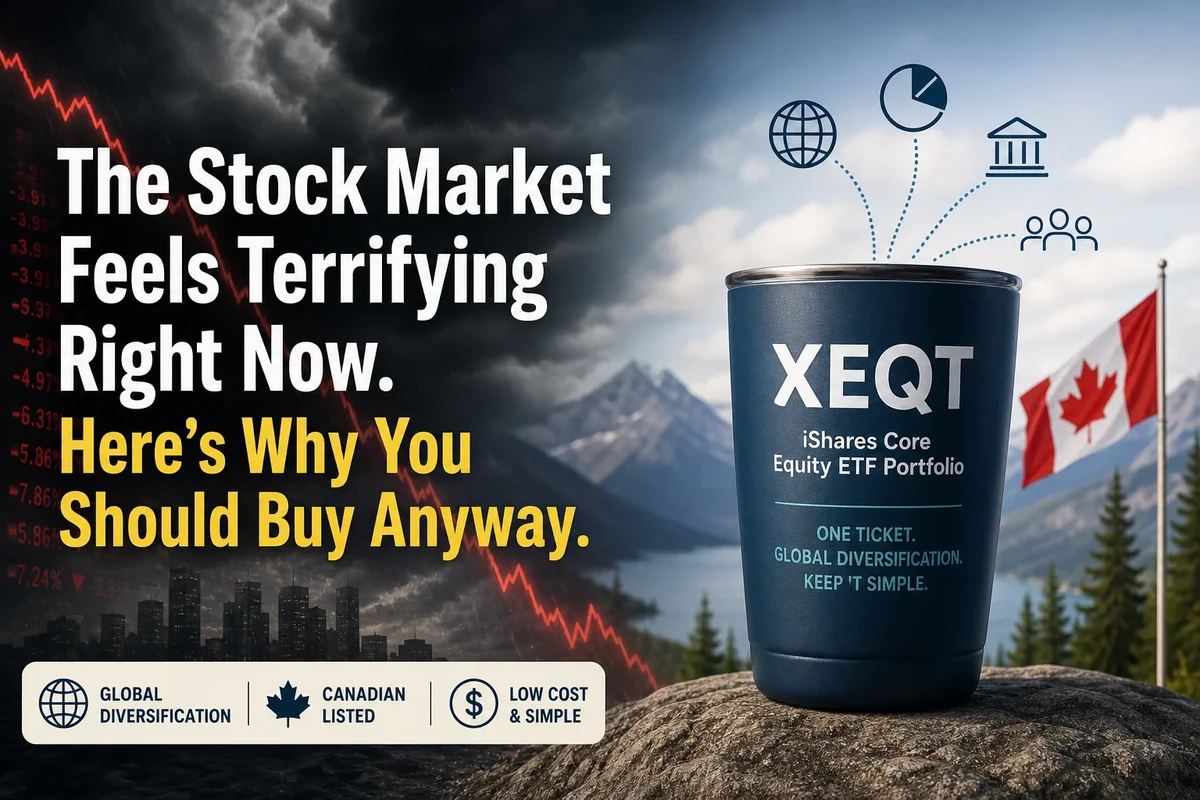
The news is bad. Your portfolio balance is lower than it was three months ago. Every headline is describing the drop in apocalyptic terms, and your instinct is screaming at you to do something, to stop the bleeding, to wait until things calm down before putting another dollar in. That instinct is wrong, and it will cost you real money if you listen to it.
Falling markets feel dangerous. They are not dangerous for accumulators, Canadians who are still working, still earning, still contributing to a TFSA or RRSP. For retirees drawing down a portfolio, a sustained crash is a genuine risk. But if you’re in your 30s or 40s putting $500 a month into XEQT, a correction is not your enemy. It is, mathematically, one of the best things that can happen to you in the short term. The problem is that your brain has no way of knowing the difference.
Why Your Brain Stops You From Buying When Stocks Drop 15, 20%
Behavioural finance has a straightforward explanation for why corrections are so psychologically difficult. Daniel Kahneman and Amos Tversky’s decades of research on loss aversion shows that people feel the pain of a financial loss roughly twice as intensely as the pleasure of an equivalent gain. That asymmetry is not a personality flaw. It’s a hardwired feature of human psychology. It kept your ancestors from making reckless decisions. In markets, it makes you a worse investor at exactly the wrong moment.
When XEQT drops 15%, your brain doesn’t calculate the expected value of buying at a lower price. It feels the paper loss on your existing shares as a real loss, registers that loss as roughly twice as painful as the gain felt good, and generates a strong signal to avoid further pain. Pausing contributions feels like protection. It is not protection. It is the most expensive move you can make, packaged as caution.
There’s also recency bias at work. When markets have been falling, your brain extrapolates the trend forward. “What if it keeps going down?” becomes the dominant mental frame, even though recovery from corrections is far more statistically common than prolonged multi-year declines. The fear isn’t irrational in isolation. It’s just irrelevant to your actual situation as a long-term accumulator.
The goal of your brain during a correction is to protect you from the feeling of having made a mistake. The goal of your portfolio is to compound wealth over 20 to 30 years. These two goals are in direct conflict when stocks are falling.
What Staying Out Costs You in Real Canadian Numbers
Consider what actually happened in 2022. XEQT fell meaningfully over the course of the year, pulled down by global equity market weakness, rising interest rates, and the difficult combination of inflation and monetary tightening that rattled portfolios everywhere. It felt terrible. It also set up one of the better buying environments Canadian index investors had seen in years.
XEQT’s 52-week low in the most recent cycle hit $37.30. The same fund trades near $45.71 today. An investor who kept making monthly contributions through that trough bought a meaningful portion of their position at prices well below where the fund trades now. An investor who paused contributions during the fear, waiting for clarity, bought back in higher and gave up those lower-cost units permanently.
The compounding math on this is not subtle. Research cited by Bank of America found that missing just the ten best trading days in a major index over a 30-year period cut total returns roughly in half compared to an investor who stayed fully invested throughout. The brutal irony is that many of those best days cluster inside the worst months, when the fear is highest and the temptation to sit on the sidelines is strongest. You can’t cherry-pick the recovery while avoiding the decline. The market doesn’t send calendar invites.
The “best days” cost: Missing just 10 of the best trading days over a 30-year period can cut your total portfolio return by approximately half compared to staying fully invested. Several of those days tend to occur during the sharpest corrections, when investors are most likely to have moved to the sideline.
The 2023 rebound following the 2022 downturn was a clean example. Canadian investors who paused contributions in late 2022, waiting for confirmation that the worst was over, largely received that confirmation in mid-to-late 2023 after significant recovery had already occurred. They paid higher prices for the same units a patient accumulator had been buying throughout the decline.
Dollar-Cost Averaging Isn’t Boring, It’s a Structural Advantage During Corrections
It’s worth being precise about what Vanguard’s historical modelling actually shows about dollar-cost averaging. Investing a lump sum immediately tends to outperform spreading it across several months roughly two-thirds of the time. This is not surprising: markets trend upward over time, so investing sooner is usually better than investing in stages. If you have $50,000 sitting in a savings account today, the evidence generally favours putting it to work now rather than in $5,000 monthly tranches.
But that finding is almost entirely irrelevant to the situation most working Canadians are actually in. If you’re contributing $600 a month from your paycheque into your TFSA, you are not choosing between lump sum and staged investing. You are a natural dollar-cost averager by necessity. The question for you is not whether to spread out a windfall. The question is whether to keep contributing during a downturn, and on that question the answer from the research is unambiguous: keep going.
When you contribute a fixed dollar amount each month to XEQT, you automatically buy more units when the price is lower. A $600 contribution when XEQT is at $40 buys 15 units. The same $600 when XEQT is at $46 buys roughly 13 units. Over 24 months that straddle a correction and recovery, the investor who kept buying ends up with more units at a lower average cost than the investor who paused and re-entered later. The math is mechanical. It doesn’t require skill or foresight. It just requires not flinching.
Dollar-cost averaging during a correction doesn’t reduce your return, it builds your unit count at prices you would never see in calmer markets. For an accumulator, that is a genuine and lasting structural advantage.
The “Greedy When Others Are Fearful” Move That Actually Works
Warren Buffett’s line about being greedy when others are fearful gets quoted constantly and almost never operationalized. Here’s what it actually looks like for a Canadian accumulator without a mountain of excess cash.
JL Collins, in “The Simple Path to Wealth,” describes a modified approach that makes intuitive sense during corrections. You start with a monthly contribution you’re comfortable with, say $800. When the market drops and your initial investment is now worth $640, instead of contributing the usual $800, you contribute $960. Not because you’ve identified a bottom. Not because you think you know what happens next. But because units are cheaper than they were, and buying more of them at lower prices is mathematically advantageous when you’re in the accumulation phase.
The critical constraint is that any increase must stay within what you can genuinely afford without touching your emergency fund or creating financial stress. This is not a signal to drain your savings account or take on debt to buy the dip. It’s a nudge to redirect, where possible, a little more of your discretionary spending toward contributions when prices are lower. The key distinction is that you’re not predicting a recovery. You’re buying more of something you were already buying, at a price that’s lower than it was.
Flex contribution range: If your standard monthly XEQT contribution is $600, $800, consider increasing it by 20, 30% during a correction of 10% or more, only if you have the cash flow to do so without touching your emergency fund. This is buying more of a discounted asset you already own, not market timing.
What the 2008, 2009 and 2022 Corrections Taught Canadian Index Investors
The 2008, 2009 financial crisis was the kind of correction that turns even experienced investors into nervous non-participants. Global equity markets fell roughly 50% peak to trough. The financial system appeared genuinely unstable. It was the most psychologically difficult environment imaginable for someone trying to continue monthly contributions.
The investors who kept buying through 2008 and into early 2009 bought a substantial portion of their equity exposure at prices that, in retrospect, represented a generational buying opportunity. From the March 2009 trough, markets delivered strong returns over the following decade. An accumulator who bought through 2008 and 2009 at depressed prices, and held those units through the subsequent recovery, built significantly more wealth than a peer who paused and re-entered once confidence returned.
The academic research on sequence of returns risk captures this dynamic precisely. Sequence risk is genuinely damaging for retirees who are drawing down a portfolio into a falling market. But for accumulators, the sequence works in reverse. Poor returns early in your accumulation phase, when your portfolio is small and your contributions are large relative to the existing balance, are not just tolerable. They are genuinely beneficial. You’re buying more units per dollar contributed, and those units compound for decades at whatever the market eventually delivers. The accumulator’s version of sequence risk is actually sequence advantage.
For context, XEQT has navigated multiple periods of meaningful volatility: the COVID crash of early 2020, the 2022 correction driven by rate hikes, and the spring 2025 tariff-driven selloff that pushed the TSX Composite to a 52-week low near 27,800 before recovering toward 36,000. In every case, investors who kept buying ended up better positioned than those who paused. The fund itself, holding approximately 9,000 securities across roughly 45% US equities, 25% Canadian, 25% international developed markets, and 5% emerging markets, is designed to absorb and recover from exactly these kinds of drawdowns. That’s what global diversification does.
Your TFSA and RRSP Are Built for This Moment
Contributing to your TFSA or RRSP during a correction is uniquely powerful because of how registered accounts work. Your TFSA contribution room doesn’t expire. Every dollar of room you have today will still be there after the correction resolves. But the lower entry price you can lock in during a downturn is temporary. Once markets recover, the opportunity to buy those units at discounted prices is gone permanently.
The 2026 TFSA annual limit is $7,000, with cumulative room of up to $109,000 if you’ve been eligible since the account launched in 2009 and never contributed. Filling that room during a 15% correction means locking in a lower cost basis for assets that will compound tax-free for the rest of your life. Every dollar of gain on those lower-cost units will never be taxed. The TFSA’s tax-free compounding interacts directly with your entry price.
The RRSP adds another layer. Your RRSP contribution deduction is worth the same dollar amount regardless of whether you buy at the top or the bottom of a correction. A $5,000 RRSP contribution generates the same tax refund whether XEQT is at $46 or $37. But at $37, that $5,000 buys meaningfully more units, all of which will compound in a tax-sheltered environment until withdrawal. The RRSP doesn’t just shelter growth, it amplifies the advantage of buying during a dip by combining lower unit cost with an immediate tax refund. The 2026 RRSP dollar cap sits at approximately $32,490 (or 18% of your prior year’s earned income, whichever is lower).
To understand how to set up contributions on Wealthsimple or Questrade and put this into practice, the complete XEQT guide covers account setup in detail.
The One Thing You Should Actually Fear More Than Falling Markets
The genuine risk isn’t the correction. The genuine risk is sitting in cash or a GIC through the correction and missing the snapback.
Market recoveries don’t wait for certainty. They happen fast, and they happen before news headlines shift from alarming to reassuring. By the time a recovery “feels safe” to re-enter, a substantial portion of the rebound has already occurred. The investors who moved to cash in early 2020 when COVID fear peaked faced a choice in March and April 2020: buy back in at prices that had already rebounded sharply from the trough, or wait even longer. Most waited. Most paid more for the same fund they could have bought at the bottom if they’d simply left their contributions running.
The spring 2025 tariff-driven correction showed the same pattern. The TSX dropped sharply on tariff announcement news, touching a 52-week low near 27,800. Within weeks, a partial policy reversal drove a meaningful recovery toward current levels above 36,000. Investors who held through the decline and kept contributing captured both the lower prices during the fear and the recovery that followed. Investors who sold or paused were left trying to pick a re-entry point that the market never offered cleanly.
The correct response to a market correction is almost never “stop buying.” It’s “keep buying, and if you can, buy a little more.” The only investor who benefits from pausing is the one who can guarantee they’ll re-enter at the exact bottom, and that investor does not exist.
High-interest savings accounts and GICs feel safe during a correction because the balance doesn’t move. But sitting in a 3, 4% fixed return while global equities recover 20% or more from a trough isn’t safety. It’s a different kind of loss, one that doesn’t show up on a statement but compounds quietly for decades. The opportunity cost of missed recovery gains is real even though no brokerage charges a fee for it.
If you want to think clearly about your own risk tolerance during downturns, it helps to reframe what you’re actually holding. XEQT isn’t a price on a screen. It’s a fractional ownership stake in approximately 9,000 companies across Canada, the United States, and international markets. Those companies are still operating, still earning revenue, still paying employees. The price is lower because other investors are scared. For a deeper look at how XEQT’s structure helps it weather volatility over time, the honest 2026 review of XEQT covers the fund’s composition and historical drawdown behaviour in more detail.
Frequently Asked Questions
Should I keep buying XEQT if the market drops 20% or more?
Yes, if your time horizon is 10 years or longer. A 20% correction reduces the price of every unit you buy by 20%, which means your fixed monthly contributions purchase more units than they would in flat or rising markets. Those additional units compound at whatever the market delivers over your holding period, and for most Canadian accumulators, the math strongly favours continuing contributions through a downturn.
Is it better to wait for the bottom before buying more XEQT?
The bottom is only visible in hindsight. Professional fund managers with billions in resources and full-time research teams cannot reliably identify bottoms in real time. Attempting to do so means being out of the market during the recovery days that cluster at and around the trough, exactly when returns tend to be highest. Keeping contributions running avoids this trap entirely.
What if the market keeps falling after I buy?
Then your next monthly contribution buys even more units at an even lower price. This is the mechanical advantage of dollar-cost averaging during a prolonged decline. Each successive contribution improves your average cost basis across the whole position. The total return on your portfolio is determined by the price when you eventually sell, years from now, not by the price on the day after you contribute.
Does it matter which registered account I use during a correction?
Both your TFSA and RRSP shelter gains from tax, so buying during a correction in either account locks in a lower cost basis that compounds fully sheltered. The RRSP has an edge for US-dividend exposure because Canada’s tax treaty eliminates the 15% US withholding tax that applies in a TFSA. For most accumulators focused on maintaining momentum during a correction, the most important move is getting the contribution made in any registered account, rather than delaying while optimizing account type.